Clinical Emotion and Cognition Research Laboratory, Goyang, Republic of Korea.
Psychiatry Investig. 2013 Jun;10(2):164-72. doi: 10.4306/pi.2013.10.2.164. Epub 2013 May 30.
We investigated gender differences in event-related potential (ERP) responses to subliminally presented threat-related stimuli.
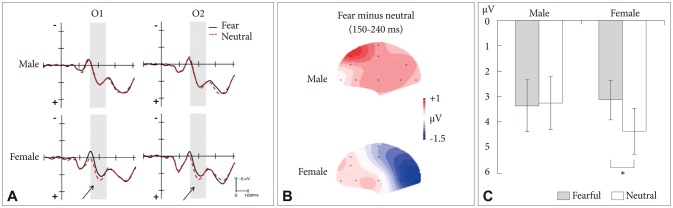
Twenty-four participants were presented with threat-related and neutral pictures for a very brief period of time (17 ms). To explore gender differences in ERP responses to subliminally presented stimuli, we examined six ERP components [P1, N170, N250, P300, Early Posterior Negativity (EPN) and Late Positive Potential (LPP)].
The result revealed that only female participants showed significant increases in the N170 and the EPN in response to subliminally presented threat-related stimuli compared to neutral stimuli.
Our results suggest that female participants exhibit greater cortical processing of subliminally presented threat-related stimuli than male participants.
我们研究了与威胁相关的潜意识刺激引发的事件相关电位(ERP)反应中的性别差异。
24 名参与者被短暂地呈现了与威胁相关和中性的图片(17 毫秒)。为了探究潜意识呈现刺激的 ERP 反应中的性别差异,我们检测了六个 ERP 成分[P1、N170、N250、P300、早期后负向变化(EPN)和晚期正性电位(LPP)]。
结果显示,只有女性参与者在潜意识呈现的与威胁相关的刺激与中性刺激相比,N170 和 EPN 明显增加。
我们的结果表明,女性参与者对潜意识呈现的与威胁相关的刺激表现出比男性参与者更强的皮层处理能力。