KTH Royal Institute of Technology, Science for Life Laboratory (SciLifeLab), Center for Industrial and Applied Mathematics, School of Computer Science and Communication, Stockholm, Sweden.
PLoS One. 2013 Jun 14;8(6):e65773. doi: 10.1371/journal.pone.0065773. Print 2013.
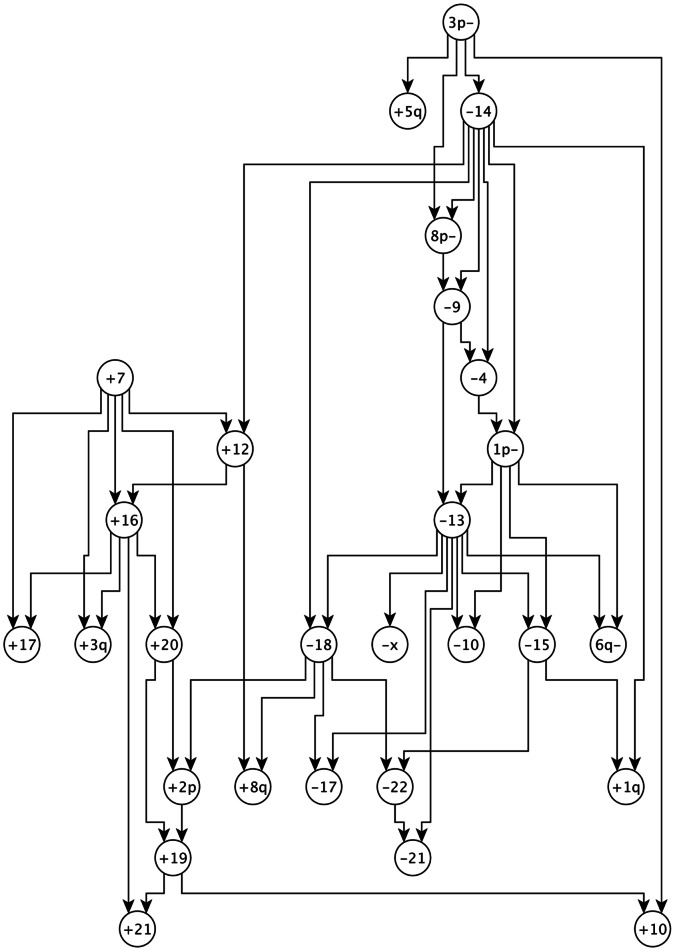
Cancer can be a result of accumulation of different types of genetic mutations such as copy number aberrations. The data from tumors are cross-sectional and do not contain the temporal order of the genetic events. Finding the order in which the genetic events have occurred and progression pathways are of vital importance in understanding the disease. In order to model cancer progression, we propose Progression Networks, a special case of Bayesian networks, that are tailored to model disease progression. Progression networks have similarities with Conjunctive Bayesian Networks (CBNs) [1],a variation of Bayesian networks also proposed for modeling disease progression. We also describe a learning algorithm for learning Bayesian networks in general and progression networks in particular. We reduce the hard problem of learning the Bayesian and progression networks to Mixed Integer Linear Programming (MILP). MILP is a Non-deterministic Polynomial-time complete (NP-complete) problem for which very good heuristics exists. We tested our algorithm on synthetic and real cytogenetic data from renal cell carcinoma. We also compared our learned progression networks with the networks proposed in earlier publications. The software is available on the website https://bitbucket.org/farahani/diprog.
癌症可能是不同类型的基因突变(如拷贝数异常)积累的结果。肿瘤中的数据是横截面的,不包含遗传事件的时间顺序。找到遗传事件发生的顺序和进展途径对于理解疾病至关重要。为了对癌症进展进行建模,我们提出了进展网络,这是一种特殊的贝叶斯网络,专门用于对疾病进展进行建模。进展网络与联合贝叶斯网络(CBN)[1]有相似之处,这是一种也被提议用于建模疾病进展的贝叶斯网络的变体。我们还描述了一种用于学习一般贝叶斯网络和特定进展网络的学习算法。我们将学习贝叶斯网络和进展网络的难题简化为混合整数线性规划(MILP)。MILP 是一个非确定性多项式时间完全(NP 完全)问题,对于该问题存在非常好的启发式算法。我们在来自肾细胞癌的合成和真实细胞遗传学数据上测试了我们的算法。我们还将学习到的进展网络与早期出版物中提出的网络进行了比较。该软件可在网站 https://bitbucket.org/farahani/diprog 上获得。