Clinic for Orthopedic and Trauma Surgery, Kantonsspital Baselland Liestal, Switzerland.
Acta Orthop. 2013 Aug;84(4):353-9. doi: 10.3109/17453674.2013.810517. Epub 2013 Jun 25.
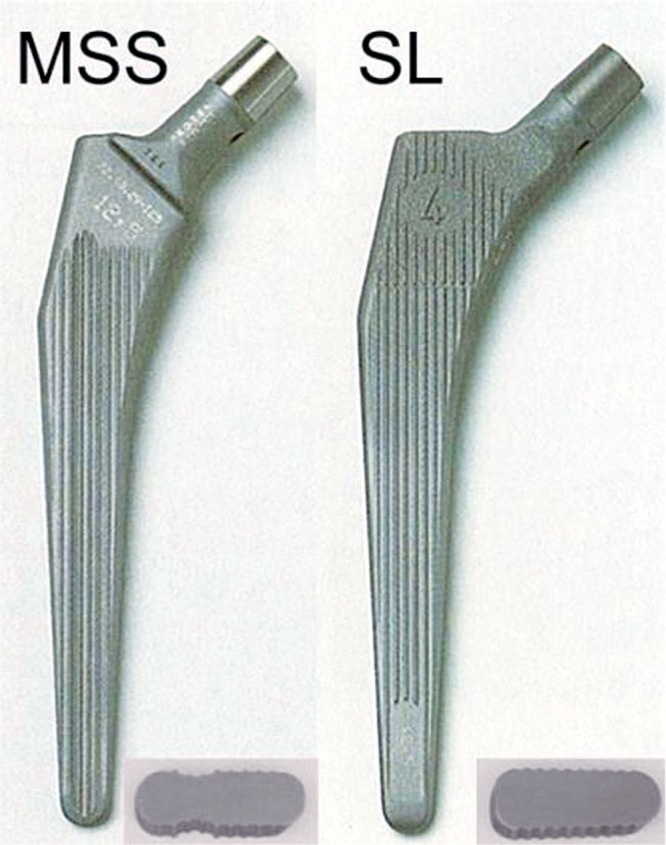
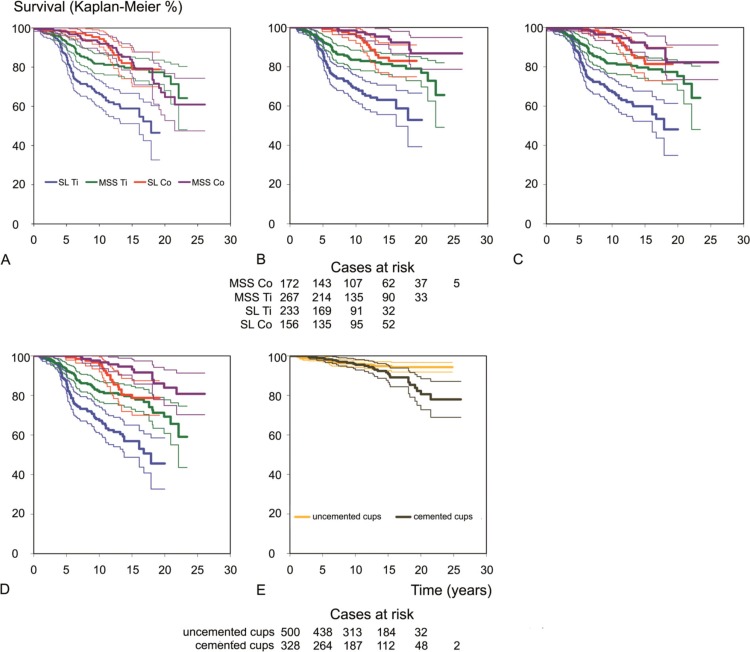
Background and purpose Even small differences in design variables for the femoral stem may influence the outcome of a hip arthroplasty. We performed a risk factor analysis for aseptic loosening of 4 different versions of cemented Müller-type straight stems with special emphasis on design modifications (2 shapes, MSS or SL, and 2 materials, CoNiCrMo (Co) or Ti-6Al-7Nb (Ti)). Methods We investigated 828 total hip replacements, which were followed prospectively in our in-house register. All stems were operated in the same setup, using Sulfix-6 bone cement and a second-generation cementing technique. Demographic and design-specific risk factors were analyzed using an adjusted Cox regression model. Results The 4 versions showed marked differences in 15-year stem survival with aseptic loosening as the endpoint: 94% (95% CI: 89-99) for MSS Co, 83% (CI: 75-91) for SL Co, 81% (CI: 76-87) for MSS Ti and 63% (CI: 56-71) for SL Ti. Cox regression analysis showed a relative risk (RR) for aseptic loosening of 3 (CI: 2-5) for stems made of Ti and of 2 (CI: 1-2) for the SL design. The RR for aseptic stem loosening increased to 8 (CI: 4-15) when comparing the most and the least successful designs (MSS Co and SL Ti). Interpretation Cemented Müller-type straight stems should be MSS-shaped and made of a material with high flexural strength (e.g. cobalt-chrome). The surface finish should be polished (Ra < 0.4 µm). These technical aspects combined with modern cementing techniques would improve the survival of Müller-type straight stems. This may be true for all types of cemented stems.
股骨柄的设计变量即使存在微小差异,也可能影响髋关节置换的结果。我们对 4 种不同型号的骨水泥固定 Müller 型直柄进行了无菌性松动的危险因素分析,特别关注设计改良(2 种形状,MSS 或 SL,2 种材料,CoNiCrMo(Co)或 Ti-6Al-7Nb(Ti))。
我们对 828 例全髋关节置换进行了前瞻性研究,这些患者都在我们的院内登记处进行随访。所有的柄都采用了 Sulfix-6 骨水泥和第二代骨水泥技术,在相同的设置下进行操作。使用调整后的 Cox 回归模型分析了人口统计学和设计特异性的危险因素。
4 种型号的柄在 15 年的随访期内,以无菌性松动为终点,表现出明显的存活率差异:MSS-Co 为 94%(95%可信区间:89-99),SL-Co 为 83%(CI:75-91),MSS-Ti 为 81%(CI:76-87),SL-Ti 为 63%(CI:56-71)。Cox 回归分析显示,Ti 材料制成的柄和 SL 设计的相对风险(RR)分别为 3(CI:2-5)和 2(CI:1-2)。比较最成功和最不成功的设计(MSS-Co 和 SL-Ti)时,无菌性柄松动的 RR 增加到 8(CI:4-15)。
骨水泥固定 Müller 型直柄应采用 MSS 形状,使用具有高弯曲强度的材料(如钴铬)制成。表面光洁度应为抛光(Ra < 0.4 µm)。这些技术方面结合现代骨水泥技术将提高 Müller 型直柄的生存率。这可能适用于所有类型的骨水泥固定柄。