Høstmark Arne Torbjørn, Lunde Marianne Sylvana Haug, Haug Anna
Lipids Health Dis. 2013 Jun 25;12:92. doi: 10.1186/1476-511X-12-92.
Previous data suggested that intake of sodas and other acid beverages might be associated with increased levels of serum triglycerides, lowered HDL cholesterol, and increased formation of mono unsaturated fatty acids, which are the preferred ones for triglyceride synthesis. The present work is an extension of these studies.
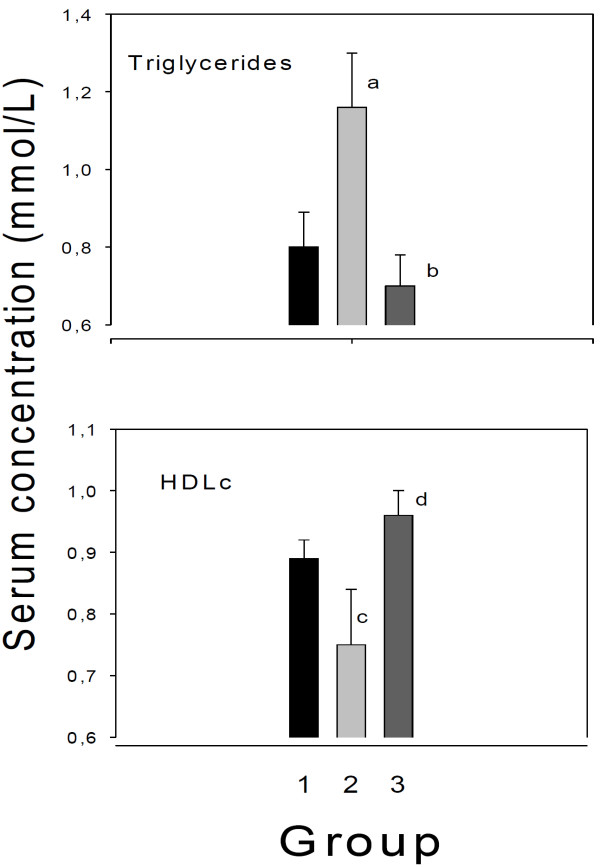
Thirty male rats were divided into 3 groups. All groups were given the same food, but various beverages: water (W), ammonium chloride, 200 mmol/L (AC), or sodium bicarbonate, 200 mmol/L (SB). Serum triglycerides, HDL cholesterol, and the fatty acid distribution in total serum lipids were determined. Delta9-desaturase in serum lipids was estimated by the ratio of palmitoleic to palmitic acid, and by the oleic/stearic acid ratio. Correlation and ANOVA were used to study associations and group differences.
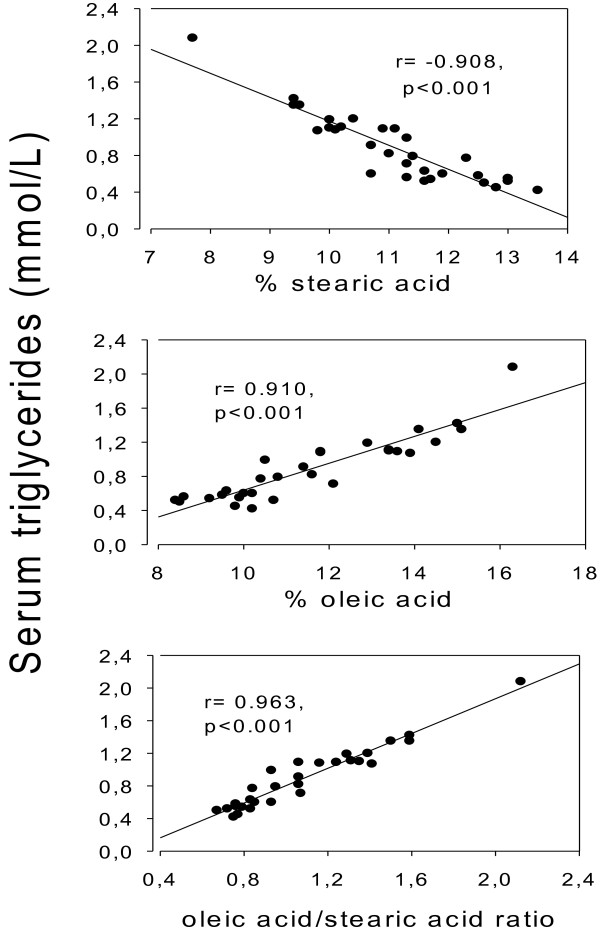
After 3 weeks, the AC group had higher triglyceride concentration and higher Delta9 desaturase indexes, but lower serum HDL and body weight as compared with the SB and W groups. In each of the groups, the oleic acid/stearic acid ratio correlated positively with serum triglycerides; in the pooled group the correlation coefficient was r = 0.963, p<0.01.
Rats ingesting ammonium chloride as compared with sodium bicarbonate responded with increased desaturase indexes, increased serum triglycerides, and lowered HDL cholesterol concentration, thereby possibly contributing to explain the increased triglyceride concentration previously observed in subjects with a frequent intake of acid beverages, such as sodas containing carbonic acid, citric acid, and phosphoric acid.
先前的数据表明,摄入汽水和其他酸性饮料可能与血清甘油三酯水平升高、高密度脂蛋白胆固醇降低以及单不饱和脂肪酸形成增加有关,而单不饱和脂肪酸是甘油三酯合成的首选脂肪酸。本研究是这些研究的延伸。
将30只雄性大鼠分为3组。所有组给予相同的食物,但饮用不同的饮料:水(W)、200 mmol/L氯化铵(AC)或200 mmol/L碳酸氢钠(SB)。测定血清甘油三酯、高密度脂蛋白胆固醇以及总血清脂质中的脂肪酸分布。通过棕榈油酸与棕榈酸的比例以及油酸/硬脂酸比例估算血清脂质中的Δ9-去饱和酶。使用相关性分析和方差分析研究关联和组间差异。
3周后,与SB组和W组相比,AC组的甘油三酯浓度更高,Δ9去饱和酶指数更高,但血清高密度脂蛋白和体重更低。在每组中,油酸/硬脂酸比例与血清甘油三酯呈正相关;在合并组中,相关系数r = 0.963,p<0.01。
与摄入碳酸氢钠的大鼠相比,摄入氯化铵的大鼠去饱和酶指数增加、血清甘油三酯增加且高密度脂蛋白胆固醇浓度降低,从而可能有助于解释先前在经常摄入酸性饮料(如含有碳酸、柠檬酸和磷酸的汽水)的受试者中观察到的甘油三酯浓度升高现象。