Ranzinger Julia, Rustom Amin, Schwenger Vedat
Department of Nephrology; University of Heidelberg; Heidelberg, Germany.
Commun Integr Biol. 2013 Jan 1;6(1):e22686. doi: 10.4161/cib.22686.
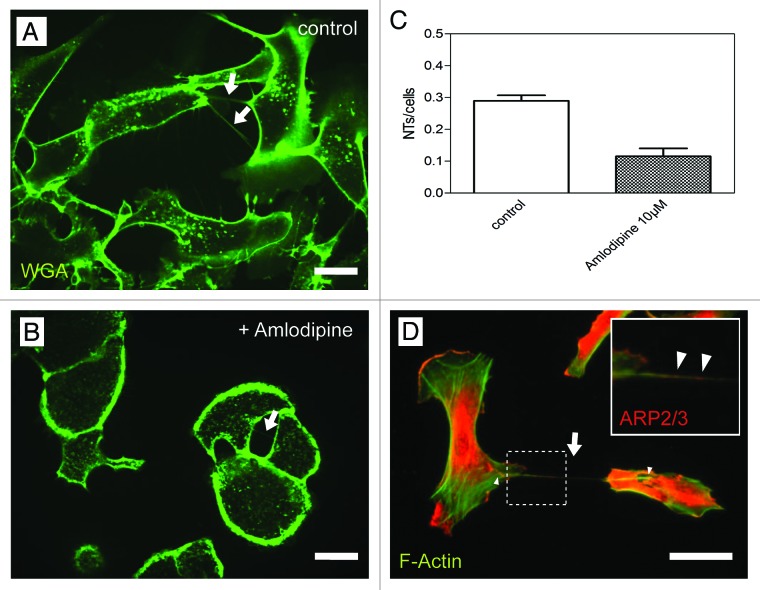
The recent awareness that eukaryotic cells can be linked and communicate via membranous nanotubes (NTs) has extended previous conceptions of cell-to-cell interaction. Apart from mediating functional connectivity between a broad range of cells, facilitating intercellular transmission of electric signals or various cellular components, there is strong evidence for participation of NTs in pathological processes of particular medical interest. In our recent study, we showed for the first time the existence of nanotubular connections between human primary peritoneal mesothelial cells (HPMCs) and provided insights to their actin/filopodia mediated building mechanism. Furthermore, we showed that tumor necrosis factor (TNF) significantly increased NT formation between HPMCs, pointing to a crucial role of NTs during inflammatory processes. Moreover, our study showed a strong correlation of NT occurrence and cellular cholesterol contents, demonstrating an interdependence of NT mediated cell communication, cytokine action and cholesterol homeostasis. Here, we further provide analysis on NT-formation processes.
最近人们意识到真核细胞可以通过膜性纳米管(NTs)相连并进行通讯,这扩展了之前对细胞间相互作用的认识。除了介导多种细胞之间的功能连接、促进电信号或各种细胞成分的细胞间传递外,有强有力的证据表明纳米管参与了具有特殊医学意义的病理过程。在我们最近的研究中,我们首次证明了人原代腹膜间皮细胞(HPMCs)之间存在纳米管连接,并深入了解了其由肌动蛋白/丝状伪足介导的形成机制。此外,我们发现肿瘤坏死因子(TNF)显著增加了HPMCs之间的纳米管形成,这表明纳米管在炎症过程中起关键作用。而且,我们的研究表明纳米管的出现与细胞胆固醇含量密切相关,证明了纳米管介导的细胞通讯、细胞因子作用和胆固醇稳态之间的相互依存关系。在此,我们进一步对纳米管形成过程进行分析。