• 文献检索
  • 文档翻译
  • 深度研究
  • 学术资讯
  • Suppr Zotero 插件Zotero 插件
  • 邀请有礼
  • 套餐&价格
  • 历史记录
应用&插件
Suppr Zotero 插件Zotero 插件浏览器插件Mac 客户端Windows 客户端微信小程序
定价
高级版会员购买积分包购买API积分包
服务
文献检索文档翻译深度研究API 文档MCP 服务
关于我们
关于 Suppr公司介绍联系我们用户协议隐私条款
关注我们

Suppr 超能文献

核心技术专利:CN118964589B侵权必究
粤ICP备2023148730 号-1Suppr @ 2026

文献检索

告别复杂PubMed语法,用中文像聊天一样搜索,搜遍4000万医学文献。AI智能推荐,让科研检索更轻松。

立即免费搜索

文件翻译

保留排版,准确专业,支持PDF/Word/PPT等文件格式,支持 12+语言互译。

免费翻译文档

深度研究

AI帮你快速写综述,25分钟生成高质量综述,智能提取关键信息,辅助科研写作。

立即免费体验

欧洲不同群体医生对在线医疗资源和搜索工具的使用情况及感知到的问题

Utilization and perceived problems of online medical resources and search tools among different groups of European physicians.

作者信息

Kritz Marlene, Gschwandtner Manfred, Stefanov Veronika, Hanbury Allan, Samwald Matthias

机构信息

Society of Physicians Vienna, Vienna, Austria.

出版信息

J Med Internet Res. 2013 Jun 26;15(6):e122. doi: 10.2196/jmir.2436.

DOI:10.2196/jmir.2436
PMID:23803299
原文链接:https://pmc.ncbi.nlm.nih.gov/articles/PMC3713956/
Abstract

BACKGROUND

There is a large body of research suggesting that medical professionals have unmet information needs during their daily routines.

OBJECTIVE

To investigate which online resources and tools different groups of European physicians use to gather medical information and to identify barriers that prevent the successful retrieval of medical information from the Internet.

METHODS

A detailed Web-based questionnaire was sent out to approximately 15,000 physicians across Europe and disseminated through partner websites. 500 European physicians of different levels of academic qualification and medical specialization were included in the analysis. Self-reported frequency of use of different types of online resources, perceived importance of search tools, and perceived search barriers were measured. Comparisons were made across different levels of qualification (qualified physicians vs physicians in training, medical specialists without professorships vs medical professors) and specialization (general practitioners vs specialists).

RESULTS

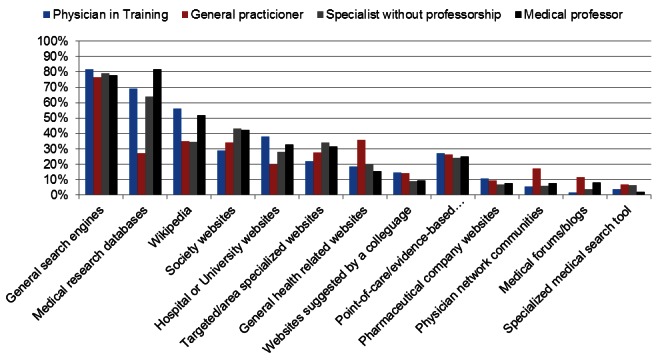
Most participants were Internet-savvy, came from Austria (43%, 190/440) and Switzerland (31%, 137/440), were above 50 years old (56%, 239/430), stated high levels of medical work experience, had regular patient contact and were employed in nonacademic health care settings (41%, 177/432). All groups reported frequent use of general search engines and cited "restricted accessibility to good quality information" as a dominant barrier to finding medical information on the Internet. Physicians in training reported the most frequent use of Wikipedia (56%, 31/55). Specialists were more likely than general practitioners to use medical research databases (68%, 185/274 vs 27%, 24/88; χ²₂=44.905, P<.001). General practitioners were more likely than specialists to report "lack of time" as a barrier towards finding information on the Internet (59%, 50/85 vs 43%, 111/260; χ²₁=7.231, P=.007) and to restrict their search by language (48%, 43/89 vs 35%, 97/278; χ²₁=5.148, P=.023). They frequently consult general health websites (36%, 31/87 vs 19%, 51/269; χ²₂=12.813, P=.002) and online physician network communities (17%, 15/86, χ²₂=9.841 vs 6%, 17/270, P<.001).

CONCLUSIONS

The reported inaccessibility of relevant, trustworthy resources on the Internet and frequent reliance on general search engines and social media among physicians require further attention. Possible solutions may be increased governmental support for the development and popularization of user-tailored medical search tools and open access to high-quality content for physicians. The potential role of collaborative tools in providing the psychological support and affirmation normally given by medical colleagues needs further consideration. Tools that speed up quality evaluation and aid selection of relevant search results need to be identified. In order to develop an adequate search tool, a differentiated approach considering the differing needs of physician subgroups may be beneficial.
https://cdn.ncbi.nlm.nih.gov/pmc/blobs/08c8/3713956/eee2b9a067c3/jmir_v15i6e122_fig2.jpg
https://cdn.ncbi.nlm.nih.gov/pmc/blobs/08c8/3713956/45cf093ab938/jmir_v15i6e122_fig1.jpg
https://cdn.ncbi.nlm.nih.gov/pmc/blobs/08c8/3713956/eee2b9a067c3/jmir_v15i6e122_fig2.jpg
https://cdn.ncbi.nlm.nih.gov/pmc/blobs/08c8/3713956/45cf093ab938/jmir_v15i6e122_fig1.jpg
https://cdn.ncbi.nlm.nih.gov/pmc/blobs/08c8/3713956/eee2b9a067c3/jmir_v15i6e122_fig2.jpg
摘要

背景

大量研究表明,医学专业人员在日常工作中存在未满足的信息需求。

目的

调查欧洲不同群体的医生使用哪些在线资源和工具来收集医学信息,并确定阻碍从互联网成功检索医学信息的障碍。

方法

通过合作伙伴网站向欧洲各地约15000名医生发送了一份详细的基于网络的问卷。分析纳入了500名具有不同学术资格和医学专业的欧洲医生。测量了不同类型在线资源的自我报告使用频率、搜索工具的感知重要性以及感知到的搜索障碍。对不同资格水平(合格医生与实习医生、无教授职位的医学专家与医学教授)和专业(全科医生与专科医生)进行了比较。

结果

大多数参与者熟悉互联网,来自奥地利(43%,190/440)和瑞士(31%,137/440),年龄在50岁以上(56%,239/430),具有高水平的医疗工作经验,经常接触患者,受雇于非学术性医疗保健机构(41%,177/432)。所有群体都报告经常使用通用搜索引擎,并将“难以获取高质量信息”列为在互联网上查找医学信息的主要障碍。实习医生报告使用维基百科的频率最高(56%,31/55)。专科医生比全科医生更有可能使用医学研究数据库(68%,185/274对27%,24/88;χ²₂=44.905,P<.001)。全科医生比专科医生更有可能将“缺乏时间”作为在互联网上查找信息的障碍(59%,50/85对43%,111/260;χ²₁=7.231,P=.007),并按语言限制搜索(48%,43/89对35%,97/278;χ²₁=5.148,P=.023)。他们经常查阅一般健康网站(36%,31/87对19%,51/269;χ²₂=12.813,P=.002)和在线医生网络社区(17%,15/86,χ²₂=9.841对6%,17/270,P<.001)。

结论

医生报告在互联网上难以获取相关、可信的资源,且经常依赖通用搜索引擎和社交媒体,这需要进一步关注。可能的解决方案包括政府加大对定制化医学搜索工具开发和推广的支持,以及为医生提供高质量内容的开放获取。协作工具在提供通常由医学同事给予的心理支持和肯定方面的潜在作用需要进一步考虑。需要确定能够加快质量评估并有助于选择相关搜索结果的工具。为了开发合适的搜索工具,考虑医生亚组不同需求的差异化方法可能是有益的。

相似文献

1
Utilization and perceived problems of online medical resources and search tools among different groups of European physicians.欧洲不同群体医生对在线医疗资源和搜索工具的使用情况及感知到的问题
J Med Internet Res. 2013 Jun 26;15(6):e122. doi: 10.2196/jmir.2436.
2
The impact of search engine selection and sorting criteria on vaccination beliefs and attitudes: two experiments manipulating Google output.搜索引擎选择和排序标准对疫苗接种观念及态度的影响:两项操纵谷歌搜索结果的实验
J Med Internet Res. 2014 Apr 2;16(4):e100. doi: 10.2196/jmir.2642.
3
4
Preferences for Accessing Medical Information in the Digital Age: Health Care Professional Survey.数字时代获取医疗信息的偏好:医疗保健专业人员调查。
J Med Internet Res. 2021 Jun 19;23(6):e25868. doi: 10.2196/25868.
5
Physicians searching the web for medical question answering: a European survey and local user studies.在网络上搜索医学问题答案的医生:一项欧洲调查及本地用户研究。
Stud Health Technol Inform. 2013;192:1103.
6
Online Health Information-Seeking in the Era of Large Language Models: Cross-Sectional Web-Based Survey Study.大语言模型时代的在线健康信息搜索:基于网络的横断面调查研究
J Med Internet Res. 2025 Mar 31;27:e68560. doi: 10.2196/68560.
7
Folic acid supplementation and malaria susceptibility and severity among people taking antifolate antimalarial drugs in endemic areas.在流行地区,服用抗叶酸抗疟药物的人群中,叶酸补充剂与疟疾易感性和严重程度的关系。
Cochrane Database Syst Rev. 2022 Feb 1;2(2022):CD014217. doi: 10.1002/14651858.CD014217.
8
Pilot Medical Certification飞行员医学认证
9
Evaluating the Acceptance and Usability of an Independent, Noncommercial Search Engine for Medical Information: Cross-Sectional Questionnaire Study and User Behavior Tracking Analysis.评估一个独立的非商业性医学信息搜索引擎的可接受性和可用性:横断面问卷调查研究及用户行为跟踪分析
JMIR Hum Factors. 2025 Jan 23;12:e56941. doi: 10.2196/56941.
10
Dr. Google: Physicians-The Web-Patients Triangle: Digital Skills and Attitudes towards e-Health Solutions among Physicians in South Eastern Poland-A Cross-Sectional Study in a Pre-COVID-19 Era.谷歌医生:网络-患者三角关系:波兰东南部医生的数字技能和对电子健康解决方案的态度——新冠疫情前的横断面研究
Int J Environ Res Public Health. 2023 Jan 5;20(2):978. doi: 10.3390/ijerph20020978.

引用本文的文献

1
The Influence of Medical Expertise and Information Search Skills on Medical Information Searching: Comparative Analysis From a Free Data Set.医学专业知识和信息搜索技能对医学信息搜索的影响:基于免费数据集的比较分析
JMIR Form Res. 2025 Apr 17;9:e62754. doi: 10.2196/62754.
2
Evaluating the Acceptance and Usability of an Independent, Noncommercial Search Engine for Medical Information: Cross-Sectional Questionnaire Study and User Behavior Tracking Analysis.评估一个独立的非商业性医学信息搜索引擎的可接受性和可用性:横断面问卷调查研究及用户行为跟踪分析
JMIR Hum Factors. 2025 Jan 23;12:e56941. doi: 10.2196/56941.
3
What information sources do Dutch medical specialists use in medical decision-making: a qualitative interview study.

本文引用的文献

1
Reviewing social media use by clinicians.审查临床医生的社交媒体使用情况。
J Am Med Inform Assoc. 2012 Sep-Oct;19(5):777-81. doi: 10.1136/amiajnl-2012-000990. Epub 2012 Jul 3.
2
Wikipedia: a key tool for global public health promotion.维基百科:全球公共卫生促进的关键工具。
J Med Internet Res. 2011 Jan 31;13(1):e14. doi: 10.2196/jmir.1589.
3
Internet-based information-seeking behaviour amongst doctors and nurses: a short review of the literature.基于互联网的医生和护士信息检索行为:文献综述。
荷兰医学专家在医疗决策中使用哪些信息来源:一项定性访谈研究。
BMJ Open. 2023 Oct 5;13(10):e073905. doi: 10.1136/bmjopen-2023-073905.
4
Not Just Mechanical Birthing Bodies: Birthing Consciousness and Birth Reflexes.不仅仅是机械的分娩身体:分娩意识与分娩反射。
J Perinat Educ. 2023 Jul 1;32(3):149-161. doi: 10.1891/JPE-2022-0007.
5
Preferences for Accessing Medical Information in the Digital Age: Health Care Professional Survey.数字时代获取医疗信息的偏好:医疗保健专业人员调查。
J Med Internet Res. 2021 Jun 19;23(6):e25868. doi: 10.2196/25868.
6
Can Medical Students Evaluate Medical Websites?: A mixed-methods study from Oman.医学生能否评估医学网站?:来自阿曼的一项混合方法研究。
Sultan Qaboos Univ Med J. 2022 Aug;22(3):362-369. doi: 10.18295/squmj.8.2021.114. Epub 2022 Aug 25.
7
Online Searching as a Practice for Evidence-Based Medicine in the Neonatal Intensive Care Unit, University of Malaya Medical Center, Malaysia: Cross-sectional Study.马来西亚马来亚大学医学中心新生儿重症监护病房将在线搜索作为循证医学实践的研究:横断面研究
JMIR Form Res. 2022 Apr 6;6(4):e30687. doi: 10.2196/30687.
8
The effect of Covid-19 in digital media use of Finnish physicians - Four wave longitudinal panel survey.Covid-19 对芬兰医生使用数字媒体的影响 - 四波纵向面板调查。
Int J Med Inform. 2022 Mar;159:104677. doi: 10.1016/j.ijmedinf.2021.104677. Epub 2021 Dec 29.
9
Digitization in gynecology and obstetrics in times of COVID-19: Results of a national survey.COVID-19 时期妇产科的数字化:一项全国性调查结果
Internet Interv. 2021 Dec;26:100478. doi: 10.1016/j.invent.2021.100478. Epub 2021 Nov 11.
10
Telemedicine as a Therapeutic Option in Sports Medicine: Results of a Nationwide Cross-Sectional Study among Physicians and Patients in Germany.远程医疗作为运动医学的一种治疗选择:德国医生和患者的全国横断面研究结果。
Int J Environ Res Public Health. 2021 Jul 2;18(13):7110. doi: 10.3390/ijerph18137110.
Health Info Libr J. 2010 Mar;27(1):2-10. doi: 10.1111/j.1471-1842.2010.00883.x.
4
Likert scales, levels of measurement and the "laws" of statistics.李克特量表、测量水平与“统计学定律”。
Adv Health Sci Educ Theory Pract. 2010 Dec;15(5):625-32. doi: 10.1007/s10459-010-9222-y. Epub 2010 Feb 10.
5
For what purpose and reasons do doctors use the Internet: a systematic review.医生使用互联网的目的和原因是什么:一项系统综述。
Int J Med Inform. 2008 Jan;77(1):4-16. doi: 10.1016/j.ijmedinf.2006.10.002. Epub 2006 Nov 29.
6
Googling for a diagnosis--use of Google as a diagnostic aid: internet based study.通过谷歌搜索进行诊断——将谷歌用作诊断辅助工具:基于互联网的研究
BMJ. 2006 Dec 2;333(7579):1143-5. doi: 10.1136/bmj.39003.640567.AE. Epub 2006 Nov 10.
7
Assessment of internet use and effects among healthcare professionals: a cross sectional survey.医疗保健专业人员的互联网使用情况及其影响评估:一项横断面调查。
Postgrad Med J. 2006 Apr;82(966):274-9. doi: 10.1136/pgmj.2005.040675.
8
The effective use of search engines on the Internet.互联网上搜索引擎的有效使用。
Nurs Stand. 2005;19(48):56-64; quiz 66. doi: 10.7748/ns2005.08.19.48.56.c3931.
9
General practitioners' use of online evidence during consultations.全科医生在会诊期间对在线证据的使用。
Int J Med Inform. 2005 Jan;74(1):1-12. doi: 10.1016/j.ijmedinf.2004.10.003.
10
Answering physicians' clinical questions: obstacles and potential solutions.回答医生的临床问题:障碍与潜在解决方案。
J Am Med Inform Assoc. 2005 Mar-Apr;12(2):217-24. doi: 10.1197/jamia.M1608. Epub 2004 Nov 23.