Marcińska Izabela, Czyczyło-Mysza Ilona, Skrzypek Edyta, Grzesiak Maciej T, Janowiak Franciszek, Filek Maria, Dziurka Michał, Dziurka Kinga, Waligórski Piotr, Juzoń Katarzyna, Cyganek Katarzyna, Grzesiak Stanisław
The F. Górski Institute of Plant Physiology, Polish Academy of Sciences, Kraków 30-239, Poland.
Int J Mol Sci. 2013 Jun 26;14(7):13171-93. doi: 10.3390/ijms140713171.
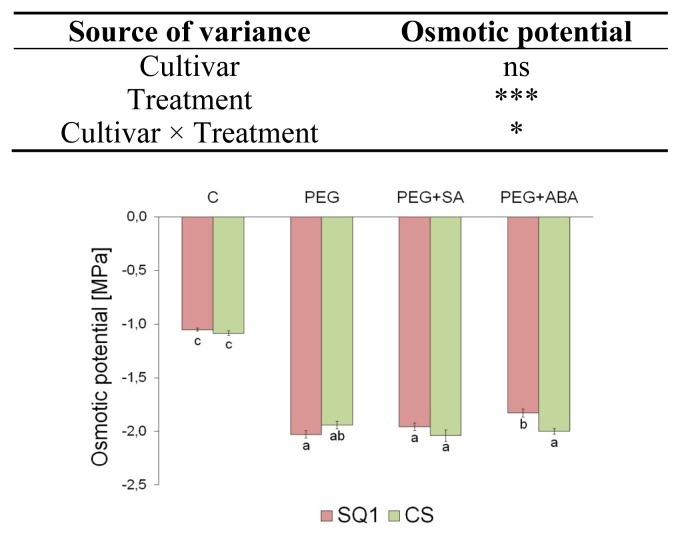
The aim of the study was to assess the role of salicylic acid (SA) and abscisic acid (ABA) in osmotic stress tolerance of wheat seedlings. This was accomplished by determining the impact of the acids applied exogenously on seedlings grown under osmotic stress in hydroponics. The investigation was unique in its comprehensiveness, examining changes under osmotic stress and other conditions, and testing a number of parameters simultaneously. In both drought susceptible (SQ1) and drought resistant (CS) wheat cultivars, significant physiological and biochemical changes were observed upon the addition of SA (0.05 mM) or ABA (0.1 μM) to solutions containing half-strength Hoagland medium and PEG 6000 (-0.75 MPa). The most noticeable result of supplementing SA or ABA to the medium (PEG + SA and PEG + ABA) was a decrease in the length of leaves and roots in both cultivars. While PEG treatment reduced gas exchange parameters, chlorophyll content in CS, and osmotic potential, and conversely, increased lipid peroxidation, soluble carbohydrates in SQ1, proline content in both cultivars and total antioxidants activity in SQ1, PEG + SA or PEG + ABA did not change the values of these parameters. Furthermore, PEG caused a two-fold increase of endogenous ABA content in SQ1 and a four-fold increase in CS. PEG + ABA increased endogenous ABA only in SQ1, whereas PEG + SA caused a greater increase of ABA content in both cultivars compared to PEG. In PEG-treated plants growing until the harvest, a greater decrease of yield components was observed in SQ1 than in CS. PEG + SA, and particularly PEG + ABA, caused a greater increase of these yield parameters in CS compared to SQ1. In conclusion, SA and ABA ameliorate, particularly in the tolerant wheat cultivar, the harmful effects and after effects of osmotic stress induced by PEG in hydroponics through better osmotic adjustment achieved by an increase in proline and carbohydrate content as well as by an increase in antioxidant activity.
本研究的目的是评估水杨酸(SA)和脱落酸(ABA)在小麦幼苗渗透胁迫耐受性中的作用。这是通过测定外源施加的这些酸对水培条件下遭受渗透胁迫的幼苗的影响来实现的。该研究的独特之处在于其全面性,考察了渗透胁迫及其他条件下的变化,并同时测试了多个参数。在干旱敏感型(SQ1)和抗旱型(CS)小麦品种中,当向含有半强度霍格兰培养液和聚乙二醇6000(-0.75 MPa)的溶液中添加SA(0.05 mM)或ABA(0.1 μM)时,均观察到了显著的生理和生化变化。向培养基中添加SA或ABA(PEG + SA和PEG + ABA)最显著的结果是两个品种的叶片和根的长度均有所缩短。聚乙二醇处理降低了气体交换参数、CS中的叶绿素含量以及渗透势,相反,增加了脂质过氧化、SQ1中的可溶性碳水化合物、两个品种中的脯氨酸含量以及SQ1中的总抗氧化活性,而PEG + SA或PEG + ABA并未改变这些参数的值。此外,聚乙二醇使SQ1中的内源ABA含量增加了两倍,使CS中的内源ABA含量增加了四倍。PEG + ABA仅使SQ1中的内源ABA增加,而PEG + SA使两个品种中的ABA含量相比聚乙二醇处理时有更大幅度的增加。在生长至收获期的聚乙二醇处理植株中,观察到SQ1中产量构成因素的下降幅度大于CS。与SQ1相比,PEG + SA,尤其是PEG + ABA使CS中的这些产量参数有更大幅度的增加。总之,SA和ABA,尤其是在耐逆性小麦品种中,通过增加脯氨酸和碳水化合物含量以及提高抗氧化活性实现更好的渗透调节,从而减轻了水培条件下聚乙二醇诱导的渗透胁迫的有害影响及后续效应。