Day Theodore Eugene, Ravi Nathan, Xian Hong, Brugh Ann
Health Services Research and Development, VA St. Louis Healthcare System, St. Louis, Missouri, United States of America.
PLoS One. 2013 Jun 21;8(6):e66812. doi: 10.1371/journal.pone.0066812. Print 2013.
Agent-based models are valuable for examining systems where large numbers of discrete individuals interact with each other, or with some environment. Diabetic Veterans seeking eye care at a Veterans Administration hospital represent one such cohort.
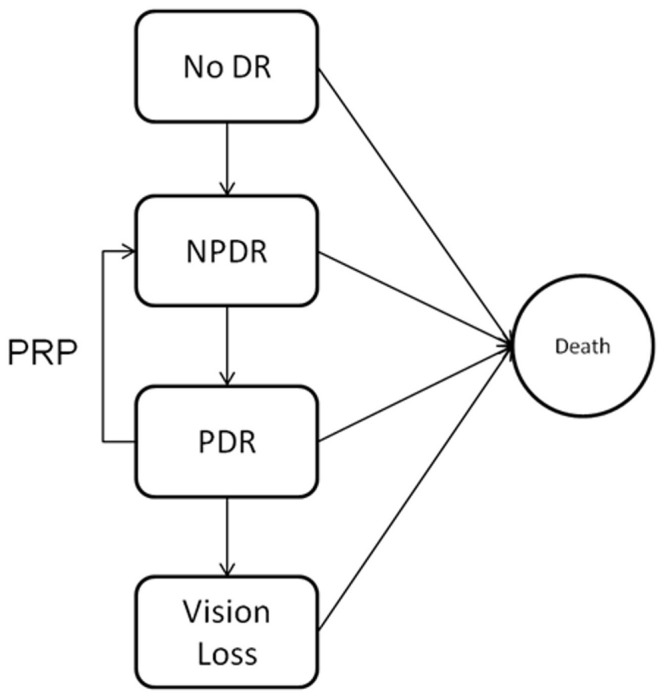
The objective of this study was to develop an agent-based template to be used as a model for a patient with diabetic retinopathy (DR). This template may be replicated arbitrarily many times in order to generate a large cohort which is representative of a real-world population, upon which in-silico experimentation may be conducted.
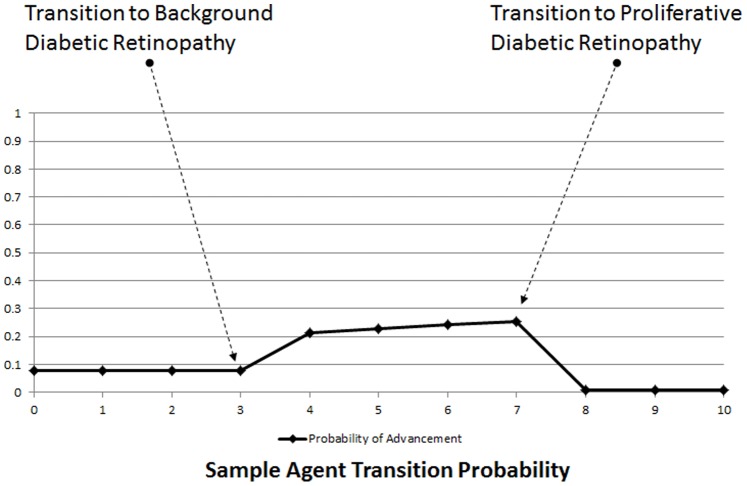
Agent-based template development was performed in java-based computer simulation suite AnyLogic Professional 6.6. The model was informed by medical data abstracted from 535 patient records representing a retrospective cohort of current patients of the VA St. Louis Healthcare System Eye clinic. Logistic regression was performed to determine the predictors associated with advancing stages of DR. Predicted probabilities obtained from logistic regression were used to generate the stage of DR in the simulated cohort.
The simulated cohort of DR patients exhibited no significant deviation from the test population of real-world patients in proportion of stage of DR, duration of diabetes mellitus (DM), or the other abstracted predictors. Simulated patients after 10 years were significantly more likely to exhibit proliferative DR (P<0.001).
Agent-based modeling is an emerging platform, capable of simulating large cohorts of individuals based on manageable data abstraction efforts. The modeling method described may be useful in simulating many different conditions where course of disease is described in categorical stages.
基于主体的模型对于研究大量离散个体相互之间或与某些环境进行交互的系统很有价值。在退伍军人管理局医院寻求眼科护理的糖尿病退伍军人就代表了这样一个群体。
本研究的目的是开发一个基于主体的模板,用作糖尿病视网膜病变(DR)患者的模型。该模板可以任意多次复制,以生成一个代表现实世界人群的大型队列,在此基础上可以进行计算机模拟实验。
基于主体的模板开发是在基于Java的计算机模拟套件AnyLogic Professional 6.6中进行的。该模型参考了从535份患者记录中提取的医学数据,这些记录代表了圣路易斯退伍军人事务医疗系统眼科诊所当前患者的回顾性队列。进行逻辑回归以确定与DR进展阶段相关的预测因素。从逻辑回归中获得的预测概率用于生成模拟队列中DR的阶段。
DR患者的模拟队列在DR阶段比例、糖尿病(DM)病程或其他提取的预测因素方面与现实世界患者的测试人群没有显著差异。10年后的模拟患者更有可能出现增殖性DR(P<0.001)。
基于主体的建模是一个新兴平台,能够基于可管理的数据提取工作模拟大量个体。所描述的建模方法可能有助于模拟许多不同的疾病情况,其中疾病进程以分类阶段描述。