MRC Laboratory for Molecular Cell Biology, University College London, London, UK.
J Thromb Haemost. 2013 Jun;11 Suppl 1(Suppl 1):192-201. doi: 10.1111/jth.12225.
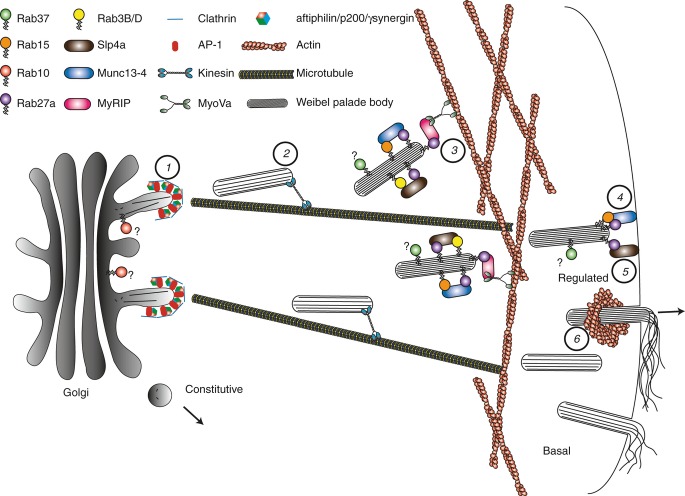
von Willebrand factor (VWF) plays key roles in both primary and secondary hemostasis by capturing platelets and chaperoning clotting factor VIII, respectively. It is stored within the Weibel-Palade bodies (WPBs) of endothelial cells as a highly prothrombotic protein, and its release is thus necessarily under tight control. Regulating the secretion of VWF involves multiple layers of cellular machinery that act together at different stages, leading to the exocytic fusion of WPBs with the plasma membrane and the consequent release of VWF. This review aims to provide a snapshot of the current understanding of those components, in particular the members of the Rab family, acting in the increasingly complex story of VWF secretion.
血管性血友病因子(VWF)通过分别捕获血小板和携带凝血因子 VIII,在初级和次级止血中发挥关键作用。它作为一种高度促血栓形成的蛋白质储存在血管内皮细胞的 Weibel-Palade 体(WPB)中,因此其释放必然受到严格控制。调节 VWF 的分泌涉及多个细胞机制层,它们在不同阶段协同作用,导致 WPB 与质膜的外显融合和随后的 VWF 释放。本综述旨在概述当前对这些成分的理解,特别是 Rab 家族成员,它们在 VWF 分泌这一日益复杂的故事中发挥作用。