Key Laboratory of Geriatrics of Health Ministry, Department of Geriatrics, Union Hospital, Tongji Medical College, Huazhong University of Science and Technology, Wuhan, China.
PLoS One. 2013 Jun 20;8(6):e66721. doi: 10.1371/journal.pone.0066721. Print 2013.
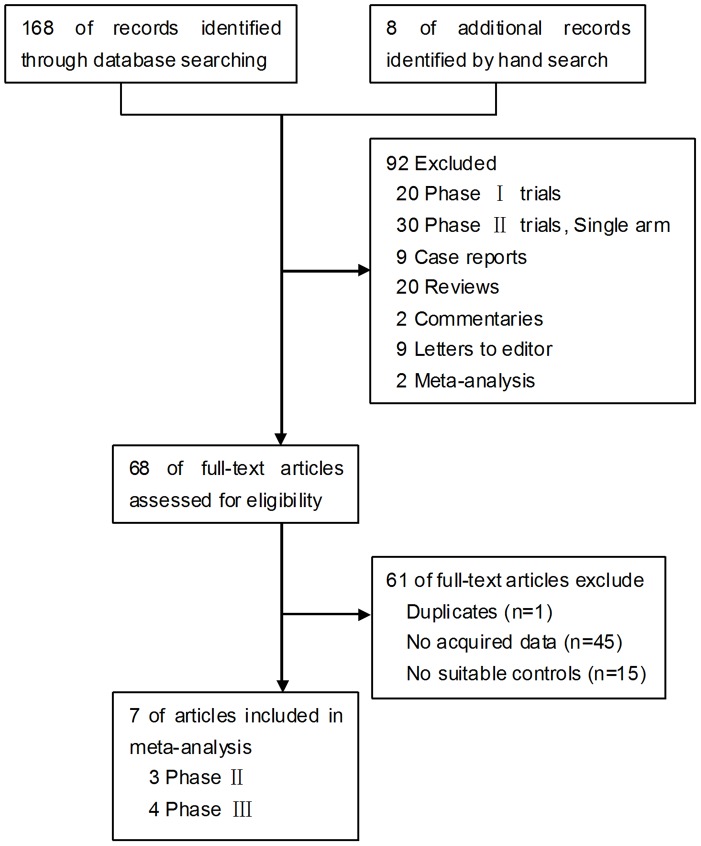
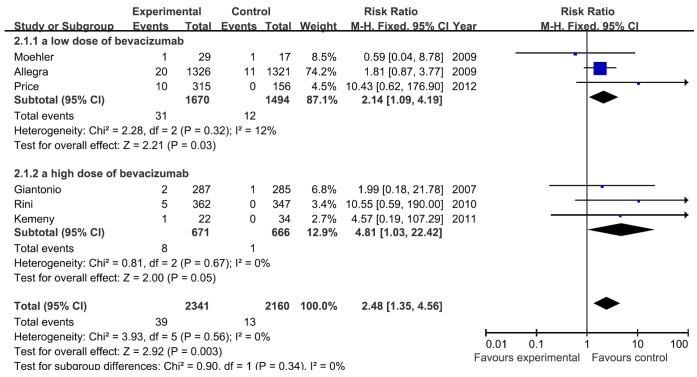
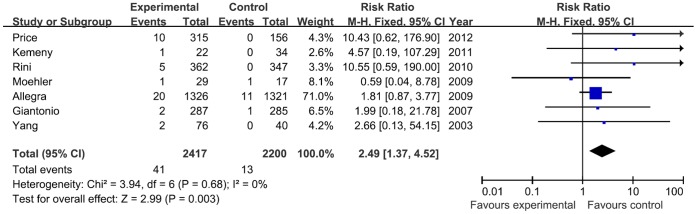
Concerns have arisen regarding the risk of ischemic heart disease with the novel antiangiogenic agent bevacizumab, a recombinant humanised monoclonal antibody to the vascular endothelial growth factor that is widely used in cancer treatment. Currently, the role of bevacizumab in ischemic heart disease is controversial. This meta-analysis was therefore performed to assess the overall risk of ischemic heart disease associated with the use of bevacizumab. The databases of PubMed, EMBASE and Web of Science were searched for English language studies of randomised controlled trials comparing bevacizumab with control therapy published through October 25, 2012. Summary incidence rates, relative risks (RRs) and 95% confidence intervals (CIs) were calculated using random-effects or fixed-effects models based on the heterogeneity of the included studies. A total of 4,617 patients from 7 randomised controlled trials were identified and included for analysis. Among those patients receiving bevacizumab, the summary incidence of ischemic heart disease was 1.0% (95% CI, 0.6%-1.4%). Patients treated with bevacizumab had a significantly increased risk of ischemic heart disease with an RR of 2.49 (95% CI, 1.37-4.52) compared with controls. In addition, both high doses and low doses of bevacizumab increased the risk of cardiac ischemia (low dose at 2.5 mg/kg per week: RR, 2.14 [95% CI, 1.09-4.19]; high dose at 5 mg/kg per week: RR, 4.81 [95% CI, 1.03-22.42]). Bevacizumab was also found to significantly increase the risk of cardiac ischemia in patients with colorectal cancer (RR, 2.13; 95% CI, 1.11-4.06) compared with controls. This meta-analysis shows the use of bevacizumab was associated with an increased risk of developing ischemic heart disease in colorectal cancer patients receiving this drug. Our conclusions are limited by the available data. Further evaluations of high-quality RCTs are needed.
人们对新型血管生成抑制剂贝伐单抗(一种广泛用于癌症治疗的血管内皮生长因子重组人源化单克隆抗体)引起缺血性心脏病的风险提出了担忧。目前,贝伐单抗在缺血性心脏病中的作用存在争议。因此,进行了这项荟萃分析,以评估使用贝伐单抗与缺血性心脏病相关的总体风险。检索了 PubMed、EMBASE 和 Web of Science 数据库,以获取 2012 年 10 月 25 日之前发表的比较贝伐单抗与对照治疗的随机对照试验的英文研究。使用随机效应或固定效应模型根据纳入研究的异质性计算汇总发生率、相对风险 (RR) 和 95%置信区间 (CI)。从 7 项随机对照试验中确定了 4617 名患者并纳入分析。在接受贝伐单抗治疗的患者中,缺血性心脏病的总发生率为 1.0%(95%CI,0.6%-1.4%)。与对照组相比,接受贝伐单抗治疗的患者缺血性心脏病的风险显著增加,RR 为 2.49(95%CI,1.37-4.52)。此外,贝伐单抗的高、低剂量均增加了心肌缺血的风险(低剂量 2.5mg/kg/周:RR,2.14[95%CI,1.09-4.19];高剂量 5mg/kg/周:RR,4.81[95%CI,1.03-22.42])。与对照组相比,贝伐单抗还显著增加了结直肠癌患者发生心肌缺血的风险(RR,2.13;95%CI,1.11-4.06)。这项荟萃分析表明,接受贝伐单抗治疗的结直肠癌患者发生缺血性心脏病的风险增加。我们的结论受到现有数据的限制。需要进一步评估高质量 RCT 的结果。