Jackson Brianna L, Blackwood Ellie M, Blum Julieanne, Carruthers Sean P, Nemorin Sabrina, Pryor Brett A, Sceneay Shannon D, Bevan Stephanie, Crewther David P
Centre for Human Psychopharmacology, Swinburne University of Technology, Melbourne, Victoria, Australia.
PLoS One. 2013 Jun 18;8(6):e66797. doi: 10.1371/journal.pone.0066797. Print 2013.
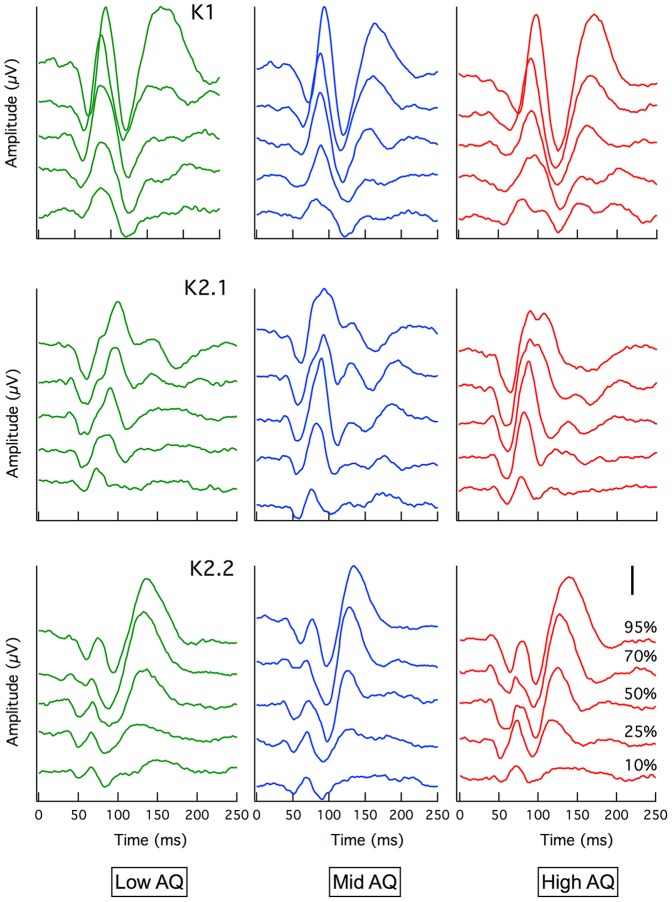
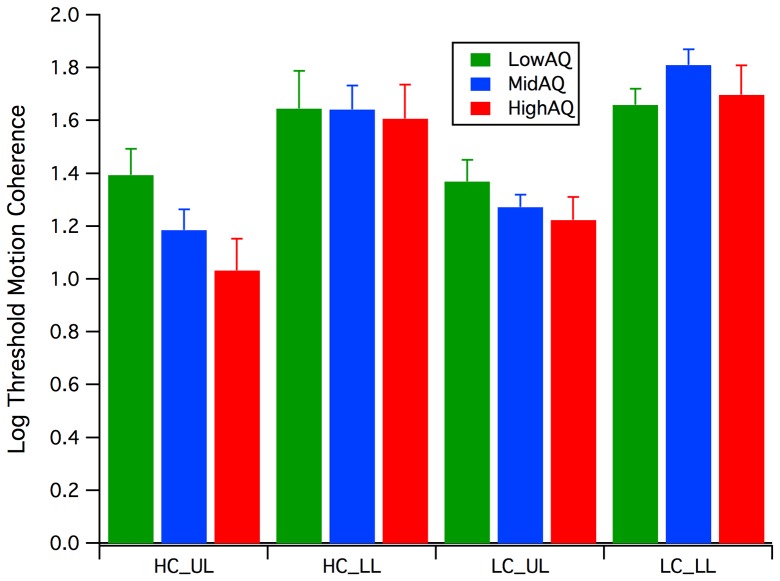
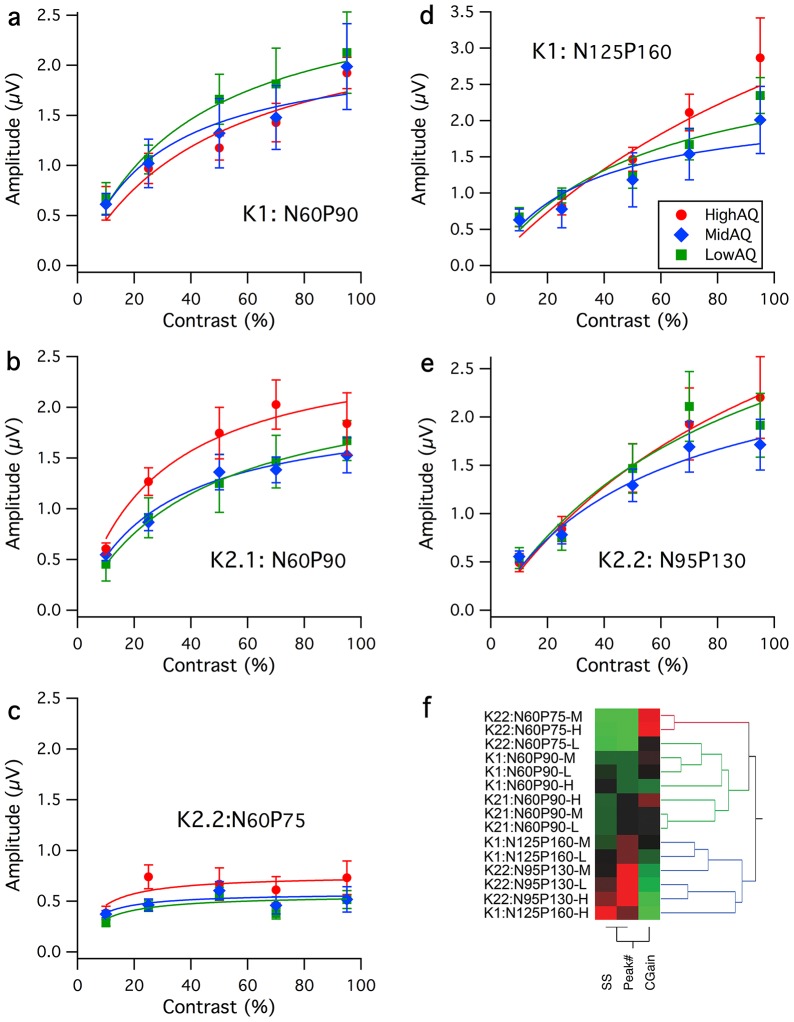
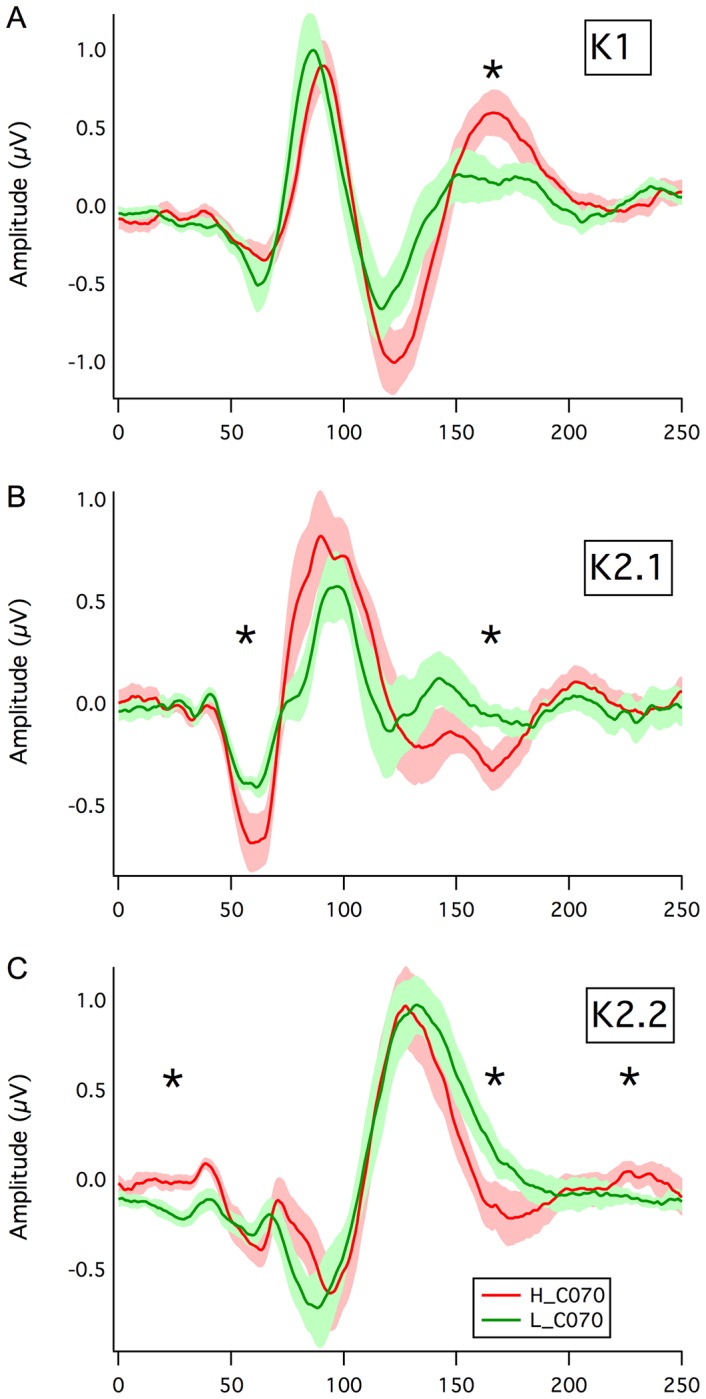
Autistic tendency has been associated with altered visual perception, especially impaired visual motion sensitivity and global/local integration, as well as enhanced visual search and local shape recognition. However, the neurophysiological mechanisms underlying these abnormalities remain poorly defined. The current study recruited 29 young adults displaying low, middle or high autistic trait as measured by Baron-Cohen's Autism spectrum Quotient (AQ), and measured motion coherence thresholds psychophysically, with manipulation of dot lifetime and stimulus contrast, as well as nonlinear cortical visual evoked potentials (VEPs) over a range of temporal luminance contrast levels from 10% to 95%. Contrast response functions extracted from the major first order and second order Wiener kernel peaks of the VEPs showed consistent variation with AQ group, and Naka-Rushton fits enabled contrast gain and semi-saturation contrasts to be elicited for each peak. A short latency second order response (previously associated with magnocellular processing) with high contrast gain and a saturating contrast response function showed higher amplitude for the High AQ (compared with Mid and Low groups) indicating poorer neural recovery after rapid stimulation. A non-linearity evoked at longer interaction times (previously associated with parvocellular processing) with no evidence of contrast saturation and lower contrast gain showed no difference between autism quotient groups across the full range of stimulus contrasts. In addition, the short latency first order response and a small, early second order second slice response showed gain and semi-saturation parameters indicative of magnocellular origin, while the longer latency first order response probably reflects a mixture of inputs (including feedback from higher cortical areas). Significant motion coherence (AQ group) * (dot lifetime) interactions with higher coherence threshold for limited dot lifetime stimuli is consistent with atypical magnocellular functioning, however psychophysical performance for those with High AQ is not explained fully, suggesting that other factors may be involved.
自闭症倾向与视觉感知改变有关,尤其是视觉运动敏感性受损和整体/局部整合能力受损,以及视觉搜索增强和局部形状识别能力增强。然而,这些异常背后的神经生理机制仍不清楚。本研究招募了29名年轻成年人,他们通过巴伦-科恩自闭症谱系商数(AQ)测量显示出低、中或高自闭症特质,并通过心理物理学方法测量了运动连贯性阈值,同时操纵了点的持续时间和刺激对比度,以及在10%至95%的一系列时间亮度对比度水平下测量了非线性皮层视觉诱发电位(VEP)。从VEP的主要一阶和二阶维纳核峰值中提取的对比度响应函数显示出与AQ组的一致变化,并且中川-拉什顿拟合能够为每个峰值引出对比度增益和半饱和对比度。具有高对比度增益和饱和对比度响应函数的短潜伏期二阶响应(以前与大细胞处理相关)在高AQ组(与中AQ组和低AQ组相比)中显示出更高的幅度,表明快速刺激后神经恢复较差。在较长相互作用时间诱发的非线性(以前与小细胞处理相关),没有对比度饱和的证据且对比度增益较低,在整个刺激对比度范围内,自闭症商数组之间没有差异。此外,短潜伏期一阶响应和一个小的、早期二阶第二切片响应显示出增益和半饱和参数,表明其起源于大细胞,而较长潜伏期一阶响应可能反映了多种输入的混合(包括来自更高皮层区域的反馈)。显著的运动连贯性(AQ组)*(点持续时间)相互作用,对于有限点持续时间刺激具有更高的连贯性阈值,这与非典型大细胞功能一致,然而,高AQ组的心理物理学表现并不能完全得到解释,这表明可能涉及其他因素。