Centre for Research into Ecological and Environmental Modelling, Scottish Oceans Institute, University of St Andrews, , St Andrews, UK.
Biol Lett. 2013 Jul 3;9(4):20130223. doi: 10.1098/rsbl.2013.0223. Print 2013 Aug 23.
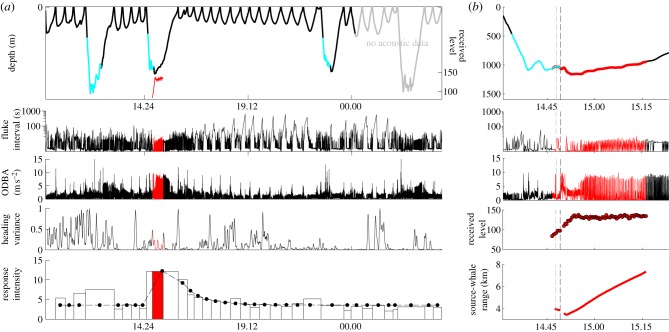
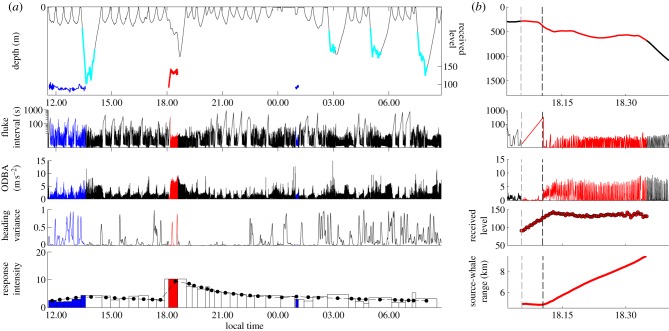
Most marine mammal- strandings coincident with naval sonar exercises have involved Cuvier's beaked whales (Ziphius cavirostris). We recorded animal movement and acoustic data on two tagged Ziphius and obtained the first direct measurements of behavioural responses of this species to mid-frequency active (MFA) sonar signals. Each recording included a 30-min playback (one 1.6-s simulated MFA sonar signal repeated every 25 s); one whale was also incidentally exposed to MFA sonar from distant naval exercises. Whales responded strongly to playbacks at low received levels (RLs; 89-127 dB re 1 µPa): after ceasing normal fluking and echolocation, they swam rapidly, silently away, extending both dive duration and subsequent non-foraging interval. Distant sonar exercises (78-106 dB re 1 µPa) did not elicit such responses, suggesting that context may moderate reactions. The observed responses to playback occurred at RLs well below current regulatory thresholds; equivalent responses to operational sonars could elevate stranding risk and reduce foraging efficiency.
大多数与海军声纳演习同时发生的海洋哺乳动物搁浅事件都涉及喙鲸(Ziphius cavirostris)。我们记录了两只标记的喙鲸的动物运动和声学数据,并获得了该物种对中频主动(MFA)声纳信号的行为反应的首次直接测量。每次记录包括 30 分钟的回放(一个 1.6 秒的模拟 MFA 声纳信号每 25 秒重复一次);一只鲸鱼还意外地受到了来自遥远海军演习的 MFA 声纳的照射。鲸鱼对低接收水平(RL;1 µPa 下的 89-127 dB re)的回放反应强烈:在停止正常的起伏和回声定位后,它们迅速、无声地游开,延长了潜水时间和随后的非觅食间隔。遥远的声纳演习(1 µPa 下的 78-106 dB re)并没有引起这样的反应,这表明环境可能会调节反应。在当前的监管阈值以下的 RL 水平观察到的对回放的反应;对操作声纳的等效反应可能会增加搁浅风险并降低觅食效率。