Division of Laboratory Sciences, National Center for Environmental Health, Centers for Disease Control and Prevention, Atlanta, GA 30341, USA.
Anal Chim Acta. 2013 Jul 17;787:267-73. doi: 10.1016/j.aca.2013.05.055. Epub 2013 Jun 6.
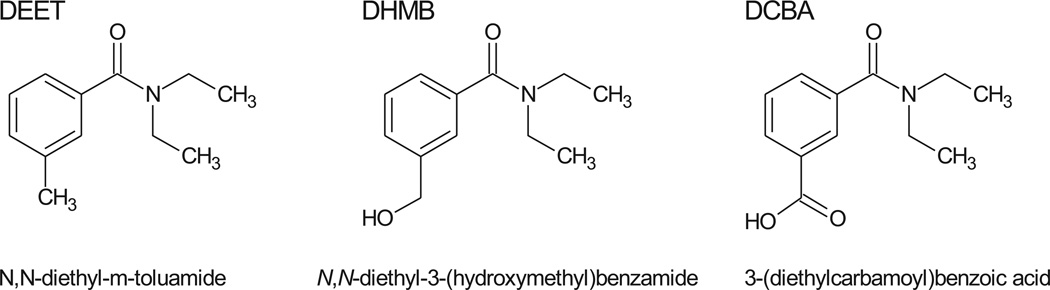
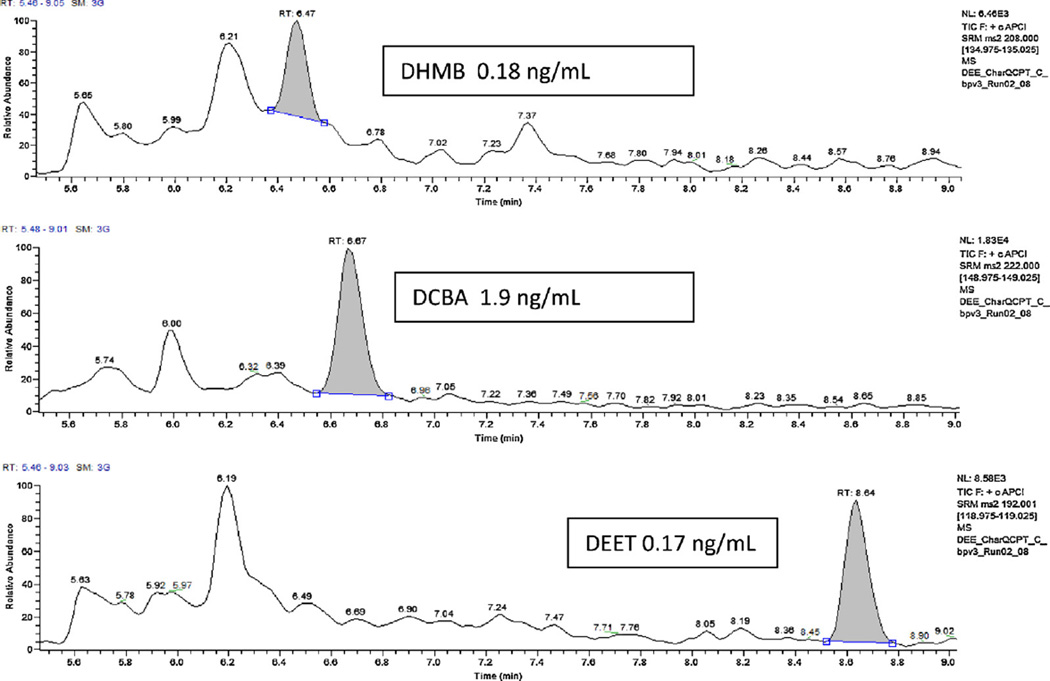
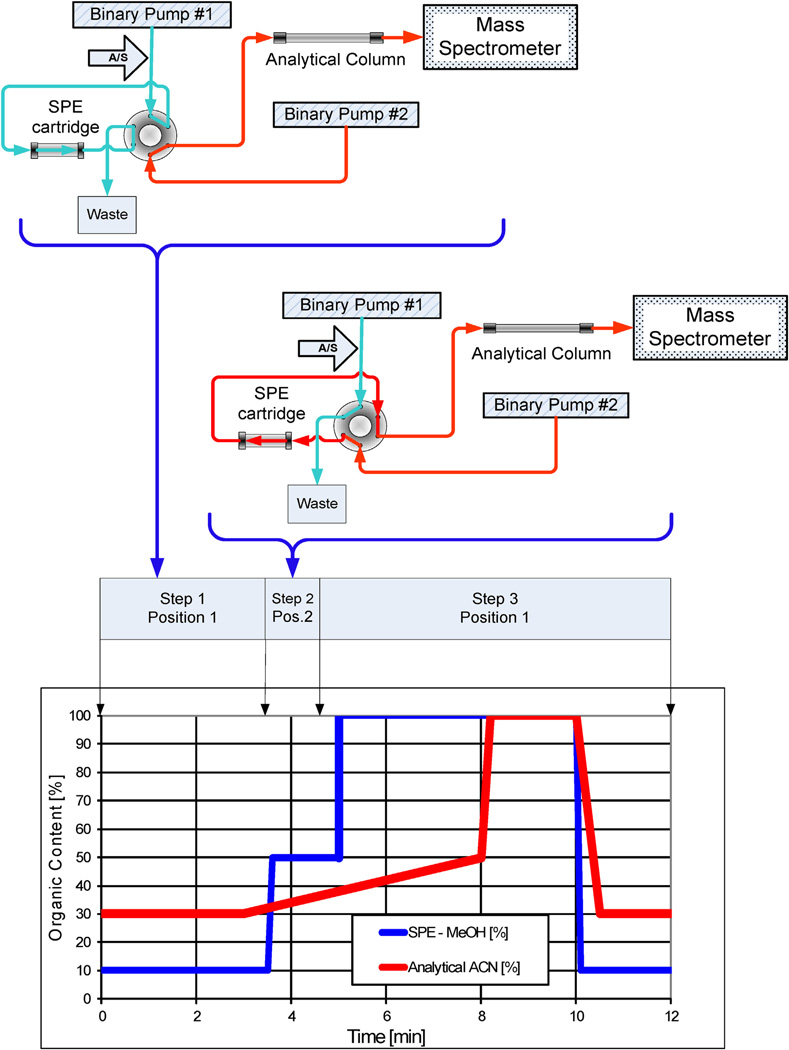
Human exposure to N,N-diethyl-m-toluamide (DEET) occurs because of the widespread use of DEET as an active ingredient in insect repellents. However, information on the extent of such exposure is rather limited. Therefore, we developed a fast on-line solid phase extraction-high performance liquid chromatography-isotope dilution tandem mass spectrometry (HPLC-MS/MS) method to measure in urine the concentrations of DEET and two of its oxidative metabolites: N,N-diethyl-3-(hydroxymethyl)benzamide and 3-(diethylcarbamoyl)benzoic acid (DCBA). To the best of our knowledge, this is the first HPLC-MS/MS method for the simultaneous quantification of DEET and its select metabolites in human urine. After enzymatic hydrolysis of the conjugated species in 0.1 mL of urine, the target analytes were retained and pre-concentrated on a monolithic column, separated from each other and from other urinary biomolecules on a reversed-phase analytical column, and detected by atmospheric pressure chemical ionization in positive ion mode. The limits of detection ranged from 0.1 ng mL(-1) to 1.0 ng mL(-1), depending on the analyte. Accuracy ranged between 90.4 and 104.9%, and precision ranged between 5.5 and 13.1% RSD, depending on the analyte and the concentration. We tested the usefulness of this method by analyzing 75 urine samples collected anonymously in the Southeastern United States in June 2012 from adults with no known exposure to DEET. Thirty eight samples (51%) tested positive for at least one of the analytes. We detected DCBA most frequently and at the highest concentrations. Our results suggest that this method can be used for the analysis of a large number of samples for epidemiological studies to assess human exposure to DEET.
人体接触 N,N-二乙基间甲苯酰胺(DEET)是因为 DEET 作为驱虫剂的有效成分被广泛使用。然而,有关这种接触的程度的信息相当有限。因此,我们开发了一种快速在线固相萃取-高效液相色谱-同位素稀释串联质谱(HPLC-MS/MS)方法,以测量尿液中 DEET 及其两种氧化代谢物:N,N-二乙基-3-(羟甲基)苯甲酰胺和 3-(二乙基氨基甲酰)苯甲酸(DCBA)的浓度。据我们所知,这是第一个用于同时定量测定人尿中 DEET 及其选择代谢物的 HPLC-MS/MS 方法。在 0.1 mL 尿液中经酶水解结合物后,目标分析物被保留并预浓缩在整体柱上,彼此以及与其他尿液生物分子在反相分析柱上分离,并在正离子模式下通过大气压化学电离检测。检测限范围取决于分析物,从 0.1 ng/mL 到 1.0 ng/mL。准确度在 90.4%到 104.9%之间,精密度取决于分析物和浓度,在 5.5%到 13.1%RSD 之间。我们通过分析 2012 年 6 月在美国东南部匿名收集的 75 份尿液样本,测试了这种方法的实用性,这些尿液样本来自没有已知 DEET 暴露的成年人。38 份(51%)样本至少有一种分析物呈阳性。我们最频繁且浓度最高地检测到 DCBA。我们的结果表明,该方法可用于分析大量样本,以进行评估人类接触 DEET 的流行病学研究。