Akhavanakbari Godrat, Entezariasl Masood, Isazadehfar Khatereh, Kahnamoyiagdam Fariba
Ardabil University of Medical Sciences, Iran.
Perspect Clin Res. 2013 Apr;4(2):136-41. doi: 10.4103/2229-3485.111798.
Cesarean section is one of the common surgeries of women. Acute post-operative pain is one of the recognized post-operative complications.
This study was planned to compare the effects of suppositories, indomethacin, diclofenac and acetaminophen, on post-operative pain and opioid usage after cesarean section.
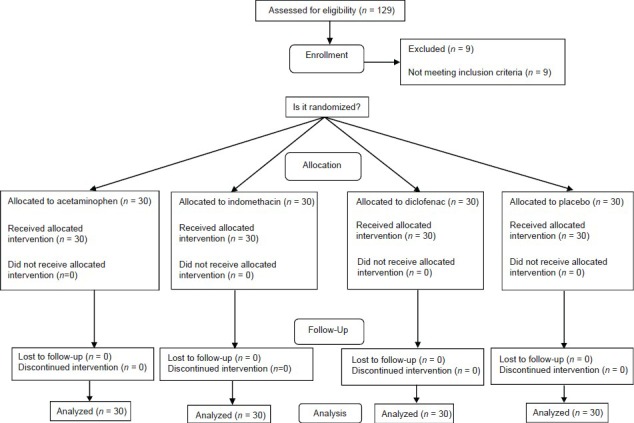
In this double-blind clinical trial study, 120 candidates of cesarean with spinal anesthesia and American Society of Anesthesiologists (ASA) I-II were randomly divided into four groups. Acetaminophen, indomethacin, diclofenac, and placebo suppositories were used in groups, respectively, after operation and the dosage was repeated every 6 h and pain score and opioid usage were compared 24 h after the surgery. The severity of pain was recorded on the basis of Visual Analog Scale (VAS) and if severe pain (VAS > 5) was observed, 0.5 mg/kg intramuscular pethidine had been used.
The data were analyzed in SPSS software version 15 and analytical statistics such as ANOVA, Chi-square, and Tukey's honestly significant difference (HSD) post-hoc.
Pain score was significantly higher in control group than other groups, and also pain score in acetaminophen group was higher than indomethacin and diclofenac. The three intervention groups received the first dose of pethidine far more than control group and the distance for diclofenac and indomethacin were significantly longer (P < 0.001). The use of indomethacin, diclofenac, and acetaminophen significantly reduces the amount of pethidine usage in 24 h after the surgery relation to control group.
Considering the significant decreasing pain score and opioid usage especially in indomethacin and diclofenac groups rather than control group, it is suggested using of indomethacin and diclofenac suppositories for post-cesarean section analgesia.
剖宫产是女性常见的手术之一。术后急性疼痛是公认的术后并发症之一。
本研究旨在比较栓剂、吲哚美辛、双氯芬酸和对乙酰氨基酚对剖宫产术后疼痛和阿片类药物使用的影响。
在这项双盲临床试验研究中,120例接受脊髓麻醉且美国麻醉医师协会(ASA)分级为I-II级的剖宫产候选者被随机分为四组。术后分别在各组使用对乙酰氨基酚、吲哚美辛、双氯芬酸和安慰剂栓剂,每6小时重复给药一次,并在术后24小时比较疼痛评分和阿片类药物使用情况。根据视觉模拟量表(VAS)记录疼痛严重程度,若观察到严重疼痛(VAS>5),则使用0.5mg/kg肌肉注射哌替啶。
数据在SPSS 15版软件中进行分析,采用方差分析、卡方检验和Tukey事后诚实显著性差异(HSD)等分析统计方法。
对照组的疼痛评分显著高于其他组,对乙酰氨基酚组的疼痛评分也高于吲哚美辛组和双氯芬酸组。三个干预组首次使用哌替啶的时间远多于对照组,双氯芬酸组和吲哚美辛组的间隔时间显著更长(P<0.001)。与对照组相比,使用吲哚美辛、双氯芬酸和对乙酰氨基酚显著减少了术后24小时内哌替啶的使用量。
鉴于尤其是吲哚美辛组和双氯芬酸组的疼痛评分和阿片类药物使用量相较于对照组显著降低,建议使用吲哚美辛和双氯芬酸栓剂进行剖宫产术后镇痛。