Queensland Institute of Medical Research, Brisbane QLD 4006, Australia.
J Exp Med. 2013 Jul 29;210(8):1635-46. doi: 10.1084/jem.20121972. Epub 2013 Jul 8.
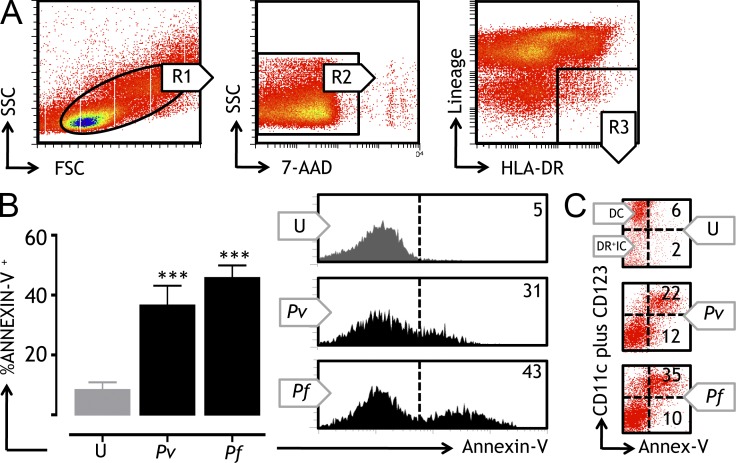
Malaria causes significant morbidity worldwide and a vaccine is urgently required. Plasmodium infection causes considerable immune dysregulation, and elicitation of vaccine immunity remains challenging. Given the central role of dendritic cells (DCs) in initiating immunity, understanding their biology during malaria will improve vaccination outcomes. Circulating DCs are particularly important, as they shape immune responses in vivo and reflect the functional status of other subpopulations. We performed cross-sectional and longitudinal assessments of the frequency, phenotype, and function of circulating DC in 67 Papuan adults during acute uncomplicated P. falciparum, P. vivax, and convalescent P. falciparum infections. We demonstrate that malaria patients display a significant reduction in circulating DC numbers and the concurrent accumulation of immature cells. Such alteration is associated with marked levels of spontaneous apoptosis and impairment in the ability of DC to mature, capture, and present antigens to T cells. Interestingly, sustained levels of plasma IL-10 were observed in patients with acute infection and were implicated in the induction of DC apoptosis. DC apoptosis was reversed upon IL-10 blockade, and DC function recovered when IL-10 levels returned to baseline by convalescence. Our data provide key information on the mechanisms behind DC suppression during malaria and will assist in developing strategies to better harness DC's immunotherapeutic potential.
疟疾在全球范围内导致了大量的发病率,因此急需一种疫苗。疟原虫感染会导致严重的免疫失调,而疫苗免疫的诱导仍然具有挑战性。鉴于树突状细胞(DC)在启动免疫中的核心作用,了解它们在疟疾期间的生物学特性将改善疫苗的效果。循环 DC 尤为重要,因为它们在体内塑造免疫反应,并反映其他亚群的功能状态。我们在 67 名巴布亚成年人中进行了疟疾急性感染、间日疟和疟原虫感染恢复期的横断面和纵向评估,以评估循环 DC 的频率、表型和功能。我们发现,疟疾患者的循环 DC 数量显著减少,同时幼稚细胞积累。这种改变与自发凋亡水平显著升高以及 DC 成熟、捕获和向 T 细胞呈递抗原的能力受损有关。有趣的是,急性感染患者持续观察到高水平的血浆 IL-10,并推测其诱导了 DC 凋亡。阻断 IL-10 后,DC 凋亡被逆转,当 IL-10 水平在恢复期恢复到基线时,DC 功能恢复。我们的数据提供了有关疟疾期间 DC 抑制背后机制的关键信息,并将有助于开发更好地利用 DC 免疫治疗潜力的策略。