Department of Human Development and Family Science, The Ohio State University, 1787 Neil Ave, Columbus, OH 43210, USA.
Health Qual Life Outcomes. 2013 Jul 10;11:116. doi: 10.1186/1477-7525-11-116.
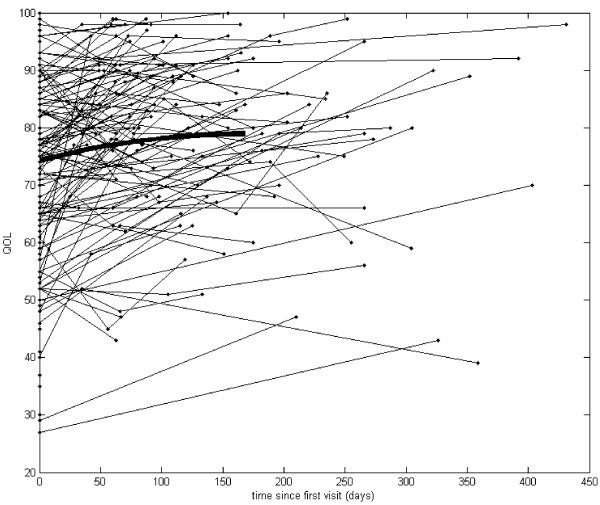
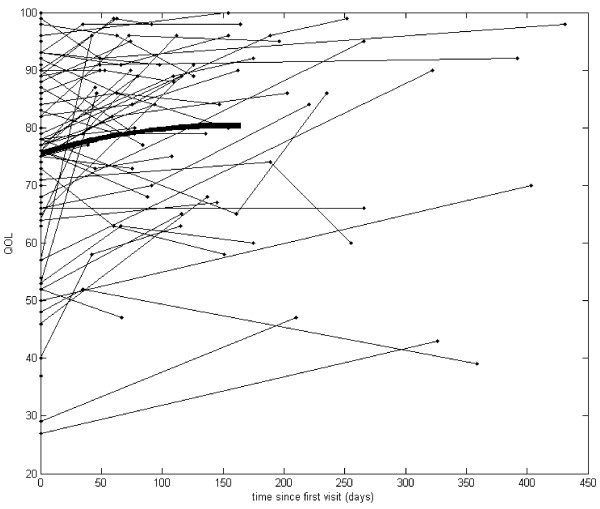
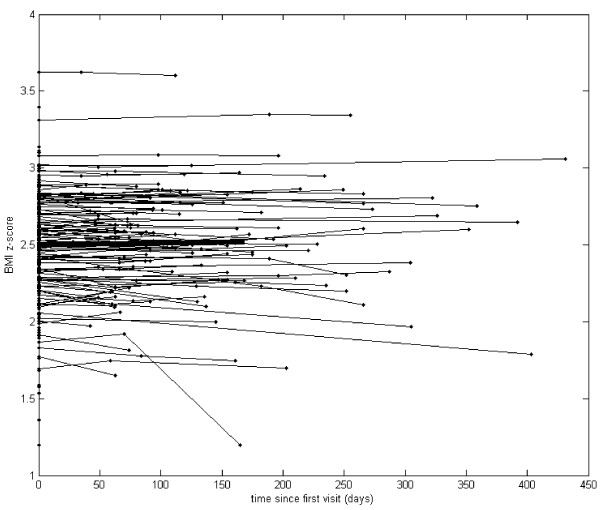
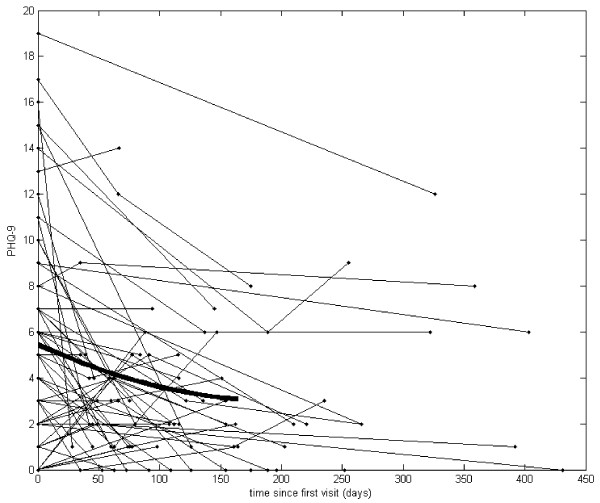
Changes in Quality of Life (QOL) measures over time with treatment of obesity have not previously been described for youth. We describe the changes from baseline through two follow up visits in youth QOL (assessed by the Pediatric Quality Life Inventory, PedsQL4.0), teen depression (assessed by the Patient Health Questionnaire, PHQ9A), Body Mass Index (BMI) and BMI z-score. We also report caregiver proxy ratings of youth QOL.
A sample of 267 pairs of youth and caregiver participants were recruited at their first visit to an outpatient weight-treatment clinic that provides care integrated between a physician, dietician, and mental health provider; of the 267, 113 attended a visit two (V2) follow-up appointment, and 48 attended visit three (V3). We investigated multiple factors longitudinally experienced by youth who are overweight and their caregivers across up to three different integrated care visits. We determined relationships at baseline in QOL, PHQ9A, and BMI z-score, as well as changes in variables over time using linear mixed models with time as a covariate.
Overall across three visits the results indicate that youth had slight declines in relative BMI, significant increases in their QOL and improvements in depression.
We encourage clinicians and researchers to track youth longitudinally throughout treatment to investigate not only youth's BMI changes, but also psychosocial changes including QOL.
此前尚未描述过肥胖治疗过程中青少年生活质量(QOL)指标随时间的变化。我们描述了青少年 QOL(通过儿科生活质量问卷 4.0 进行评估)、青少年抑郁(通过患者健康问卷 9 项量表评估)、体重指数(BMI)和 BMI z 评分从基线到两次随访的变化情况。我们还报告了照顾者对青少年 QOL 的代理评估。
一项由 267 对青少年及其照顾者参与者组成的样本在他们首次就诊于一家提供医生、营养师和心理健康提供者之间整合护理的门诊体重治疗诊所时被招募;在 267 名参与者中,有 113 名参加了第二次(V2)随访预约,有 48 名参加了第三次(V3)随访预约。我们研究了超重青少年及其照顾者在多达三次不同的综合护理就诊过程中经历的多个因素。我们通过线性混合模型,将时间作为协变量,确定了基线时 QOL、PHQ9A 和 BMI z 评分之间的关系,以及随着时间的变化变量的变化情况。
总体而言,在三次就诊中,结果表明青少年的相对 BMI 略有下降,QOL 显著提高,抑郁症状有所改善。
我们鼓励临床医生和研究人员在治疗过程中对青少年进行纵向跟踪,不仅要调查青少年 BMI 的变化,还要调查包括 QOL 在内的心理社会变化。