Department of Neurology, Foshan Hospital of TCM, Affiliated Hospital of Guangzhou University of Chinese Medicine, Foshan 528000, China.
Evid Based Complement Alternat Med. 2013;2013:431986. doi: 10.1155/2013/431986. Epub 2013 Jun 10.
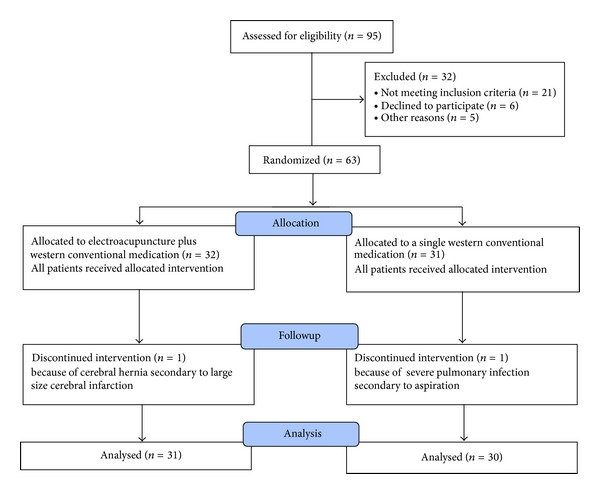
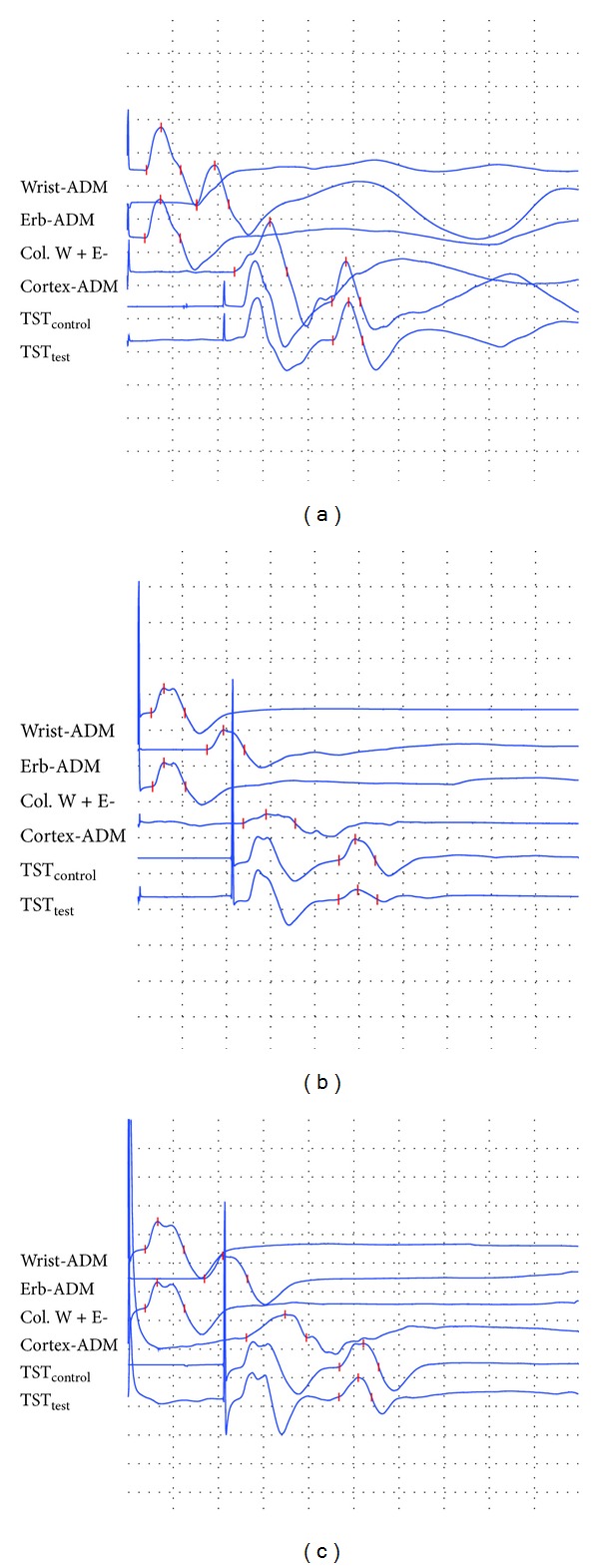
The objective of this pilot study was to objectively assess electroacupuncture for motor function recovery in patients with acute ischemic stroke using the triple-stimulation technique (TST). The patients received either electroacupuncture plus western conventional medication (WCM) (n = 32) or single WCM (n = 31) for 14 days. The total clinical effective rate was statistically significantly superior in electroacupuncture group to that in WCM group (P < 0.01). Fugl-Meyer Assessment Scale (FMA) score, National Institutes of Health Stroke Scale (NIHSS) score, and TSTratio were statistically more significant in electroacupuncture group than those in WCM group (P < 0.01). There was positive correlation between TSTratio and NIHS score both before and after treatment (P < 0.01) and negative correlation between TSTratio and FAM score both before treatment and after treatment (P < 0.01). Comparing between the two groups or between pretreatment and posttreatment, adverse events, electrocardiogram, liver function, and kidney function showed no statistically significant difference (P > 0.05). In conclusion, electroacupuncture was beneficial for the motor function recovery of patients with acute ischemic stroke and was generally safe. TST can be used for quantitative evaluation of electroacupuncture for motor function recovery in patients with acute ischemic stroke because it can objectively analyze the injury and recovery of corticospinal tract impairments.
本研究旨在采用三重刺激技术(TST)客观评估电针对急性缺血性脑卒中患者运动功能恢复的作用。患者接受电针加西药常规治疗(WCM)(n = 32)或单纯 WCM(n = 31)治疗 14 天。电针组的总临床有效率明显高于 WCM 组(P < 0.01)。电针组 Fugl-Meyer 评估量表(FMA)评分、美国国立卫生研究院卒中量表(NIHSS)评分和 TSTratio 均明显优于 WCM 组(P < 0.01)。治疗前后 TSTratio 与 NIHSS 评分均呈正相关(P < 0.01),治疗前后 TSTratio 与 FMA 评分均呈负相关(P < 0.01)。两组间或治疗前后比较,不良反应、心电图、肝功能、肾功能均无统计学差异(P > 0.05)。结论:电针对急性缺血性脑卒中患者的运动功能恢复有益,且一般安全。TST 可用于评估电针对急性缺血性脑卒中患者运动功能恢复的疗效,因为它可以客观分析皮质脊髓束损伤和恢复情况。