Wu Dandong, Ma Jingxi, Zhang Liping, Wang Sanrong, Tan Botao, Jia Gongwei
Department of Rehabilitation Medicine, The Second Affiliated Hospital of Chongqing Medical University, 76 Linjiang Road, Yuzhong District, Chongqing 400010, China.
Department of Neurology, Chongqing General Hospital, University of Chinese Academy of Sciences, Yuzhong District, Chongqing 400013, China.
Neural Plast. 2020 Aug 1;2020:8841752. doi: 10.1155/2020/8841752. eCollection 2020.
Transcutaneous auricular vagus nerve stimulation (taVNS) is regarded as a potential method for recovery in stroke. The effectiveness of taVNS in acute and subacute stroke should be further discussed as previously, only a few small-scale trials have focused on chronic stroke patients. The objective of this study is to investigate the effect and safety of taVNS on upper limb motor function in subacute ischemic stroke patients.
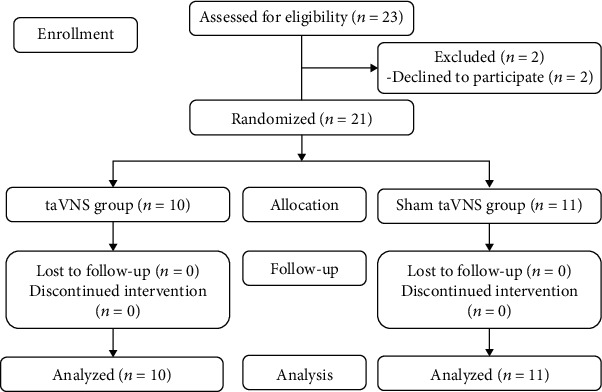
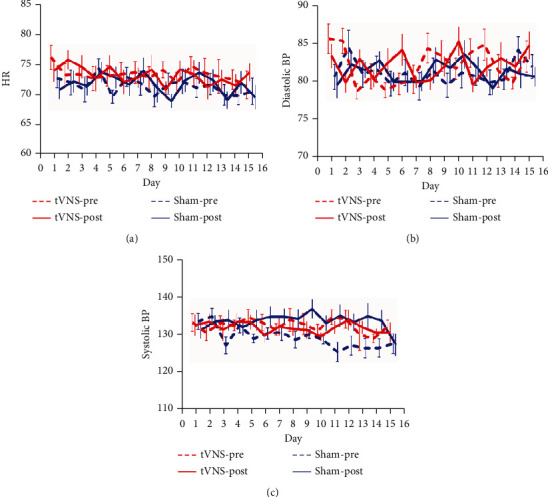
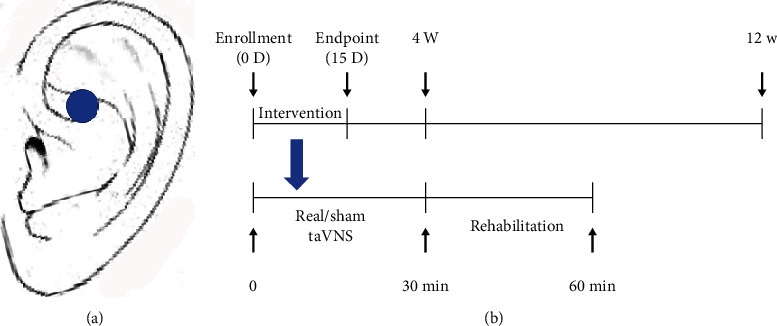
Twenty-one subacute ischemia stroke patients with single upper limb motor function impairment were enrolled and randomly assigned to conventional rehabilitation training with real or sham taVNS, delivered for 15 consecutive days. Electrodes were fixed to the cymba conchae of the left ear with or without electrical stimulation. Conventional rehabilitation training was performed immediately after the end of real or sham taVNS by the same therapists. Baseline assessments were performed on day 0 of enrollment, and posttreatment evaluations were performed at 15 days, 4 weeks, and 12 weeks after the first intervention. The assessment included the upper limb Fugl-Meyer assessment (FMA-U), the Wolf motor function test (WMFT), the Functional Independence Measurement (FIM), and Brunnstrom stage. Heart rate (HR) and blood pressure (BP) were measured before and after each taVNS intervention. At the same time, any adverse effects were observed during the procedure. Outcomes were assessed by a blind evaluator.
There were no significant differences in FMA-U, WMFT, FIM, and Brunnstrom scores between the two groups at baseline ( > 0.05). At the endpoint, the FMA-U, WMFT, and FIM scores were significantly higher than before treatment ( < 0.05), and there was a significantly greater improvement of those measurements in taVNS group compared with sham-taVNS group ( < 0.05). Significant improvements in FMA-U score were found between groups at follow-up. Only one case of skin redness occurred during the study.
This study revealed that taVNS appeared to be beneficial to the recovery of upper limb motor function in subacute ischemia stroke patients without obvious adverse effects. . This trial is registered with ChiCTR1800019635 on 20 November 2018 (http://www.chictr.org.cn/showproj.aspx?proj=32961).
经皮耳迷走神经刺激(taVNS)被视为一种促进中风恢复的潜在方法。由于之前仅有少数小规模试验聚焦于慢性中风患者,taVNS在急性和亚急性中风中的有效性仍有待进一步探讨。本研究旨在探究taVNS对亚急性缺血性中风患者上肢运动功能的影响及安全性。
纳入21例患有单侧上肢运动功能障碍的亚急性缺血性中风患者,并将其随机分为接受真实或假刺激taVNS的常规康复训练组,连续治疗15天。电极固定于左耳耳甲腔,给予或不给予电刺激。真实或假刺激taVNS结束后,由同一名治疗师立即进行常规康复训练。在入组第0天进行基线评估,并在首次干预后的15天、4周和12周进行治疗后评估。评估内容包括上肢Fugl-Meyer评估(FMA-U)、Wolf运动功能测试(WMFT)、功能独立性测量(FIM)以及Brunnstrom分期。在每次taVNS干预前后测量心率(HR)和血压(BP)。同时,观察治疗过程中出现的任何不良反应。结果由一名盲法评估者进行评估。
两组在基线时的FMA-U、WMFT、FIM和Brunnstrom评分无显著差异(>0.05)。在研究终点,FMA-U、WMFT和FIM评分显著高于治疗前(<0.05),与假刺激taVNS组相比,taVNS组这些测量指标的改善更为显著(<0.05)。随访期间,两组间FMA-U评分有显著改善。研究期间仅出现1例皮肤发红。
本研究表明,taVNS似乎有助于亚急性缺血性中风患者上肢运动功能的恢复,且无明显不良反应。本试验于2018年11月20日在中国临床试验注册中心注册,注册号为ChiCTR1800019635(http://www.chictr.org.cn/showproj.aspx?proj=32961)。