Department of Epidemiology and Public Health, Swiss Tropical and Public Health Institute, Basel, Switzerland.
PLoS One. 2013 Jun 20;8(6):e65722. doi: 10.1371/journal.pone.0065722. Print 2013.
More than 1 billion people are currently infected with soil-transmitted helminths and schistosomes. The global strategy to control helminthiases is the regular administration of anthelmintic drugs to at-risk populations. However, rapid re-infection occurs in areas where hygiene, access to clean water, and sanitation are inadequate.
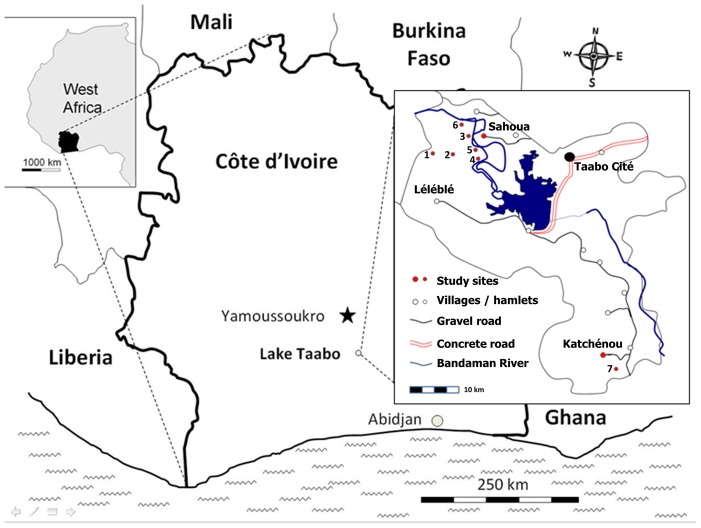
In July 2011, inhabitants from two villages and seven hamlets of the Taabo health demographic surveillance system in south-central Côte d'Ivoire provided stool and urine samples. Kato-Katz and ether-concentration methods were used for the diagnosis of Schistosoma mansoni, soil-transmitted helminths (Ascaris lumbricoides, Trichuris trichiura, and hookworm), and intestinal protozoa. Urine samples were subjected to a filtration method for the diagnosis of Schistosoma haematobium. A questionnaire was administered to households to obtain information on knowledge, attitude, practice, and beliefs in relation to hygiene, sanitation, and defecation behavior. Logistic regression models were employed to assess for associations between questionnaire data and parasitic infections.
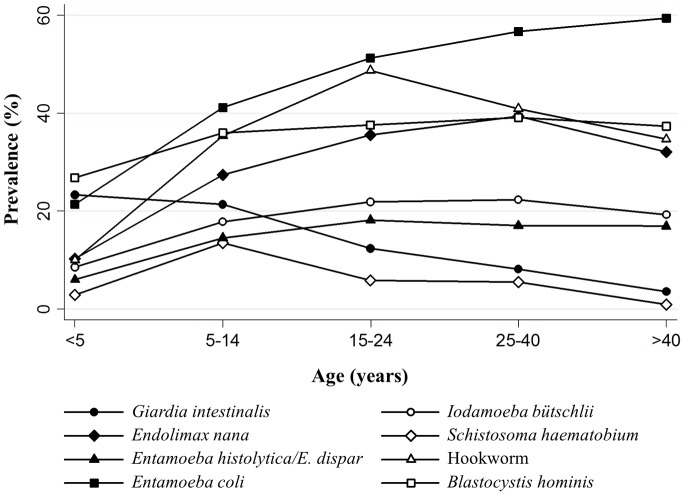
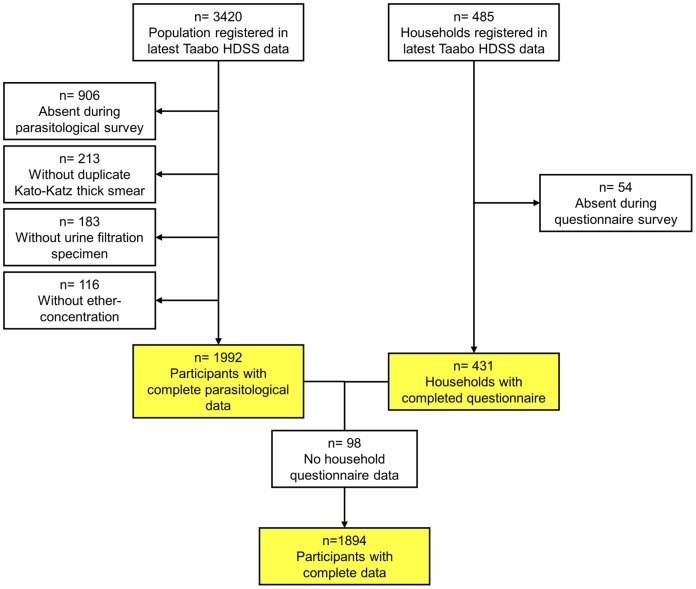
A total of 1,894 participants had complete data records. Parasitological examinations revealed prevalences of hookworm, S. haematobium, T. trichiura, S. mansoni, and A. lumbricoides of 33.5%, 7.0%, 1.6%, 1.3% and 0.8%, respectively. Giardia intestinalis and Entamoeba histolytica/E. dispar were detected in 15.0% and 14.4% of the participants, respectively. Only one out of five households reported the presence of a latrine, and hence, open defecation was common. Logistic regression analysis revealed that age, sex, socioeconomic status, hygiene, and defecation behavior are determinants for helminths and intestinal protozoa infections.
CONCLUSIONS/SIGNIFICANCE: We found that inadequate sanitation and hygiene behavior are associated with soil-transmitted helminths and intestinal protozoa infections in the Taabo area of south-central Côte d'Ivoire. Our data will serve as a benchmark to monitor the effect of community-led total sanitation and hygiene education to reduce the transmission of helminthiases and intestinal protozoa infections.
目前,全球有超过 10 亿人感染了土源性蠕虫和血吸虫病。全球控制蠕虫病的战略是定期向高危人群提供驱虫药物。然而,在卫生、清洁水和环境卫生条件不足的地区,迅速重新感染的情况时有发生。
2011 年 7 月,来自科特迪瓦中南部 Taabo 卫生人口监测系统的两个村庄和七个小村庄的居民提供了粪便和尿液样本。采用加藤厚涂片法和乙醚浓集法诊断曼氏血吸虫、土源性蠕虫(蛔虫、鞭虫和钩虫)和肠道原生动物。尿液样本采用过滤法诊断埃及血吸虫。向家庭发放问卷,以获取有关卫生、环境卫生和排便行为的知识、态度、实践和信念方面的信息。采用逻辑回归模型评估问卷数据与寄生虫感染之间的关联。
共有 1894 名参与者有完整的数据记录。寄生虫学检查显示,钩虫、埃及血吸虫、鞭虫、曼氏血吸虫和蛔虫的流行率分别为 33.5%、7.0%、1.6%、1.3%和 0.8%。15.0%的参与者检测到贾第虫和溶组织内阿米巴/迪斯帕内阿米巴,14.4%的参与者检测到溶组织内阿米巴/迪斯帕内阿米巴。只有五分之一的家庭报告有厕所,因此,随地排便很常见。逻辑回归分析显示,年龄、性别、社会经济地位、卫生和排便行为是蠕虫和肠道原生动物感染的决定因素。
结论/意义:我们发现,在科特迪瓦中南部 Taabo 地区,卫生和卫生行为不足与土源性蠕虫和肠道原生动物感染有关。我们的数据将作为一个基准,用于监测社区主导的全民卫生和卫生教育对减少蠕虫病和肠道原生动物感染传播的效果。