Swiss Centre for International Health, Swiss Tropical and Public Health Institute, P.O. Box, CH-4002 Basel, Switzerland.
Parasit Vectors. 2011 Oct 7;4:195. doi: 10.1186/1756-3305-4-195.
Intestinal parasitic infections represent a public health problem in Tajikistan, but epidemiological evidence is scarce. The present study aimed at assessing the extent of helminths and intestinal protozoa infections among children of 10 schools in four districts of Tajikistan, and to make recommendations for control.
A cross-sectional survey was carried out in early 2009. All children attending grades 2 and 3 (age: 7-11 years) from 10 randomly selected schools were invited to provide a stool sample and interviewed about sanitary situation and hygiene behaviour. A questionnaire pertaining to demographic and socioeconomic characteristics was addressed to the heads of households. On the spot, stool samples were subjected to duplicate Kato-Katz thick smear examination for helminth diagnosis. Additionally, 1-2 g of stool was fixed in sodium acetate-acetic acid-formalin, transferred to a specialised laboratory in Europe and examined for helminths and intestinal protozoa. The composite results from both methods served as diagnostic 'gold' standard.
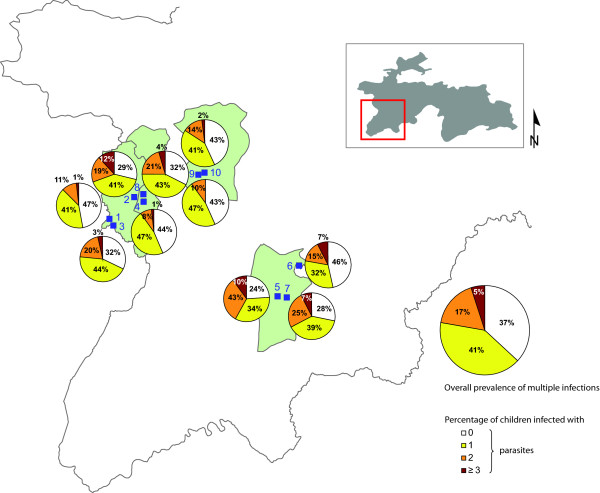
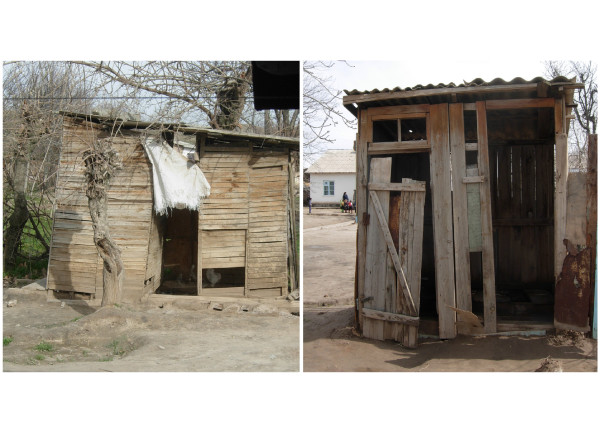
Out of 623 registered children, 602 participated in our survey. The overall prevalence of infection with helminths and pathogenic intestinal protozoa was 32.0% and 47.1%, respectively. There was pronounced spatial heterogeneity. The most common helminth species was Hymenolepis nana (25.8%), whereas the prevalences of Ascaris lumbricoides, hookworm and Enterobius vermicularis were below 5%. The prevalence of pathogenic intestinal protozoa, namely Giardia intestinalis and Entamoeba histolytica/E. dispar was 26.4% and 25.9%, respectively. Almost half of the households draw drinking water from unimproved sources, such as irrigation canals, rivers and unprotected wells. Sanitary facilities were pit latrines, mostly private, and a few shared with neighbours. The use of public tap/standpipe as a source of drinking water emerged as a protective factor for G. intestinalis infection. Protected spring water reduced the risk of infection with E. histolytica/E. dispar and H. nana.
Our data obtained from the ecological 'lowland' areas in Tajikistan call for school-based deworming (recommended drugs: albendazole and metronidazole), combined with hygiene promotion and improved sanitation. Further investigations are needed to determine whether H. nana represents a public health problem.
肠道寄生虫感染是塔吉克斯坦的一个公共卫生问题,但缺乏流行病学证据。本研究旨在评估塔吉克斯坦四个地区 10 所学校的儿童的蠕虫和肠道原生动物感染程度,并为控制提供建议。
2009 年初进行了横断面调查。邀请所有就读于随机选择的 10 所学校 2 年级和 3 年级(年龄:7-11 岁)的儿童提供粪便样本,并就卫生状况和卫生行为进行访谈。向家庭负责人发放一份关于人口和社会经济特征的调查问卷。当场,粪便样本用双份加藤厚涂片法进行蠕虫诊断。此外,1-2 克粪便用醋酸钠-乙酸-福尔马林固定,转移到欧洲的一个专门实验室,检查蠕虫和肠道原生动物。两种方法的综合结果作为诊断“金”标准。
在登记的 623 名儿童中,有 602 名参加了我们的调查。感染蠕虫和致病性肠道原生动物的总患病率分别为 32.0%和 47.1%。存在明显的空间异质性。最常见的蠕虫物种是细粒棘球绦虫(25.8%),而蛔虫、钩虫和毛首鞭形线虫的患病率低于 5%。致病性肠道原生动物,即贾第虫和溶组织内阿米巴/迪斯帕阿米巴的患病率分别为 26.4%和 25.9%。几乎一半的家庭从灌溉渠、河流和无保护的水井等未经改良的水源中取水。卫生设施是坑式厕所,大多是私人的,少数与邻居共用。使用公共水龙头/饮水站作为饮用水源是感染贾第虫的保护因素。受保护的泉水降低了感染溶组织内阿米巴/迪斯帕阿米巴和细粒棘球绦虫的风险。
我们从塔吉克斯坦生态“低地”地区获得的数据呼吁开展以学校为基础的驱虫(推荐药物:阿苯达唑和甲硝唑),并结合卫生促进和改善卫生条件。需要进一步调查以确定细粒棘球绦虫是否构成公共卫生问题。