Swiss Tropical and Public Health Institute, P.O. Box, CH-4002, Basel, Switzerland.
University of Basel, P.O. Box, CH-4003, Basel, Switzerland.
Parasit Vectors. 2018 Feb 27;11(1):115. doi: 10.1186/s13071-018-2642-x.
Preventive chemotherapy with donated anthelminthic drugs is the cornerstone for the control of helminthiases. However, reinfection can occur rapidly in the absence of clean water and sanitation coupled with unhygienic behaviour. The purpose of this study was to assess the effect of an integrated package of interventions, consisting of preventive chemotherapy, community-led total sanitation (CLTS) and health education, on the prevalence of helminth and intestinal protozoa infections and on participants' knowledge, attitude, practice and beliefs (KAPB) towards these diseases including water, sanitation and hygiene (WASH).
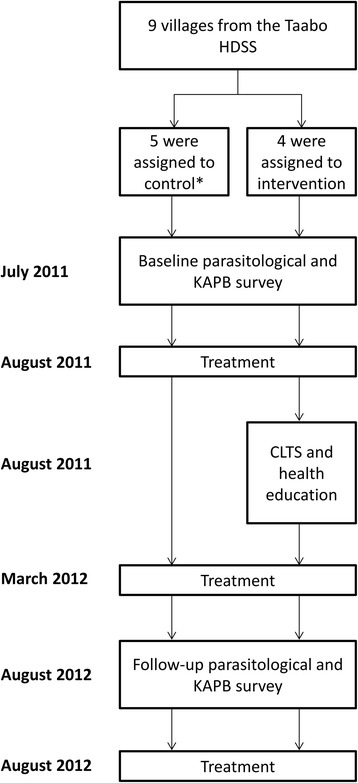
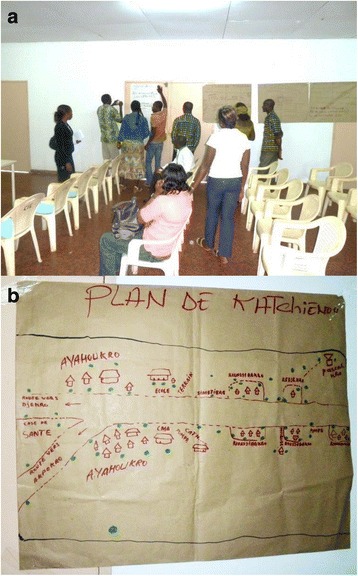
A cross-sectional survey was carried out in nine communities of south-central Côte d'Ivoire to assess people's infection with helminths and intestinal protozoa and KAPB. Subsequently, interventions were targeted to five communities, while the remaining communities served as control. The intervention encouraged latrine construction and an evaluation was done 6-7 months later to determine open defecation status of the respective communities. Anthelminthic treatment was provided to all community members. A follow-up cross-sectional survey was conducted approximately one year later, using the same procedures.
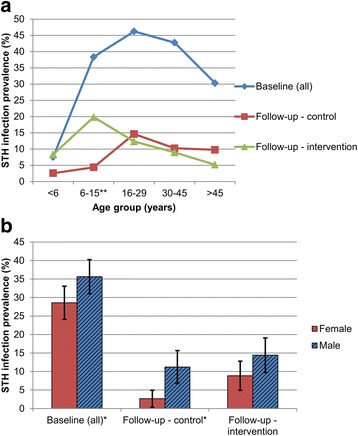
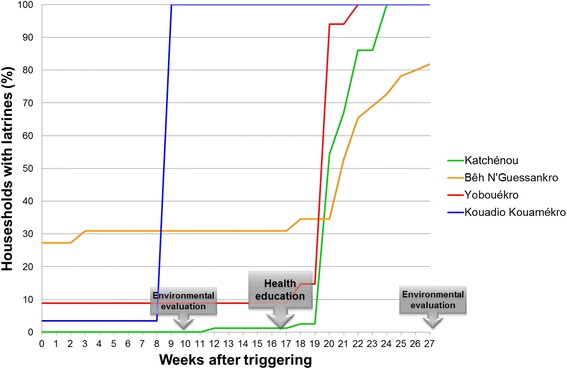
Overall, 810 people had complete baseline and follow-up data and were given anthelminthic treatment. The baseline prevalence of hookworm, Schistosoma haematobium, Trichuris trichiura, Schistosoma mansoni and Ascaris lumbricoides was 31.1%, 7.0%, 2.0%, 1.0% and 0.3%, respectively. Four of the five intervention communities were classified open-defecation free. For hookworm infection, we observed higher negative changes in terms of proportion of decrease (-0.10; 95% confidence interval (CI): - 0.16, -0.04) and higher egg reduction rate (64.9 vs 15.2%) when comparing intervention with control communities. For intestinal protozoa, prevalence reduction was higher in intervention compared to control communities (8.2 vs 2.6%) and WASH indicators and intervention outcomes associated with lower odds for infection at follow-up. The intervention significantly impacted on reported latrine use (before: 15.5%, after: 94.6%), open defecation in the community surroundings (before: 75.0%, after: 16.7%) and awareness for environmental contamination through open defecation (before: 20.4%, after: 52.2%).
An integrated package of interventions consisting of preventive chemotherapy, health education and CLTS reduces the prevalence of helminth and intestinal protozoa infection. Additional studies in other social-ecological settings are warranted to confirm our findings.
捐赠的驱虫药物预防性化疗是控制蠕虫病的基石。然而,如果没有清洁水和卫生设施,再加上不卫生的行为,很快就会再次感染。本研究的目的是评估综合干预措施(包括预防性化疗、社区主导的整体环境卫生和健康教育)对蠕虫和肠道原生动物感染的影响,以及对参与者对这些疾病(包括水、环境卫生和个人卫生)的知识、态度、实践和信念(KAPB)的影响。
在科特迪瓦中南部的 9 个社区进行了横断面调查,以评估人们感染蠕虫和肠道原生动物的情况以及 KAPB。随后,对 5 个社区进行了干预,而其余社区则作为对照。干预措施鼓励建造厕所,并在 6-7 个月后进行评估,以确定各自社区的露天排便状况。对所有社区成员进行驱虫治疗。大约一年后,使用相同的程序进行了后续的横断面调查。
共有 810 人完成了基线和随访数据,并接受了驱虫治疗。钩虫、埃及血吸虫、鞭虫、曼氏血吸虫和蛔虫的基线患病率分别为 31.1%、7.0%、2.0%、1.0%和 0.3%。五个干预社区中有四个被归类为无露天排便。对于钩虫感染,与对照组相比,干预组在比例下降(-0.10;95%置信区间(CI):-0.16,-0.04)和卵减少率(64.9%对 15.2%)方面有更高的负变化。与对照组相比,肠道原生动物的患病率下降在干预组更高(8.2%对 2.6%),与感染相关的个人卫生和干预措施与较低的感染几率相关。干预措施显著影响了报告的厕所使用率(之前:15.5%,之后:94.6%)、社区周围的露天排便(之前:75.0%,之后:16.7%)和对通过露天排便造成的环境污染的认识(之前:20.4%,之后:52.2%)。
包括预防性化疗、健康教育和社区主导的整体环境卫生在内的综合干预措施可降低蠕虫和肠道原生动物感染的患病率。需要在其他社会生态环境中进行更多的研究来证实我们的发现。