Laboratoire de Neurosciences Cognitives (LNC), INSERM U960, and Institut d'Etudes de la Cognition (IEC), Ecole Normale Supérieure (ENS), Paris, France.
PLoS One. 2013 Jun 28;8(6):e67371. doi: 10.1371/journal.pone.0067371. Print 2013.
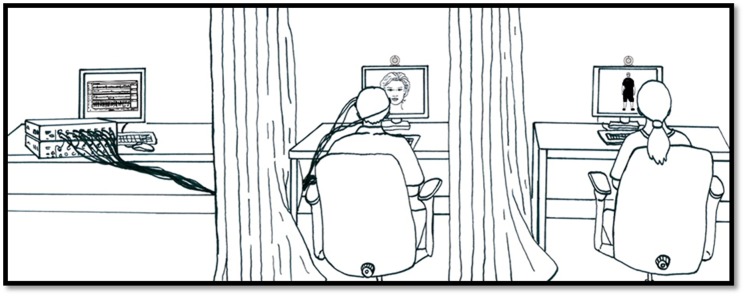
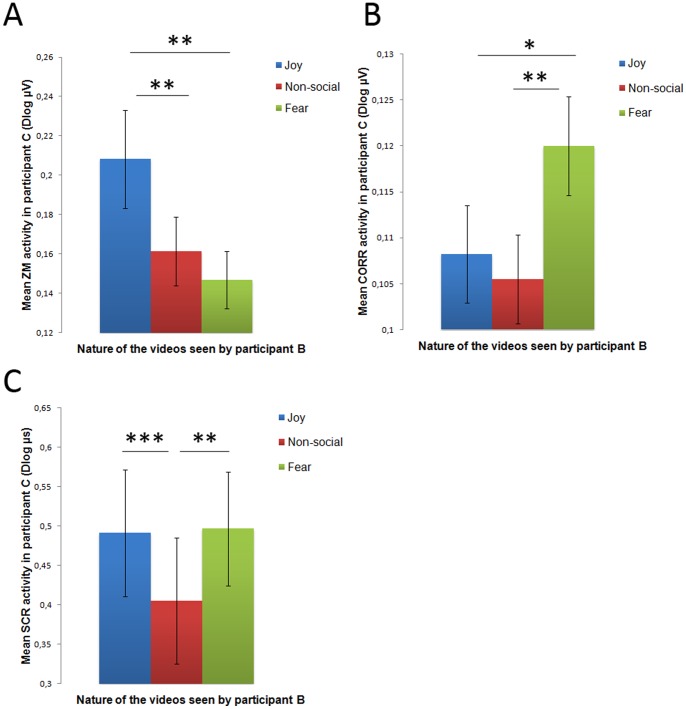
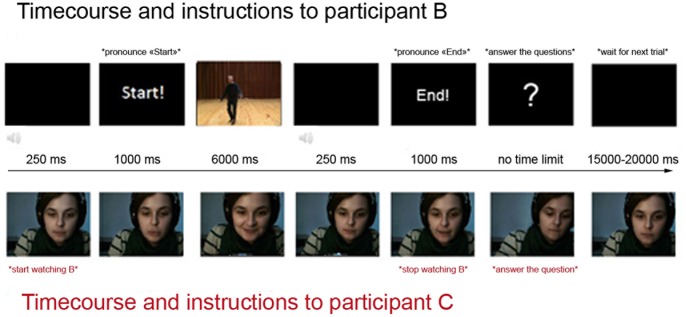
Little is known about the spread of emotions beyond dyads. Yet, it is of importance for explaining the emergence of crowd behaviors. Here, we experimentally addressed whether emotional homogeneity within a crowd might result from a cascade of local emotional transmissions where the perception of another's emotional expression produces, in the observer's face and body, sufficient information to allow for the transmission of the emotion to a third party. We reproduced a minimal element of a crowd situation and recorded the facial electromyographic activity and the skin conductance response of an individual C observing the face of an individual B watching an individual A displaying either joy or fear full body expressions. Critically, individual B did not know that she was being watched. We show that emotions of joy and fear displayed by A were spontaneously transmitted to C through B, even when the emotional information available in B's faces could not be explicitly recognized. These findings demonstrate that one is tuned to react to others' emotional signals and to unintentionally produce subtle but sufficient emotional cues to induce emotional states in others. This phenomenon could be the mark of a spontaneous cooperative behavior whose function is to communicate survival-value information to conspecifics.
目前对于情绪在双元体之外的传播知之甚少。然而,对于解释群体行为的出现,这一点很重要。在这里,我们通过实验解决了这样一个问题:即群体内部的情绪同质性是否可能源于局部情绪传递的级联,在这种级联中,观察者对面部表情的感知会在观察者的面部和身体上产生足够的信息,从而将情绪传递给第三方。我们重现了一种群体情境的最小元素,并记录了个体 C 的面部肌电图活动和皮肤电导率反应,C 观察个体 B 观看个体 A 展示的快乐或恐惧的全身表情。关键的是,个体 B 并不知道她正在被观察。我们表明,即使 B 面部的情绪信息无法被明确识别,A 所展示的快乐和恐惧情绪也会通过 B 自发地传递给 C。这些发现表明,一个人能够对他人的情绪信号做出反应,并无意识地产生微妙但足够的情绪暗示,从而在他人身上引起情绪状态。这种现象可能是一种自发的合作行为的标志,其功能是向同类传达生存价值信息。