Nagy Stanislav, Wright Charles, Tramm Nora, Labello Nicholas, Burov Stanislav, Biron David
Institute for Biophysical Dynamics, University of Chicago , Chicago , United States.
Elife. 2013 Jul 2;2:e00782. doi: 10.7554/eLife.00782.
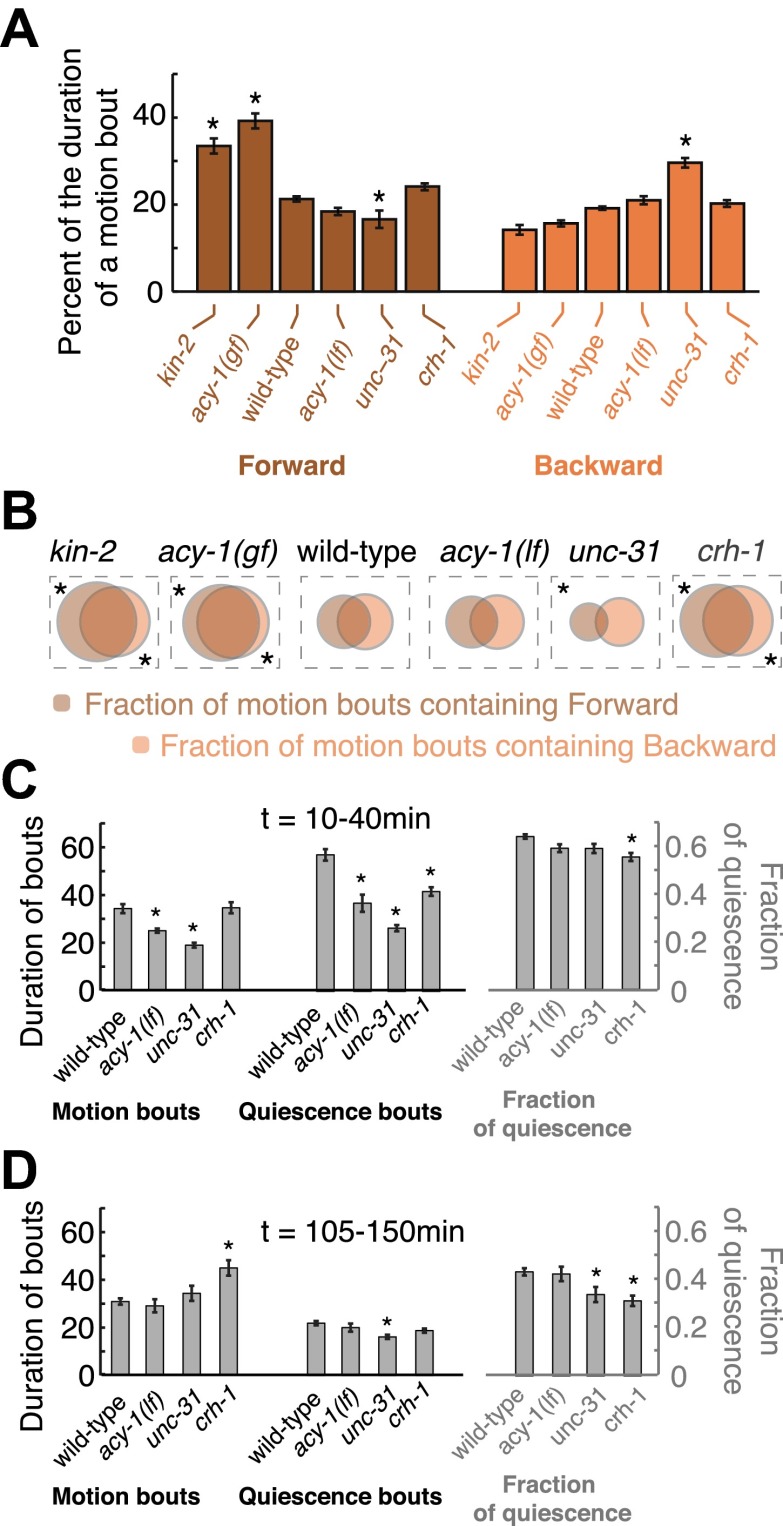
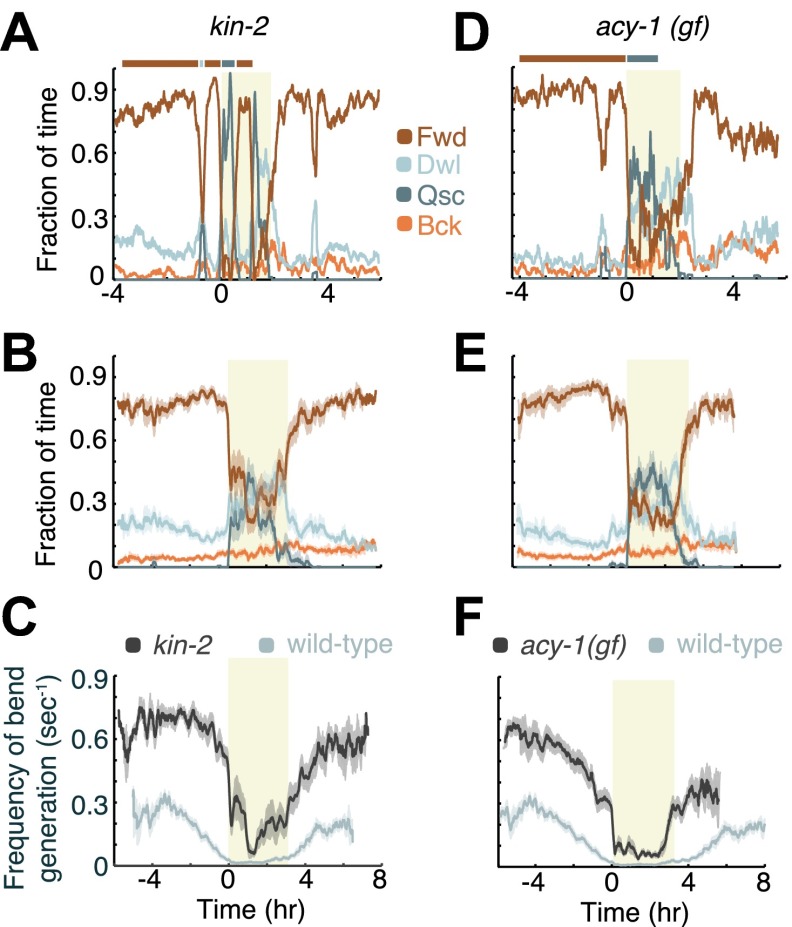
Despite their simplicity, longitudinal studies of invertebrate models are rare. We thus sought to characterize behavioral trends of Caenorhabditis elegans, from the mid fourth larval stage through the mid young adult stage. We found that, outside of lethargus, animals exhibited abrupt switching between two distinct behavioral states: active wakefulness and quiet wakefulness. The durations of epochs of active wakefulness exhibited non-Poisson statistics. Increased Gαs signaling stabilized the active wakefulness state before, during and after lethargus. In contrast, decreased Gαs signaling, decreased neuropeptide release, or decreased CREB activity destabilized active wakefulness outside of, but not during, lethargus. Taken together, our findings support a model in which protein kinase A (PKA) stabilizes active wakefulness, at least in part through two of its downstream targets: neuropeptide release and CREB. However, during lethargus, when active wakefulness is strongly suppressed, the native role of PKA signaling in modulating locomotion and quiescence may be minor. DOI:http://dx.doi.org/10.7554/eLife.00782.001.
尽管无脊椎动物模型的纵向研究很简单,但却很少见。因此,我们试图描述秀丽隐杆线虫从第四幼虫中期到年轻成虫中期的行为趋势。我们发现,在嗜睡期之外,动物表现出两种不同行为状态之间的突然转换:活跃清醒和安静清醒。活跃清醒时期的持续时间呈现非泊松统计特征。在嗜睡期之前、期间和之后,增加的Gαs信号传导稳定了活跃清醒状态。相比之下,在嗜睡期之外(但不是在嗜睡期期间),降低的Gαs信号传导、减少的神经肽释放或降低的CREB活性会破坏活跃清醒状态的稳定性。综上所述,我们的研究结果支持一种模型,即蛋白激酶A(PKA)至少部分通过其两个下游靶点:神经肽释放和CREB来稳定活跃清醒状态。然而,在嗜睡期,当活跃清醒受到强烈抑制时,PKA信号传导在调节运动和静止方面的天然作用可能较小。DOI:http://dx.doi.org/10.7554/eLife.00782.001