Department of Parasitology, Medical College, Zhengzhou University, Zhengzhou 450052, China.
Biomed Res Int. 2013;2013:139745. doi: 10.1155/2013/139745. Epub 2013 Jun 13.
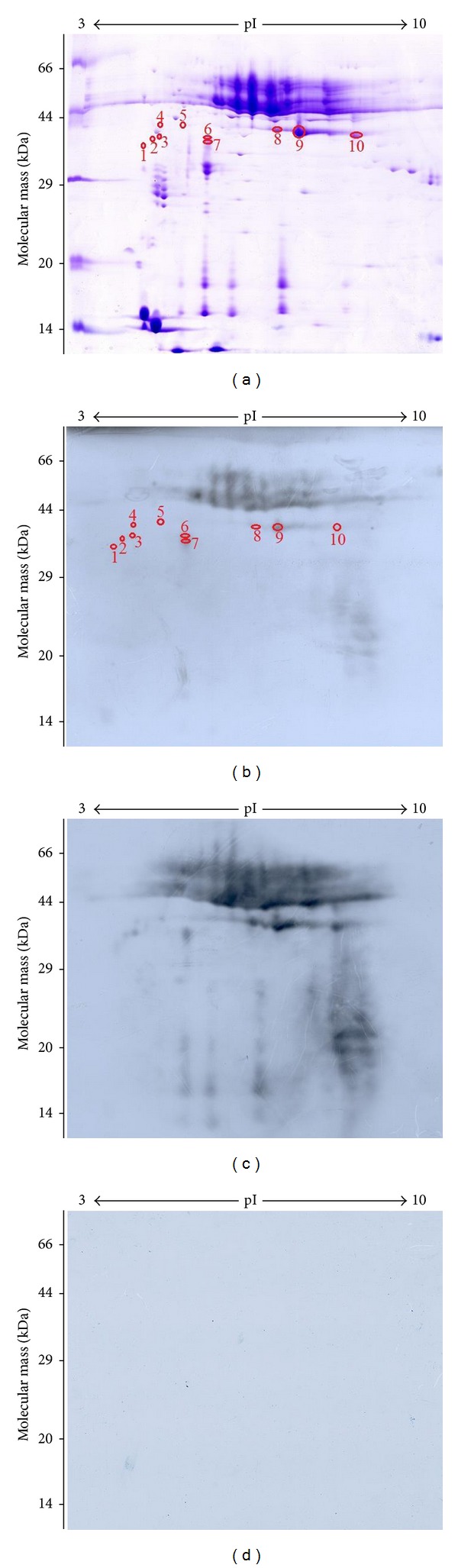
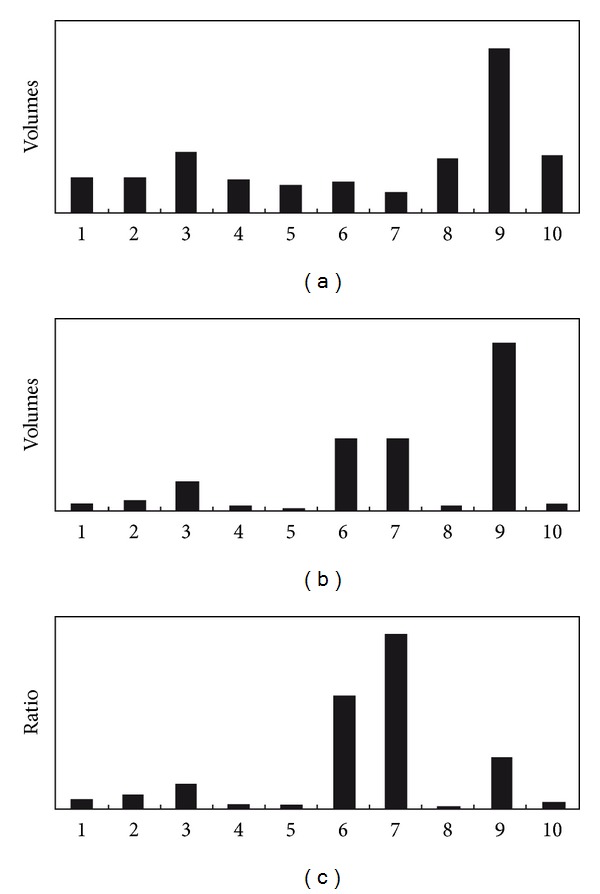
Although the excretory-secretory (ES) proteins of Trichinella spiralis muscle larvae are the most commonly used diagnostic antigens for trichinellosis, their main disadvantage is the false negative results during the early stage of infection and cross-reaction of their main components (43, 45, 49, and 53 kDa) with sera of patients with other helminthiasis. The aim of this study was to identify early specific diagnostic antigens in T. spiralis ES proteins with 30-40 kDa. The ES proteins were analyzed by two-dimensional electrophoresis (2-DE), and a total of approximately 150 proteins spots were detected with isoelectric point (pI) varying from 4 to 7 and molecular weight from 14 to 66 kDa. When probed with sera from infected mice at 18 days postinfection, ten protein spots with molecular weight of 30-40 kDa were recognized and identified by MALDI-TOF/TOF-MS. All of ten spots were successfully identified and characterized to correlate with five different proteins, including two potential serine proteases, one antigen targeted by protective antibodies, one deoxyribonuclease (DNase) II, and one conserved hypothetical protein. These proteins might be the early specific diagnostic antigens for trichinellosis.
尽管旋毛虫肌肉幼虫的排泄/分泌(ES)蛋白是旋毛虫病最常用的诊断抗原,但它们的主要缺点是在感染早期会出现假阴性结果,并且其主要成分(43、45、49 和 53 kDa)与其他寄生虫病患者的血清发生交叉反应。本研究旨在鉴定旋毛虫 ES 蛋白中具有 30-40 kDa 的早期特异性诊断抗原。通过二维电泳(2-DE)分析 ES 蛋白,检测到等电点(pI)为 4-7、分子量为 14-66 kDa 的约 150 个蛋白质斑点。用感染后 18 天的感染小鼠的血清进行探测时,发现了 10 个分子量为 30-40 kDa 的蛋白斑点,并通过 MALDI-TOF/TOF-MS 进行鉴定。十个斑点均成功鉴定并与五个不同的蛋白质相关联,包括两个潜在的丝氨酸蛋白酶、一个保护性抗体靶向的抗原、一个脱氧核糖核酸酶(DNase)II 和一个保守的假设蛋白。这些蛋白质可能是旋毛虫病的早期特异性诊断抗原。