Pathak Rajesh Kumar, Taj Gohar, Pandey Dinesh, Arora Sandeep, Kumar Anil
Department of Molecular Biology & Genetic Engineering, College of Basic Sciences & Humanities, G.B. Pant University Of Agriculture & Technology, Pantnagar-263145, Uttarakhand, India.
Bioinformation. 2013 May 25;9(9):443-9. doi: 10.6026/97320630009443. Print 2013.
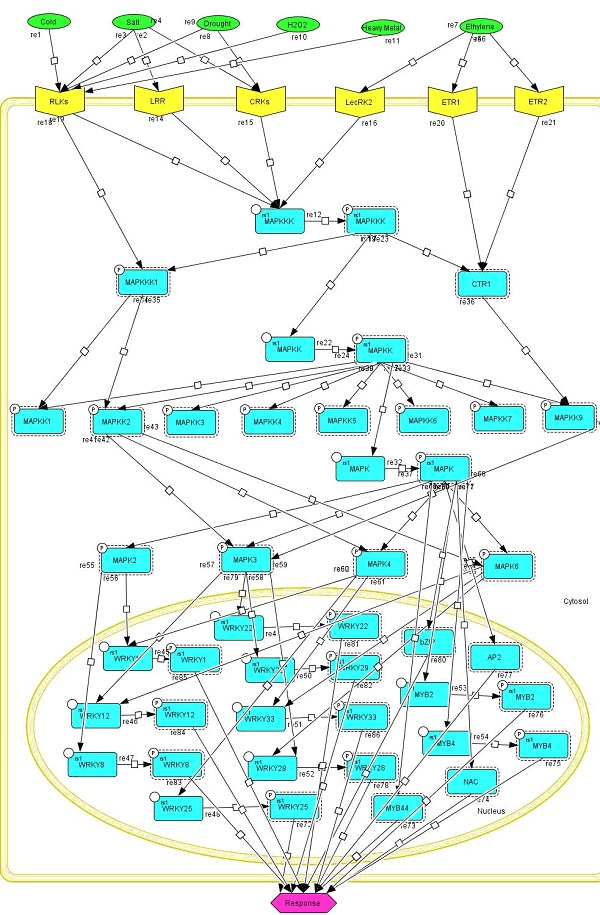
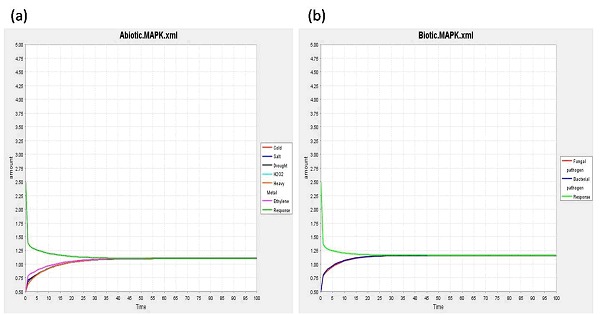
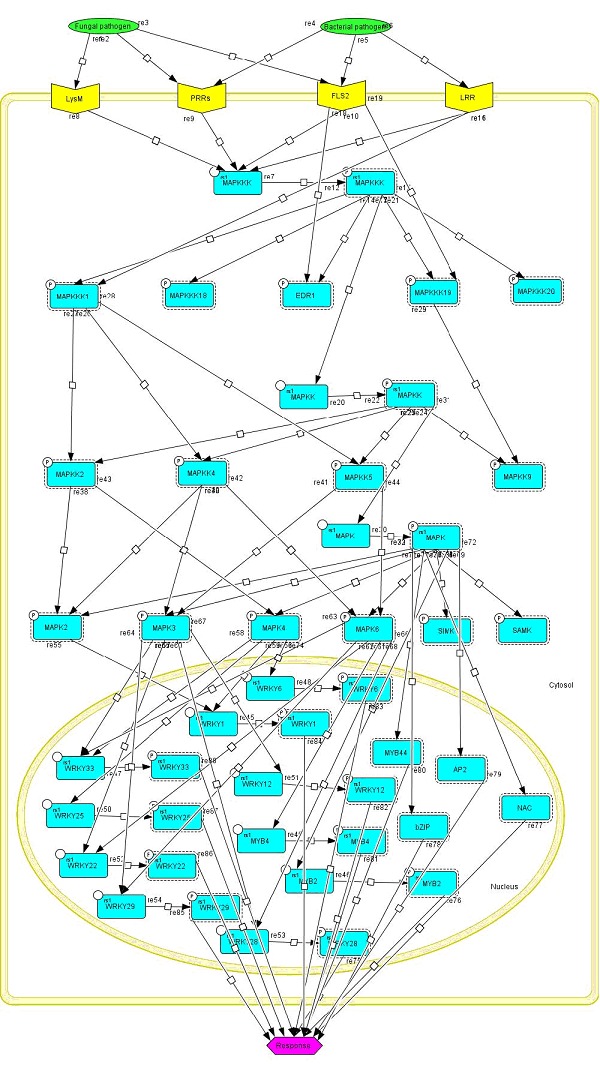
Mitogen-Activated Protein Kinases (MAPKs) cascade plays an important role in regulating plant growth and development, generating cellular responses to the extracellular stimuli. MAPKs cascade mainly consist of three sub-families i.e. mitogen-activated protein kinase kinase kinase (MAPKKK), mitogen-activated protein kinase kinase (MAPKK) and mitogen activated protein kinase (MAPK), several cascades of which are activated by various abiotic and biotic stresses. In this work we have modeled the holistic molecular mechanisms essential to MAPKs activation in response to several abiotic and biotic stresses through a system biology approach and performed its simulation studies. As extent of abiotic and biotic stresses goes on increasing, the process of cell division, cell growth and cell differentiation slow down in time dependent manner. The models developed depict the combinatorial and multicomponent signaling triggered in response to several abiotic and biotic factors. These models can be used to predict behavior of cells in event of various stresses depending on their time and exposure through activation of complex signaling cascades.
丝裂原活化蛋白激酶(MAPKs)级联在调节植物生长发育以及产生细胞对细胞外刺激的反应中发挥着重要作用。MAPKs级联主要由三个亚家族组成,即丝裂原活化蛋白激酶激酶激酶(MAPKKK)、丝裂原活化蛋白激酶激酶(MAPKK)和丝裂原活化蛋白激酶(MAPK),其中几个级联会被各种非生物和生物胁迫激活。在这项工作中,我们通过系统生物学方法对响应多种非生物和生物胁迫时MAPKs激活所必需的整体分子机制进行了建模,并进行了模拟研究。随着非生物和生物胁迫程度的不断增加,细胞分裂、细胞生长和细胞分化过程会以时间依赖的方式减缓。所开发出的模型描绘了响应多种非生物和生物因素时触发的组合式和多组分信号传导。这些模型可用于根据各种胁迫发生的时间和暴露情况,通过激活复杂的信号级联来预测细胞的行为。