Miller Christine L
MillerBio Baltimore, MD, USA.
Front Behav Neurosci. 2013 Jul 9;7:82. doi: 10.3389/fnbeh.2013.00082. eCollection 2013.
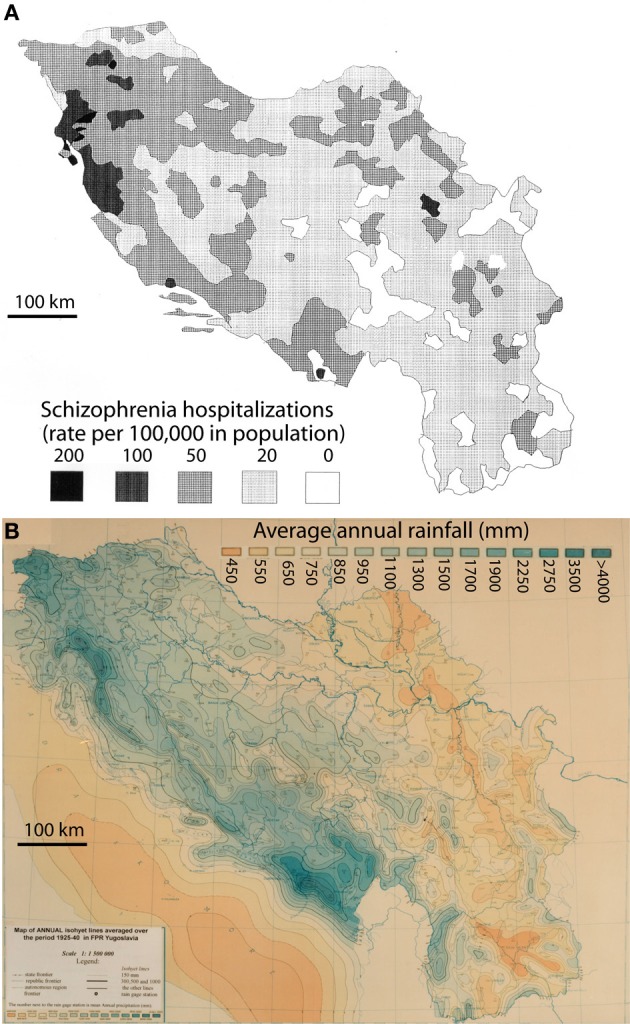
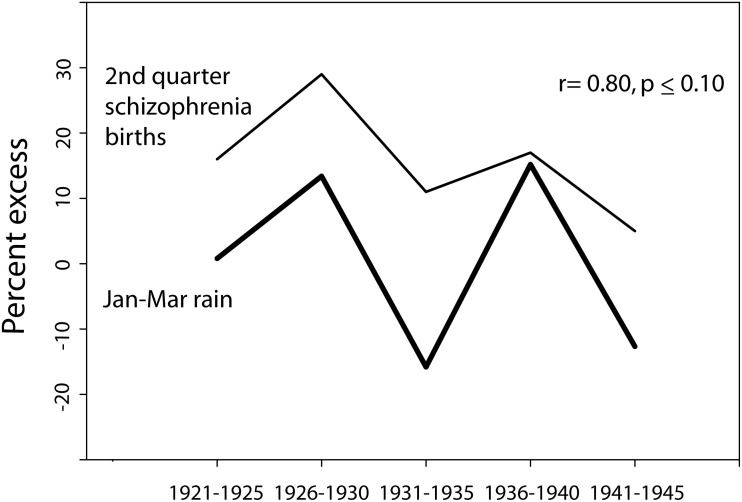
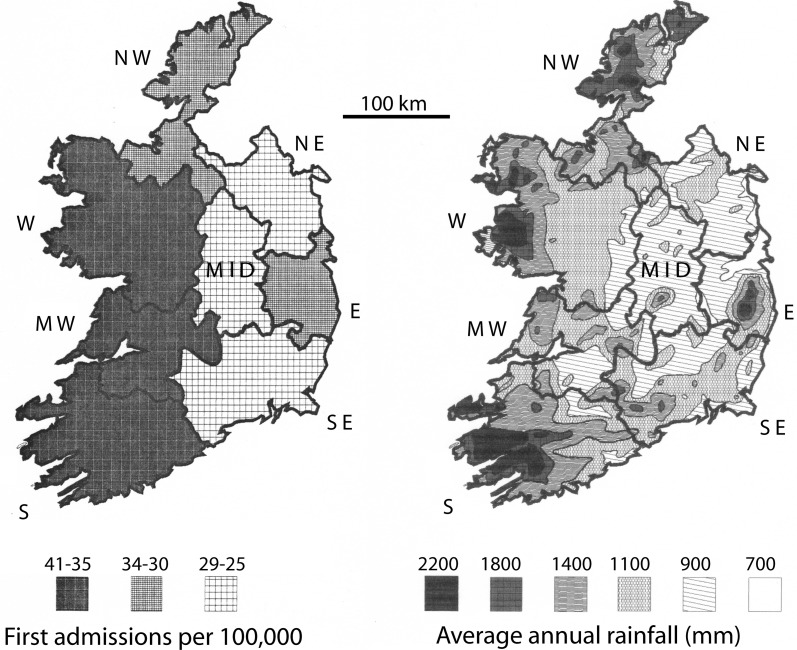
Numerous environmental factors have been identified as influential in the development of schizophrenia. Some are byproducts of modern life, yet others were present in our evolutionary past and persist to a lesser degree in the current era. The present study brings together published epidemiological data for schizophrenia and data on variables related to photic input for places of residence across geographical regions, using rainfall as an inverse, proxy measure for light levels. Data were gathered from the literature for two countries, the former Yugoslavia and Ireland, during a time in the early 20th century when mobility was relatively limited. The data for Yugoslavia showed a strong correlation between hospital census rates for schizophrenia (by place of birth) and annual rain (r = 0.96, p = 0.008). In Ireland, the hospital census rates and first admissions for schizophrenia (by place of permanent residence) showed a trend for correlation with annual rain, reaching significance for 1st admissions when the rainfall data was weighted by the underlying population distribution (r = 0.71, p = 0.047). In addition, across the years 1921-1945, birth-year variations in a spring quarter season-of-birth effect for schizophrenia in Ireland showed a trend for correlation with January-March rainfall (r = 0.80, p ≤ 0.10). The data are discussed in terms of the effect of photoperiod on the gestation and behavior of offspring in animals, and the premise is put forth that vestigial phenotypic plasticity for such photic cues still exists in humans. Moreover, genetic polymorphisms of risk identified for psychotic disorders include genes modulated by photoperiod and sunlight intensity. Such a relationship between phenotypic plasticity in response to a particular environmental regime and subsequent natural selection for fixed changes in the environmentally responsive genes, has been well studied in animals and should not be discounted when considering human disease.
众多环境因素已被确定为对精神分裂症的发展具有影响。有些是现代生活的副产品,而另一些则存在于我们的进化史中,并在当今时代以较低程度持续存在。本研究汇集了已发表的精神分裂症流行病学数据以及与不同地理区域居住地光输入相关变量的数据,使用降雨量作为光照水平的反向替代指标。数据是从20世纪初流动性相对有限时期的两个国家,即前南斯拉夫和爱尔兰的文献中收集的。南斯拉夫的数据显示,精神分裂症的医院普查率(按出生地)与年降雨量之间存在很强的相关性(r = 0.96,p = 0.008)。在爱尔兰,精神分裂症的医院普查率和首次入院率(按永久居住地)与年降雨量呈现出相关趋势,当降雨量数据按潜在人口分布加权时,首次入院率达到显著水平(r = 0.71,p = 0.047)。此外,在1921年至1945年期间,爱尔兰精神分裂症春季季度出生季节效应的出生年份变化与1月至3月降雨量呈现出相关趋势(r = 0.80,p≤0.10)。从光周期对动物后代的妊娠和行为的影响方面对这些数据进行了讨论,并提出了这样的前提,即人类中仍然存在针对此类光信号的残留表型可塑性。此外,已确定的精神障碍风险的基因多态性包括受光周期和阳光强度调节的基因。这种对特定环境状况的表型可塑性与随后对环境响应基因固定变化的自然选择之间的关系,在动物中已得到充分研究,在考虑人类疾病时不应被忽视。