• 文献检索
  • 文档翻译
  • 深度研究
  • 学术资讯
  • Suppr Zotero 插件Zotero 插件
  • 邀请有礼
  • 套餐&价格
  • 历史记录
应用&插件
Suppr Zotero 插件Zotero 插件浏览器插件Mac 客户端Windows 客户端微信小程序
定价
高级版会员购买积分包购买API积分包
服务
文献检索文档翻译深度研究API 文档MCP 服务
关于我们
关于 Suppr公司介绍联系我们用户协议隐私条款
关注我们

Suppr 超能文献

核心技术专利:CN118964589B侵权必究
粤ICP备2023148730 号-1Suppr @ 2026

文献检索

告别复杂PubMed语法,用中文像聊天一样搜索,搜遍4000万医学文献。AI智能推荐,让科研检索更轻松。

立即免费搜索

文件翻译

保留排版,准确专业,支持PDF/Word/PPT等文件格式,支持 12+语言互译。

免费翻译文档

深度研究

AI帮你快速写综述,25分钟生成高质量综述,智能提取关键信息,辅助科研写作。

立即免费体验

在脊髓灰质炎流行国家,到三级保健中心就诊的儿科患者未接种疫苗的原因。

Reasons for non-vaccination in pediatric patients visiting tertiary care centers in a polio-prone country.

机构信息

Dow Medical College, Dow University of Health Sciences, Baba-e-Urdu Road, Karachi 74200, Pakistan.

出版信息

Arch Public Health. 2013 Jul 13;71(1):19. doi: 10.1186/0778-7367-71-19.

DOI:10.1186/0778-7367-71-19
PMID:23848348
原文链接:https://pmc.ncbi.nlm.nih.gov/articles/PMC3716633/
Abstract

BACKGROUND

The Expanded Program on Immunization (EPI) was initiated by World Health Organization (WHO) in 1974 in order to save children from life threatening, disabling vaccine-preventable diseases (VPDs). In Pakistan, this program was launched in 1978 with the main objectives of eradicating polio by 2012, eliminating measles and neonatal tetanus by 2015, and minimizing the incidence of other VPDs. However, despite the efforts of government and WHO, this program has not received the amount of success that was desired. Hence, the objectives of this study were to elucidate the main reasons behind not achieving the full immunization coverage in Pakistan, the awareness of children's attendant about the importance of vaccination, their attitudes, thoughts and fears regarding childhood immunization, and the major hurdles faced in pursuit of getting their children vaccinated.

METHODS

This was an observational, cross-sectional, questionnaire-based study conducted during a one year period from 4th January, 2012 to 6th January, 2013 at the pediatric outpatient clinics of Civil Hospital (CHK) and National Institute of Child Health (NICH). We attempted to interview all the parents who could be approached during the period of the study. Thus, convenience sampling was employed. The parents were approached in the clinics and interviewed after seeking informed, written consent. Those patients who were not accompanied by either of their parents were excluded from the study. The study instrument comprised of three sections. The first section consisted was concerned with the demographics of the patient and the parents. The second section dealt with the reasons for complete vaccination or under-vaccination. The last section aimed to assess the knowledge, attitudes and beliefs of the respondents.

RESULTS

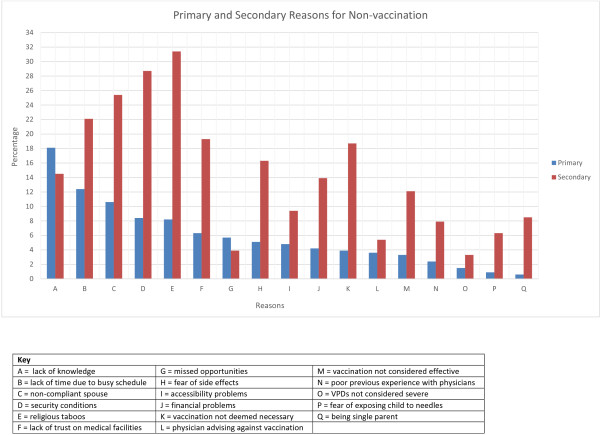
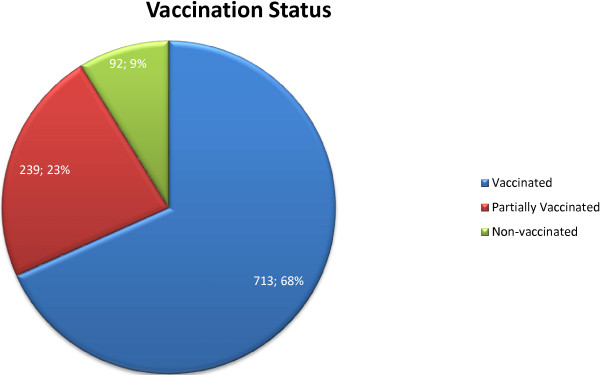
Out of 1044 patients, only 713(68.3%) were fully vaccinated, 239(22.9%) were partially vaccinated while 92(8.8%) had never been vaccinated. The vaccination status showed statistically significant association with ethnicity, income, residence, number of children and paternal occupation (p < 0.05 for all). The most common provocative factor for vaccination compliance was mass media (61.9%). The most common primary reason for non-vaccination was lack of knowledge (18.1%), whereas the most common secondary reason for non-vaccination was religious taboos (31.4%). Majority of the respondents demonstrated poor knowledge of EPI schedules or VPDs. However, most believed that there was a need for more active government/NGO involvement in this area.

CONCLUSION

The most common primary reason for non-vaccination, i.e. lack of knowledge, and the most common secondary reason, i.e. religious taboos, imply that there is dire need to promote awareness among the masses in collaboration with NGOs, and major religious and social organizations.
https://cdn.ncbi.nlm.nih.gov/pmc/blobs/4904/3716633/03ffeafb7360/0778-7367-71-19-2.jpg
https://cdn.ncbi.nlm.nih.gov/pmc/blobs/4904/3716633/ce082cf6d913/0778-7367-71-19-1.jpg
https://cdn.ncbi.nlm.nih.gov/pmc/blobs/4904/3716633/03ffeafb7360/0778-7367-71-19-2.jpg
https://cdn.ncbi.nlm.nih.gov/pmc/blobs/4904/3716633/ce082cf6d913/0778-7367-71-19-1.jpg
https://cdn.ncbi.nlm.nih.gov/pmc/blobs/4904/3716633/03ffeafb7360/0778-7367-71-19-2.jpg
摘要

背景

世界卫生组织(WHO)于 1974 年发起了扩大免疫规划(EPI),旨在使儿童免受危及生命的、致残的疫苗可预防疾病(VPD)的侵害。在巴基斯坦,该规划于 1978 年启动,主要目标是到 2012 年根除小儿麻痹症,到 2015 年消除麻疹和新生儿破伤风,并尽量减少其他 VPD 的发病率。然而,尽管政府和世卫组织做出了努力,该规划仍未取得预期的成功。因此,本研究的目的是阐明巴基斯坦未能实现全面免疫接种覆盖的主要原因、儿童照顾者对疫苗接种重要性的认识、他们对儿童免疫接种的态度、想法和担忧,以及在为孩子接种疫苗方面面临的主要障碍。

方法

这是一项观察性、横断面、基于问卷的研究,于 2012 年 1 月 4 日至 2013 年 1 月 6 日在公立医院(CHK)和国家儿童健康研究所(NICH)的儿科门诊进行。我们试图在研究期间采访所有能接触到的家长。因此,采用了便利抽样法。在征得知情、书面同意后,在诊所中与家长进行面谈。那些没有父母陪伴的患者被排除在研究之外。研究工具包括三个部分。第一部分涉及患者和家长的人口统计学特征。第二部分涉及完全接种或部分接种的原因。第三部分旨在评估受访者的知识、态度和信念。

结果

在 1044 名患者中,只有 713 名(68.3%)完全接种了疫苗,239 名(22.9%)部分接种了疫苗,92 名(8.8%)从未接种过疫苗。接种状况与种族、收入、居住地、儿童数量和父亲职业呈统计学显著关联(p<0.05)。促进疫苗接种依从性的最常见刺激因素是大众媒体(61.9%)。不接种疫苗的最常见主要原因是缺乏知识(18.1%),而不接种疫苗的最常见次要原因是宗教禁忌(31.4%)。大多数受访者对 EPI 计划或 VPD 的知识了解甚少。然而,大多数人认为需要政府/非政府组织在这方面更积极地参与。

结论

不接种疫苗的最常见主要原因,即缺乏知识,以及最常见的次要原因,即宗教禁忌,这意味着迫切需要与非政府组织以及主要的宗教和社会组织合作,在大众中宣传提高认识。

相似文献

1
Reasons for non-vaccination in pediatric patients visiting tertiary care centers in a polio-prone country.在脊髓灰质炎流行国家,到三级保健中心就诊的儿科患者未接种疫苗的原因。
Arch Public Health. 2013 Jul 13;71(1):19. doi: 10.1186/0778-7367-71-19.
2
[Immunization coverage of children aged 0 to 5 years in Libreville (Gabon)].[加蓬利伯维尔0至5岁儿童的免疫接种覆盖率]
Sante. 2010 Oct-Dec;20(4):215-9. doi: 10.1684/san.2010.0204. Epub 2011 Jan 25.
3
Pakistan Ranks Third Globally With the Most Unvaccinated Children: Is the Impact of Parental Perception and Attitude on Immunization an Essential Contributing Factor to an Unsuccessful Vaccination Coverage?巴基斯坦未接种疫苗的儿童数量位居全球第三:父母的认知和态度对免疫接种的影响是否是疫苗接种覆盖率未达标的一个重要因素?
Cureus. 2021 Nov 19;13(11):e19751. doi: 10.7759/cureus.19751. eCollection 2021 Nov.
4
Knowledge, attitudes, and beliefs of school nurses and personnel and associations with nonmedical immunization exemptions.学校护士及工作人员的知识、态度和信念以及与非医疗免疫豁免的关联。
Pediatrics. 2004 Jun;113(6):e552-9. doi: 10.1542/peds.113.6.e552.
5
[The Expanded Programme on Immunization in 1988].[1988年扩大免疫规划]
Dev Sante. 1989 Dec(84):18-22.
6
A perspective on controlling vaccine-preventable diseases among children in Liberia.关于利比里亚儿童疫苗可预防疾病防控的观点
Infect Control. 1984 Nov;5(11):538-41. doi: 10.1017/s0195941700061075.
7
Vaccination coverage before and after primary health care implementation and trend of target diseases in Al Hassa, Saudi Arabia.沙特阿拉伯胡富夫地区初级卫生保健实施前后的疫苗接种覆盖率及目标疾病趋势
J Egypt Public Health Assoc. 1992;67(1-2):75-86.
8
[Immunizations in hospitalized and outpatient children: the reduction of lost vaccination opportunities].[住院和门诊儿童的免疫接种:减少错过的疫苗接种机会]
Bol Med Hosp Infant Mex. 1992 May;49(5):271-4.
9
Immunization status of children admitted to a tertiary-care hospital of north India: reasons for partial immunization or non-immunization.印度北部一家三级护理医院收治儿童的免疫状况:部分免疫或未免疫的原因。
J Health Popul Nutr. 2010 Jun;28(3):300-4. doi: 10.3329/jhpn.v28i3.5560.
10
Early two-dose measles vaccination schedule in Guinea-Bissau: good protection and coverage in infancy.几内亚比绍早期两剂次麻疹疫苗接种计划:在婴儿期提供良好的保护和覆盖率。
Int J Epidemiol. 1999 Apr;28(2):347-52. doi: 10.1093/ije/28.2.347.

引用本文的文献

1
Religious belongings and Covid-19 vaccination.宗教物品与新冠疫苗接种。
BMC Public Health. 2024 Sep 27;24(1):2585. doi: 10.1186/s12889-024-20133-4.
2
Religious beliefs and practices toward HPV vaccine acceptance in Islamic countries: A scoping review.宗教信仰和做法对 HPV 疫苗在伊斯兰国家的接受度的影响:范围综述。
PLoS One. 2024 Aug 29;19(8):e0309597. doi: 10.1371/journal.pone.0309597. eCollection 2024.
3
Trends of non-vaccination, under-vaccination and missed opportunities for vaccination (2003-2014) amongst children 0-23 months in Kenya.

本文引用的文献

1
Public health failings behind Pakistan's measles surge.巴基斯坦麻疹疫情激增背后的公共卫生缺陷。
Lancet. 2013 Jan 19;381(9862):189. doi: 10.1016/s0140-6736(13)60072-0.
2
Measles epidemic exposes inadequate vaccination coverage in Pakistan.麻疹疫情暴露了巴基斯坦疫苗接种覆盖率不足的问题。
BMJ. 2013 Jan 14;346:f245. doi: 10.1136/bmj.f245.
3
Paternal education status significantly influences infants' measles vaccination uptake, independent of maternal education status.父亲的受教育程度显著影响婴儿麻疹疫苗的接种率,而与母亲的受教育程度无关。
肯尼亚0至23个月儿童中未接种疫苗、疫苗接种不足及疫苗接种错失机会的趋势(2003 - 2014年)
PLOS Glob Public Health. 2024 Feb 6;4(2):e0002906. doi: 10.1371/journal.pgph.0002906. eCollection 2024.
4
Vaccine hesitancy within the Muslim community: Islamic faith and public health perspectives.穆斯林群体中的疫苗犹豫:伊斯兰教信仰与公共卫生视角。
Hum Vaccin Immunother. 2023 Dec 31;19(1):2190716. doi: 10.1080/21645515.2023.2190716. Epub 2023 Mar 13.
5
Attitudes and personal beliefs about the COVID-19 vaccine among people with COVID-19: a mixed-methods analysis.新冠病毒感染者对 COVID-19 疫苗的态度和个人信念:一项混合方法分析。
BMC Public Health. 2022 Oct 18;22(1):1936. doi: 10.1186/s12889-022-14335-x.
6
Partial Social Integration as a Predictor of COVID-19 Vaccine Rejection and Distress Indicators.部分社交融合可预测对 COVID-19 疫苗的排斥和困扰指标。
Front Public Health. 2022 Jul 26;10:900070. doi: 10.3389/fpubh.2022.900070. eCollection 2022.
7
Factors related to parents' adherence to childhood immunization.与父母坚持儿童免疫接种相关的因素。
BMC Public Health. 2022 Apr 25;22(1):819. doi: 10.1186/s12889-022-13232-7.
8
Vaccine Hesitancy Among Religious Groups: Reasons Underlying This Phenomenon and Communication Strategies to Rebuild Trust.宗教群体中的疫苗犹豫:这一现象背后的原因及重建信任的沟通策略
Front Public Health. 2022 Feb 7;10:824560. doi: 10.3389/fpubh.2022.824560. eCollection 2022.
9
Resources for assessing parents' vaccine hesitancy: a systematic review of the literature.评估父母疫苗犹豫资源的文献系统综述。
J Prev Med Hyg. 2020 Oct 6;61(3):E340-E373. doi: 10.15167/2421-4248/jpmh2020.61.3.1448. eCollection 2020 Sep.
10
Why Have Immunization Efforts in Pakistan Failed to Achieve Global Standards of Vaccination Uptake and Infectious Disease Control?为什么巴基斯坦的免疫接种工作未能达到全球疫苗接种率和传染病控制标准?
Risk Manag Healthc Policy. 2020 Feb 12;13:111-124. doi: 10.2147/RMHP.S211170. eCollection 2020.
BMC Public Health. 2012 May 8;12:336. doi: 10.1186/1471-2458-12-336.
4
Reasons related to non-vaccination and under-vaccination of children in low and middle income countries: findings from a systematic review of the published literature, 1999-2009.中低收入国家儿童未接种和未完全接种疫苗的原因:对 1999-2009 年已发表文献的系统综述研究结果
Vaccine. 2011 Oct 26;29(46):8215-21. doi: 10.1016/j.vaccine.2011.08.096. Epub 2011 Sep 3.
5
Childhood vaccination in informal urban settlements in Nairobi, Kenya: who gets vaccinated?肯尼亚内罗毕非正规城市住区的儿童疫苗接种:哪些人接种疫苗?
BMC Public Health. 2011 Jan 4;11(1):6. doi: 10.1186/1471-2458-11-6.
6
Trends in immunization completion and disparities in the context of health reforms: the case study of Tanzania.免疫接种完成情况的趋势及卫生改革背景下的差异:以坦桑尼亚为例。
BMC Health Serv Res. 2010 Oct 30;10:299. doi: 10.1186/1472-6963-10-299.
7
From their own perspective - constraints in the Polio Eradication Initiative: perceptions of health workers and managers in a district of Pakistan's Punjab province.从他们自己的角度看——消灭脊髓灰质炎倡议中的制约因素:巴基斯坦旁遮普省一个地区卫生工作者和管理人员的看法。
BMC Int Health Hum Rights. 2010 Aug 23;10:22. doi: 10.1186/1472-698X-10-22.
8
Determinants of vaccination coverage in rural Nigeria.尼日利亚农村地区疫苗接种覆盖率的决定因素。
BMC Public Health. 2008 Nov 5;8:381. doi: 10.1186/1471-2458-8-381.
9
Identifying the determinants of childhood immunization in the Philippines.确定菲律宾儿童免疫接种的决定因素。
Vaccine. 2009 Jan 1;27(1):169-75. doi: 10.1016/j.vaccine.2008.08.042. Epub 2008 Nov 12.
10
Assessment of EPI (expanded program of immunization) vaccine coverage in a peri-urban area.城市周边地区扩大免疫规划(EPI)疫苗接种率评估
J Pak Med Assoc. 2007 Aug;57(8):391-5.