Department of Biology, Massachusetts Institute of Technology, 77 Massachusetts Avenue, Cambridge, Massachusetts, 02139.
Proteins. 2013 Nov;81(11):1857-61. doi: 10.1002/prot.24364. Epub 2013 Aug 23.
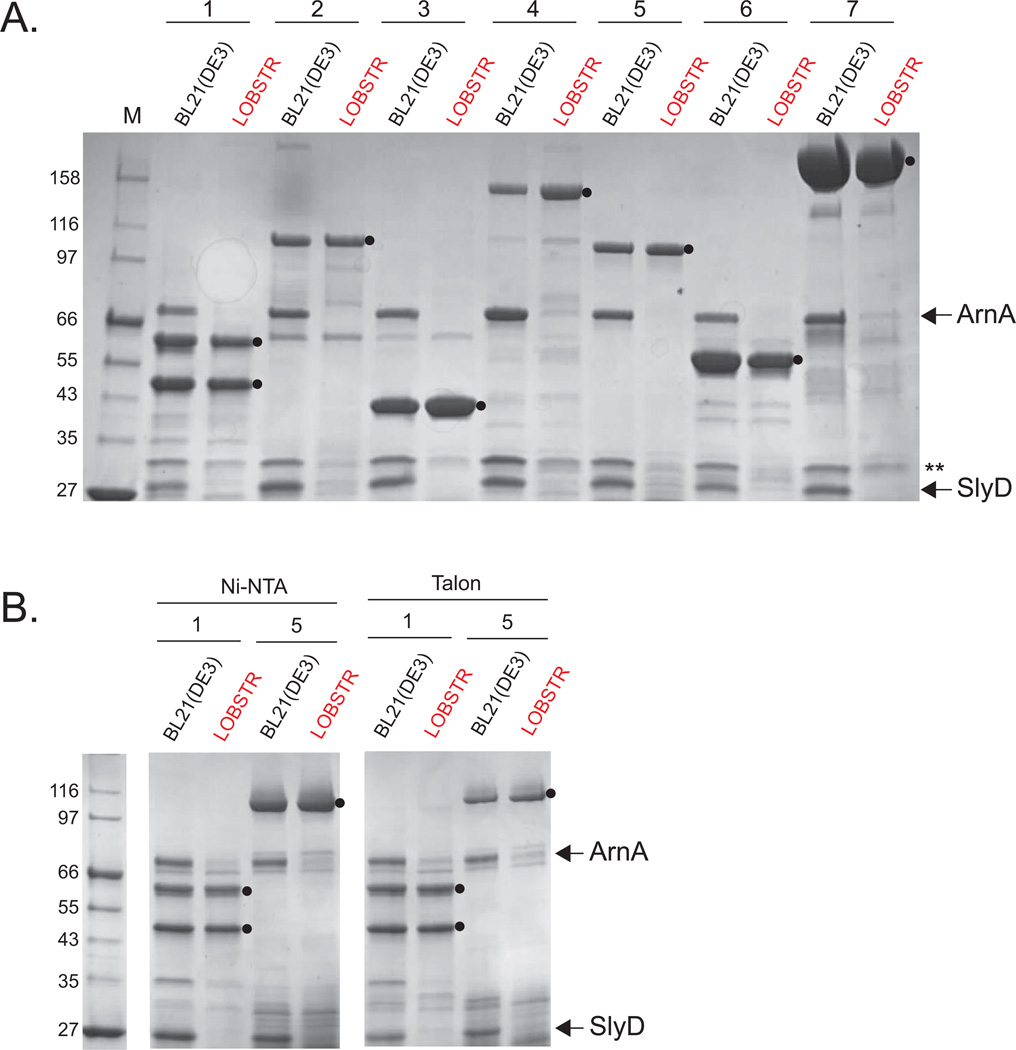
His-tag affinity purification is one of the most commonly used methods to purify recombinant proteins expressed in E. coli. One drawback of using the His-tag is the co-purification of contaminating histidine-rich E. coli proteins. We engineered a new E. coli expression strain, LOBSTR (low background strain), which eliminates the most abundant contaminants. LOBSTR is derived from the E. coli BL21(DE3) strain and carries genomically modified copies of arnA and slyD, whose protein products exhibit reduced affinities to Ni and Co resins, resulting in a much higher purity of the target protein. The use of LOBSTR enables the pursuit of challenging low-expressing protein targets by reducing background contamination with no additional purification steps, materials, or costs, and thus pushes the limits of standard His-tag purifications.
His 标签亲和纯化是最常用于纯化在大肠杆菌中表达的重组蛋白的方法之一。使用 His 标签的一个缺点是会共纯化出污染的富含组氨酸的大肠杆菌蛋白。我们设计了一种新的大肠杆菌表达菌株 LOBSTR(低背景菌株),它可以去除最丰富的污染物。LOBSTR 源自大肠杆菌 BL21(DE3)菌株,带有基因组修饰的 arnA 和 slyD 拷贝,其蛋白产物对 Ni 和 Co 树脂的亲和力降低,从而使目标蛋白的纯度更高。LOBSTR 的使用通过减少背景污染,无需额外的纯化步骤、材料或成本,从而实现具有挑战性的低表达蛋白靶标的追求,并推动了标准 His 标签纯化的极限。