Sharifirad Gholam Reza, Eslami Ahmad Ali, Charkazi Abdurrahman, Mostafavi Firozeh, Shahnazi Hossein
Department of Health Education and Health Promotion, School of Health, Isfahan University of Medical Sciences, Isfahan, Iran.
J Res Med Sci. 2012 Dec;17(12):1128-36.
According to transtheoretical model (TTM), Stage matched interventions are more effective in quitting. The objective of current study was to investigate the effect of individual counseling, line follow-up, and free nicotine replacement therapy (NRT) on smoking cessation in smokers who are in preparation stage of smoking.
In a randomized clinical trial design, through sending the short message system, potential participants in preparation stage of smoking were recruited and divided into control (n = 60)and treatment (n = 50) groups. The treatment group received an in-person counseling, line follow-up, and free NRT. TTM variables trend; pros and cons of smoking, behavioral and experiential processes, temptation, were assessed at baseline, 3 and 6 months follow-up along with point prevalence and continuous abstinence.
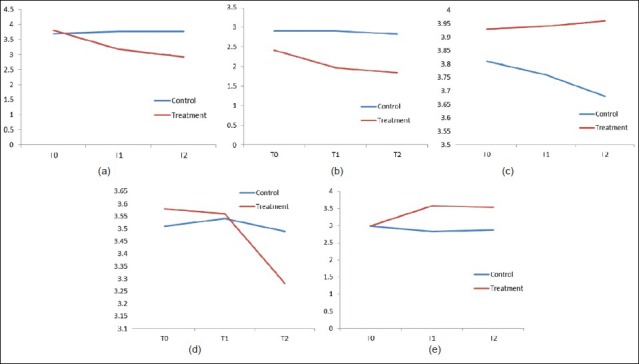
Continuous abstinence at 6-month follow-up were 3.3% (n = 2) in control group and 46% (n = 23) in the treatment group (x (2) = 34.041, P < 0.001). Time Χ group analyses indicated that except cons of smoking (P > 0.05), all TTM constructs had significantly changed; temptation (F = 36.864, P < 0.001), pros (F = 12.172, P < 0.001), experiential processes (F = 3.377, P < 0.001), and behavioral processes (F = 11.131, P < 0.001).
Interventions based on TTM variables increased the quite rate in prepared and motivated people. Our findings suggest that interventions through individual counseling along with free NRT and line follow-up in people who prepare for quitting are beneficial for our country.
根据跨理论模型(TTM),阶段匹配的干预措施在戒烟方面更有效。本研究的目的是调查个体咨询、电话随访和免费尼古丁替代疗法(NRT)对处于戒烟准备阶段的吸烟者戒烟的影响。
在一项随机临床试验设计中,通过短信系统招募处于戒烟准备阶段的潜在参与者,并将其分为对照组(n = 60)和治疗组(n = 50)。治疗组接受面对面咨询、电话随访和免费NRT。在基线、3个月和6个月随访时评估TTM变量趋势;吸烟的利弊、行为和体验过程、诱惑,以及时点患病率和持续戒烟情况。
对照组在6个月随访时的持续戒烟率为3.3%(n = 2),治疗组为46%(n = 23)(χ(2)=34.041,P < 0.001)。时间×组分析表明,除吸烟的弊端(P > 0.05)外,所有TTM结构均有显著变化;诱惑(F = 36.864,P < 0.001)、益处(F = 12.172,P < 0.001)、体验过程(F = 3.377,P < 0.001)和行为过程(F = 11.131,P < 0.001)。
基于TTM变量的干预措施提高了有准备和有动机的人群的戒烟率。我们的研究结果表明,对准备戒烟的人群通过个体咨询、免费NRT和电话随访进行干预对我国有益。