Department of Internal Medicine, Section Tropical Medicine University Medical Centre Hamburg-Eppendorf, Hamburg, Germany.
Malar J. 2013 Jul 15;12:241. doi: 10.1186/1475-2875-12-241.
Severe malaria is a potentially life-threatening infectious disease. It has been conclusively shown that artesunate compared to quinine is superior in antiparasitic efficacy and in lowering mortality showing a better short-term safety profile. Regarding longer-term effects, reports of delayed haemolysis after parenteral artesunate for severe malaria in returning travellers have been published recently. So far, delayed haemolysis has not been described after the use of parenteral quinine.
In this retrospective study, all patients treated for severe malaria at the University Medical Centre Hamburg-Eppendorf were included between 2006 and 2012. The primary endpoint was the proportion of delayed haemolysis in patients treated with quinine versus those who received artesunate. As secondary endpoint, the proportion of any adverse event was assessed.
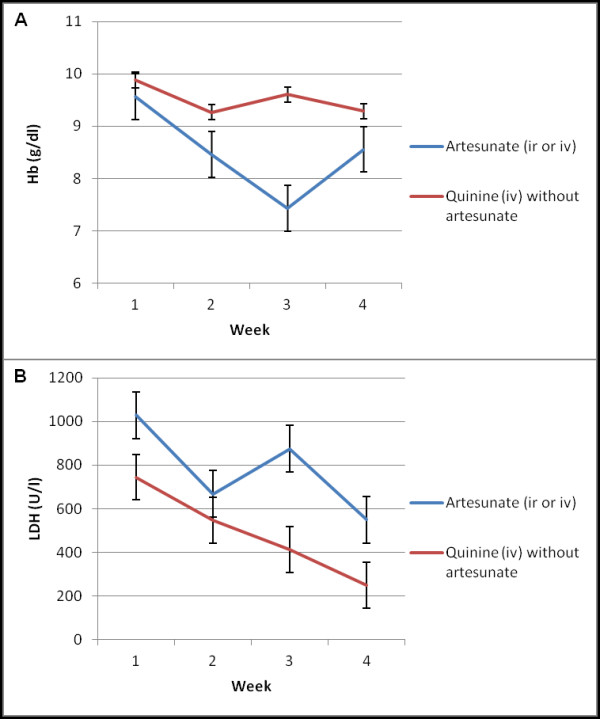
A total of 36 patients with severe malaria were included in the analysis. Of these, 16 patients contributed sufficient data to assess the endpoint delayed haemolysis. Twelve were treated primarily with intravenous quinine - with four patients having received intrarectal artesunate as an adjunct treatment - and five patients were treated primarily with artesunate. Five cases of delayed haemolysis could be detected - two in patients treated with quinine and intrarectal artesunate and three in patients treated with artesunate. No case of delayed haemolysis was detected in patients treated with quinine alone.While adverse events observed in patients treated with artesunate were limited to delayed haemolysis (three patients, 60%) and temporary deterioration in renal function (three patients, 60%), patients treated with quinine showed a more diverse picture of side effects with 22 patients (71%) experiencing at least one adverse event. The most common adverse events after quinine were hearing disturbances (12 patients, 37%), hypoglycaemia (10 patients, 32%) and cardiotoxicity (three patients, 14%).
This study provides further evidence on delayed haemolysis after artesunate and underlines the importance of a standardized follow-up of patients treated with artesunate for severe malaria.
严重疟疾是一种潜在威胁生命的传染病。已经明确证实,青蒿琥酯在抗寄生虫疗效和降低死亡率方面优于奎宁,显示出更好的短期安全性。关于长期影响,最近有报道称,在返回旅行者中使用青蒿琥酯治疗严重疟疾后会出现延迟性溶血。到目前为止,还没有报道在使用青蒿琥酯后出现延迟性溶血。
在这项回顾性研究中,纳入了 2006 年至 2012 年期间在汉堡-埃彭多夫大学医学中心接受严重疟疾治疗的所有患者。主要终点是接受奎宁治疗的患者与接受青蒿琥酯治疗的患者中延迟性溶血的比例。次要终点是评估任何不良事件的比例。
共纳入 36 例严重疟疾患者进行分析。其中,16 例患者提供了足够的数据来评估延迟性溶血的终点。12 例患者主要接受静脉注射奎宁治疗-其中 4 例患者接受直肠内青蒿琥酯作为辅助治疗-5 例患者主要接受青蒿琥酯治疗。检测到 5 例延迟性溶血病例-2 例在接受奎宁和直肠内青蒿琥酯治疗的患者中,3 例在接受青蒿琥酯治疗的患者中。在单独接受奎宁治疗的患者中未检测到延迟性溶血。接受青蒿琥酯治疗的患者观察到的不良事件仅限于延迟性溶血(3 例,60%)和肾功能暂时恶化(3 例,60%),而接受奎宁治疗的患者则表现出更多样的副作用,有 22 例(71%)患者至少出现 1 种不良事件。奎宁治疗后最常见的不良事件是听力障碍(12 例,37%)、低血糖(10 例,32%)和心脏毒性(3 例,14%)。
本研究进一步证实了青蒿琥酯治疗后出现延迟性溶血的情况,并强调了对接受青蒿琥酯治疗严重疟疾的患者进行标准化随访的重要性。