Deutscher Meredith, Beneden Chris Van, Burton Deron, Shultz Alvin, Morgan Oliver W, Chamany Shadi, Jordan Hannah T, Zhang Xingyou, Flannery Brendan, Feikin Daniel R, Olack Beatrice, Lindblade Kim A, Breiman Robert F, Olsen Sonja J
Respiratory Diseases Branch, National Center for Immunization and Respiratory Diseases, Centers for Disease Control and Prevention, Atlanta, GA, USA.
J Epidemiol Glob Health. 2012 Jun;2(2):73-81. doi: 10.1016/j.jegh.2012.03.001. Epub 2012 May 22.
Surveillance is essential to estimating the global burden of pneumonia, yet differences in surveillance methodology and health care-seeking behaviors limit inter-country comparisons.
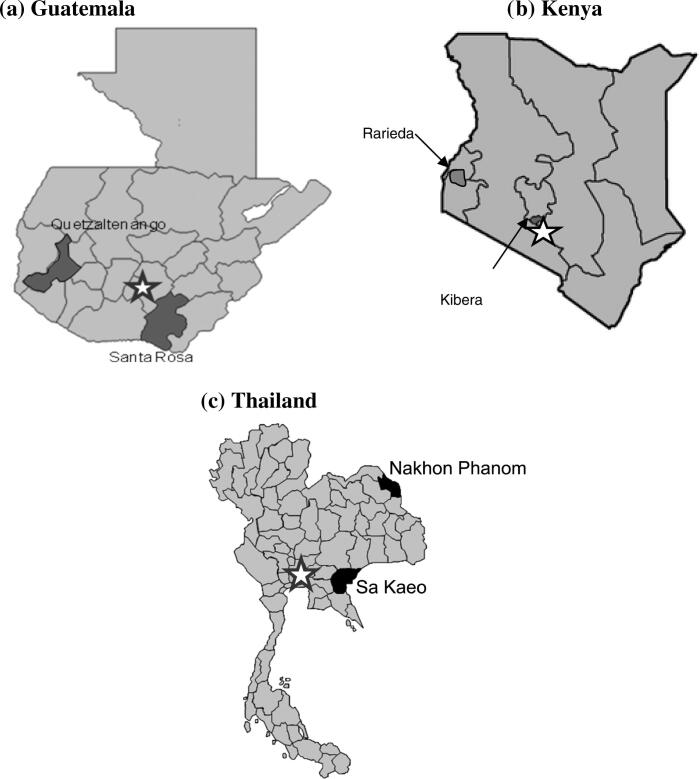
Results were compared from community surveys measuring health care-seeking for pneumonia defined as: (1) cough and difficulty breathing for ⩾2days; or, (2) provider-diagnosed pneumonia. Surveys were conducted in six sites in Guatemala, Kenya and Thailand; these sites also conduct, active, hospital- and population-based disease surveillance for pneumonia.
Frequency of self-reported pneumonia during the preceding year ranged from 1.1% (Thailand) to 6.3% (Guatemala) and was highest in children aged <5years and in urban sites. The proportion of persons with pneumonia who sought hospital-based medical services ranged from 12% (Guatemala, Kenya) to 80% (Thailand) and was highest in children <5years of age. Hospitals and private provider offices were the most common places where persons with pneumonia sought health care. The most commonly cited reasons for not seeking health care were: (a) mild illness; (b) already recovering; and (3) cost of treatment.
Health care-seeking patterns varied widely across countries. Using results from standardized health care utilization surveys to adjust facility-based surveillance estimates of pneumonia allows for more accurate and comparable estimates.
监测对于评估全球肺炎负担至关重要,但监测方法和就医行为的差异限制了国家间的比较。
比较了社区调查的结果,这些调查衡量了对肺炎的就医情况,肺炎定义为:(1)咳嗽和呼吸困难持续≥2天;或,(2)经医疗服务提供者诊断为肺炎。在危地马拉、肯尼亚和泰国的六个地点进行了调查;这些地点还对肺炎开展了基于医院和人群的主动疾病监测。
前一年自我报告的肺炎发生率从1.1%(泰国)到6.3%(危地马拉)不等,在<5岁儿童和城市地区最高。肺炎患者寻求医院医疗服务的比例从12%(危地马拉、肯尼亚)到80%(泰国)不等,在<5岁儿童中最高。医院和私人医疗机构是肺炎患者最常寻求医疗服务的地方。最常被提及的不寻求医疗服务的原因是:(a)病情较轻;(b)已经在康复;以及(3)治疗费用。
各国的就医模式差异很大。利用标准化医疗服务利用调查的结果来调整基于机构的肺炎监测估计值,可以得出更准确和可比的估计。