Dugas Andrea Freyer, Morton Melinda, Beard Raphaelle, Pines Jesse M, Bayram Jamil D, Hsieh Yu-Hsiang, Kelen Gabor, Uscher-Pines Lori, Jeng Kevin, Cole Gai, Rothman Richard
Department of Emergency Medicine, Johns Hopkins University, Baltimore, Maryland, United States.
PLoS Curr. 2013 Apr 17;5:ecurrents.dis.1f277e0d2bf80f4b2bb1dd5f63a13993. doi: 10.1371/currents.dis.1f277e0d2bf80f4b2bb1dd5f63a13993.
To identify and prioritize potential Emergency Department (ED) and hospital-based interventions which could mitigate the impact of crowding during patient surge from a widespread infectious respiratory disease outbreak and determine potential data sources that may be useful for triggering decisions to implement these high priority interventions.
Expert panel utilizing Nominal Group Technique to identify and prioritize interventions, and in addition, determine appropriate "triggers" for implementation of the high priority interventions in the context of four different infectious respiratory disease scenarios that vary by patient volumes (high versus low) and illness severity (high versus low).
One day in-person conference held November, 2011.
Regional and national experts representing the fields of public health, disease surveillance, clinical medicine, ED operations, and hospital operations.
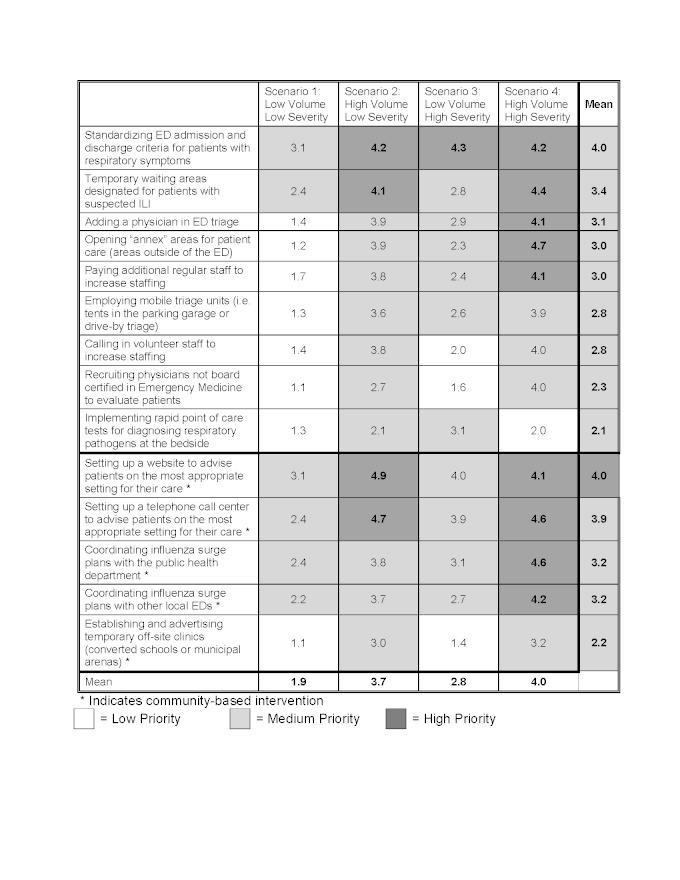
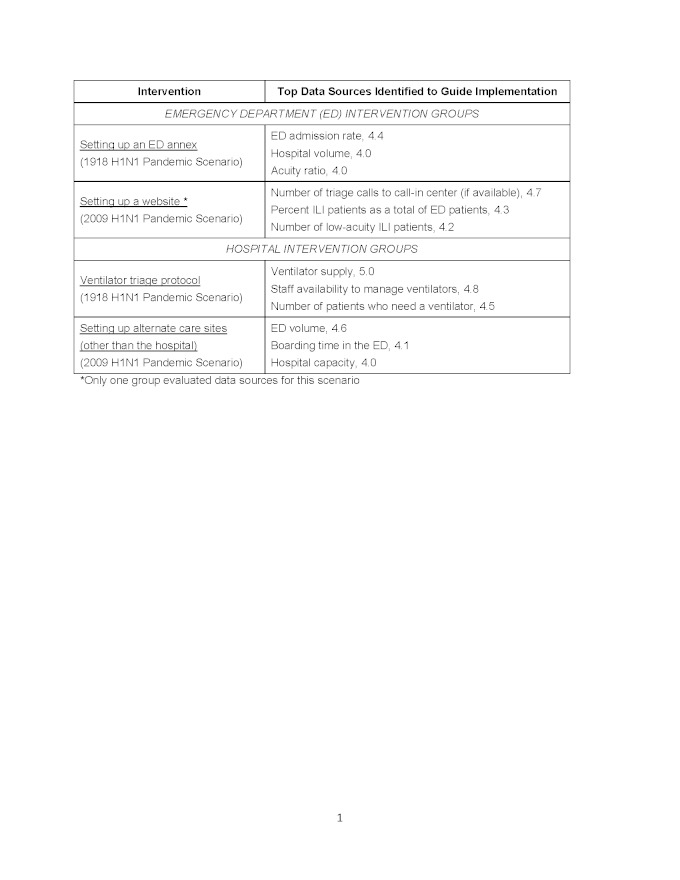
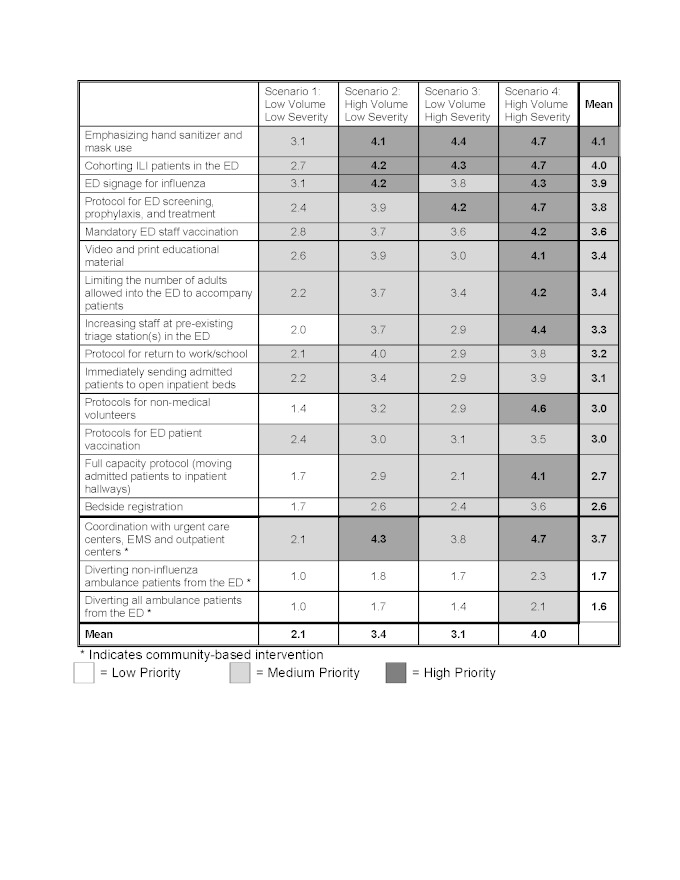
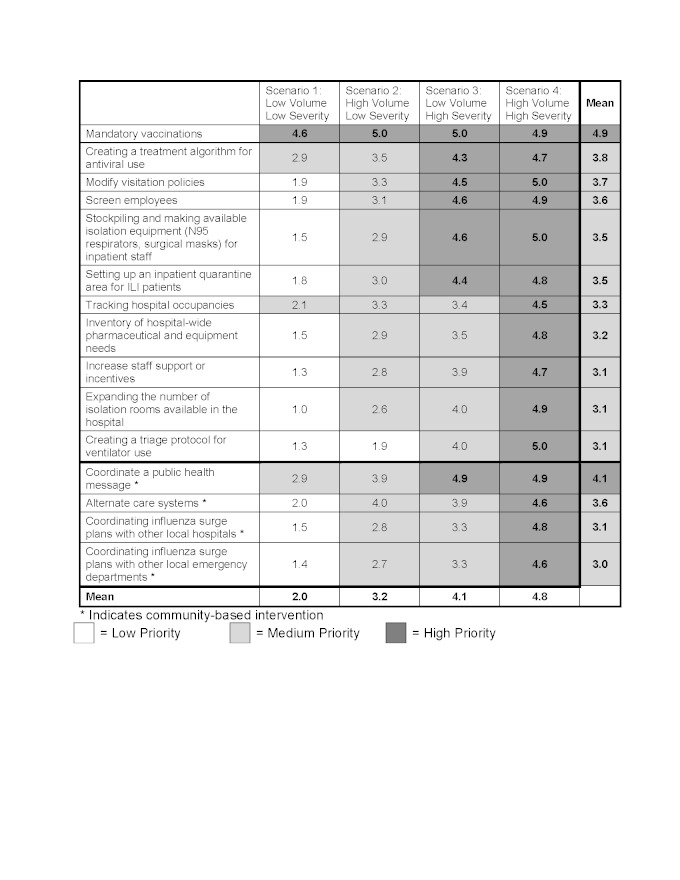
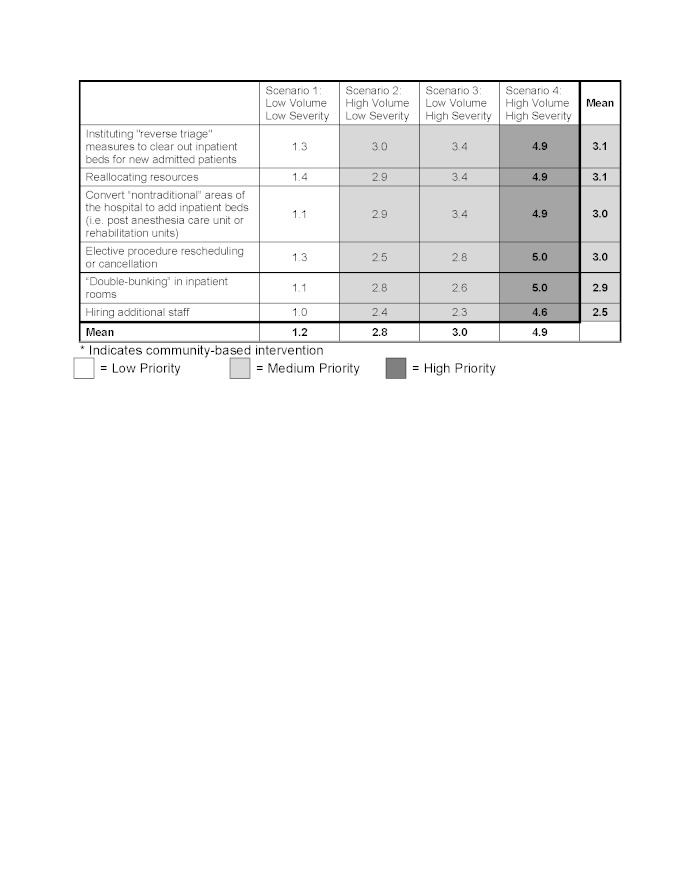
Prioritized list of potential interventions to reduce ED and hospital crowding, respectively. In addition, we created a prioritized list of potential data sources which could be useful to trigger interventions.
High priority interventions to mitigate ED surge included standardizing admission and discharge criteria and instituting infection control measures. To mitigate hospital crowding, panelists prioritized mandatory vaccination and an algorithm for antiviral use. Data sources identified for triggering implementation of these interventions were most commonly ED and hospital utilization metrics.
We developed a prioritized list of potentially useful interventions to mitigate ED and hospital crowding in various outbreak scenarios. The data sources identified to "trigger" the implementation of these high priority interventions consist mainly of sources available at the local, institutional level.
识别并确定潜在的急诊科及医院干预措施的优先级,这些措施可减轻广泛传染性呼吸道疾病爆发导致患者激增期间拥挤状况的影响,并确定可能有助于触发实施这些高优先级干预措施决策的潜在数据来源。
专家小组采用名义小组技术来识别干预措施并确定其优先级,此外,在四种不同的传染性呼吸道疾病情景(根据患者数量[高与低]和疾病严重程度[高与低]而有所不同)的背景下,确定实施高优先级干预措施的适当“触发因素”。
2011年11月举行的为期一天的现场会议。
代表公共卫生、疾病监测、临床医学、急诊科运营和医院运营领域的区域和国家专家。
分别列出减轻急诊科和医院拥挤状况的潜在干预措施的优先级清单。此外,我们创建了一份可能有助于触发干预措施的潜在数据来源的优先级清单。
减轻急诊科激增的高优先级干预措施包括标准化入院和出院标准以及制定感染控制措施。为减轻医院拥挤状况,小组成员将强制接种疫苗和抗病毒药物使用算法列为优先事项。确定用于触发实施这些干预措施的数据来源最常见的是急诊科和医院的使用指标。
我们制定了一份在各种爆发情景下减轻急诊科和医院拥挤状况的潜在有用干预措施的优先级清单。确定用于“触发”实施这些高优先级干预措施的数据来源主要包括地方机构层面可用的来源。