College of Horticulture, Jinling Institute of Technology, Nanjing 210038, China.
Int J Mol Sci. 2013 Jul 12;14(7):14689-99. doi: 10.3390/ijms140714689.
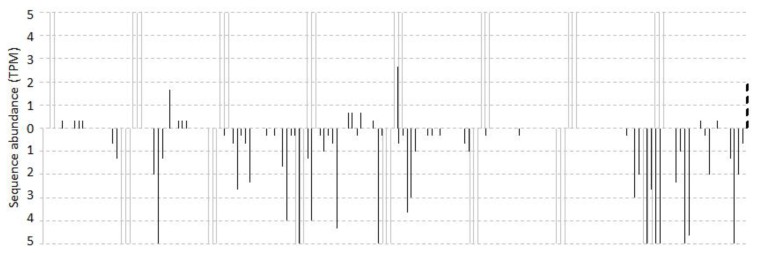
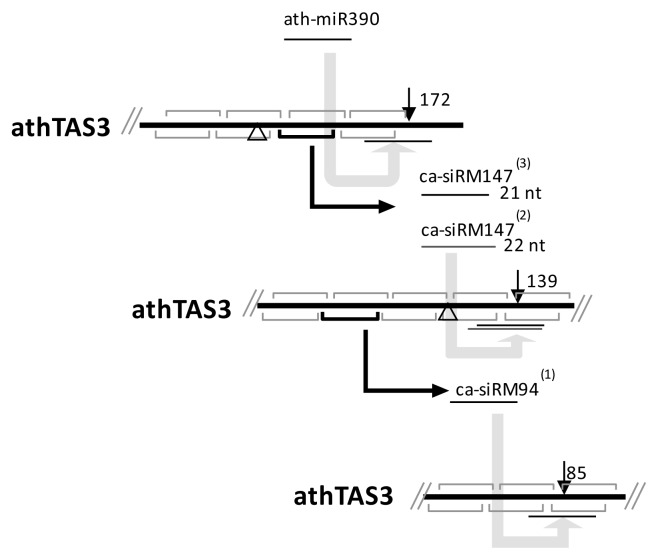
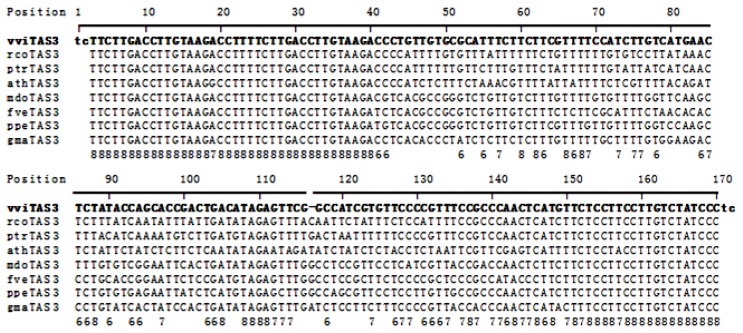
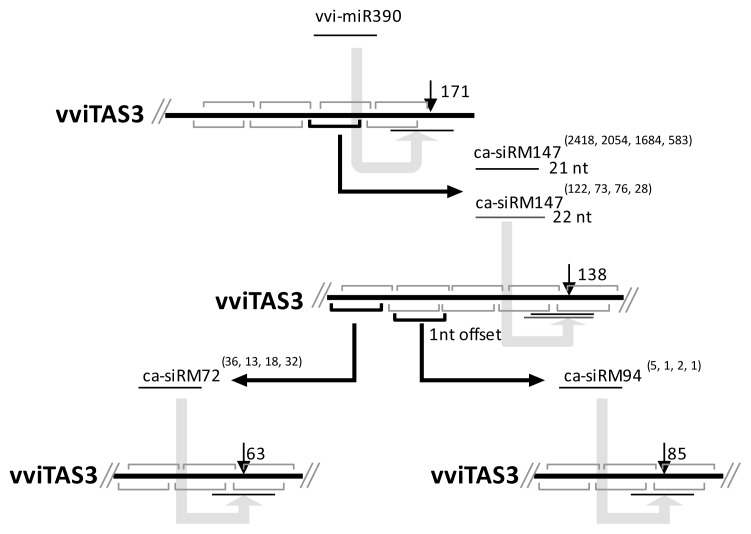
The production of small RNAs (sRNAs) from phased positions set by microRNA-directed cleavage of trans-acting-siRNA-producing locus (TAS) transcript has been characterized extensively; however, the production of sRNAs from non-phased positions remains unknown. We report three cis-cleavages that occurred in TAS3 transcripts in Vitis vinifera, by combining high-throughput sRNA deep sequencing information with evolutional conservation and genome-wide RNA degradome analysis. The three cis-cleavages can be deciphered to generate an orderly cleavage cascade, and can also produce distinct phasing patterns. Each of the patterns, either upstream or downstream of the cis-cleaved position, had a set of sRNAs arranged in 21-nucleotide increments. Part of the cascading cis-cleavages was also conserved in Arabidopsis thaliana. Our results will enhance the understanding of the production of sRNAs from non-phased positions that are not set by microRNA-directed cleavage.
小 RNA(sRNAs)的产生来自 microRNA 指导的转座活性 siRNA 产生基因座(TAS)转录物的分相位置的切割已被广泛研究;然而,来自非分相位置的 sRNAs 的产生仍不清楚。我们报告了在葡萄属植物 TAS3 转录物中发生的三个顺式切割,方法是将高通量 sRNA 深度测序信息与进化保守性和全基因组 RNA 降解组分析相结合。这三个顺式切割可以被破译以产生有序的切割级联,并且还可以产生不同的分相模式。每个模式,无论是在顺式切割位置的上游还是下游,都有一组以 21 个核苷酸为增量排列的 sRNAs。级联顺式切割的一部分也在拟南芥中保守。我们的结果将增强对非分相位置的 sRNAs 的产生的理解,这些 sRNAs 的产生不是由 microRNA 指导的切割设定的。