Department of Anatomy, Histology, Embryology, Medical School, University of Patras, 26500 Patras, Greece.
Biomed Res Int. 2013;2013:230805. doi: 10.1155/2013/230805. Epub 2013 Jun 19.
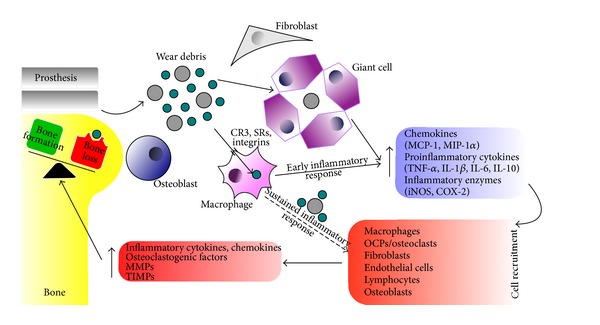
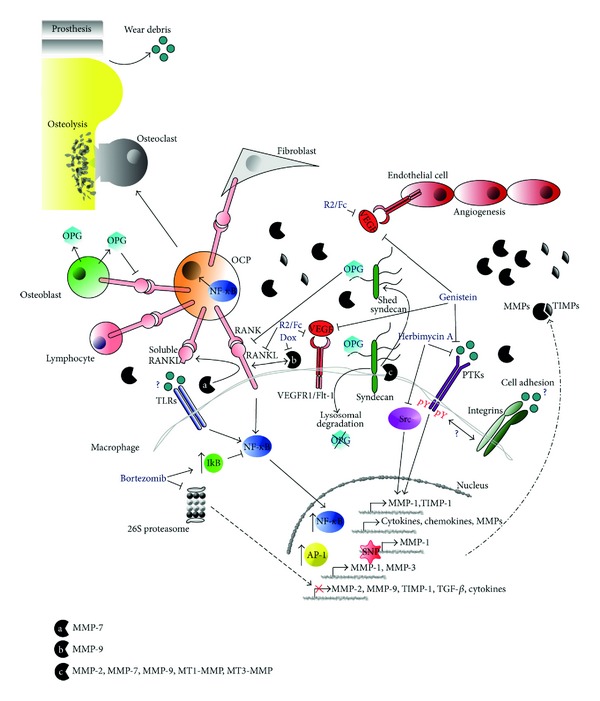
The leading complication of total joint replacement is periprosthetic osteolysis, which often results in aseptic loosening of the implant, leading to revision surgery. Extracellular matrix degradation and connective tissue remodeling around implants have been considered as major biological events in the periprosthetic loosening. Critical mediators of wear particle-induced inflammatory osteolysis released by periprosthetic synovial cells (mainly macrophages) are inflammatory cytokines, chemokines, and proteolytic enzymes, mainly matrix metalloproteinases (MMPs). Numerous studies reveal a strong interdependence of MMP expression and activity with the molecular mechanisms that control the composition and turnover of periprosthetic matrices. MMPs can either actively modulate or be modulated by the molecular mechanisms that determine the debris-induced remodeling of the periprosthetic microenvironment. In the present study, the molecular mechanisms that control the composition, turnover, and activity of matrix macromolecules within the periprosthetic microenvironment exposed to wear debris are summarized and presented. Special emphasis is given to MMPs and their endogenous tissue inhibitors (TIMPs), as well as to the proteasome pathway, which appears to be an elegant molecular regulator of specific matrix macromolecules (including specific MMPs and TIMPs). Furthermore, strong rationale for potential clinical applications of the described molecular mechanisms to the treatment of periprosthetic loosening and osteolysis is provided.
人工关节置换术的主要并发症是假体周围骨溶解,这通常会导致假体无菌性松动,从而需要进行翻修手术。植入物周围细胞外基质的降解和结缔组织的重塑被认为是假体松动的主要生物学事件。由假体滑膜细胞(主要是巨噬细胞)释放的磨损颗粒诱导的炎症性骨溶解的关键介质是炎症细胞因子、趋化因子和蛋白水解酶,主要是基质金属蛋白酶(MMPs)。大量研究表明,MMP 的表达和活性与控制假体周围基质组成和更新的分子机制之间存在很强的相互依赖性。MMP 可以主动调节或被决定假体周围微环境中碎片诱导重塑的分子机制调节。在本研究中,总结并提出了暴露于磨损颗粒的假体周围微环境中基质大分子的组成、周转和活性的控制分子机制。特别强调了基质金属蛋白酶(MMPs)及其内源性组织抑制剂(TIMPs),以及蛋白酶体途径,它似乎是特定基质大分子(包括特定的 MMPs 和 TIMPs)的优雅分子调节剂。此外,还为描述的分子机制在假体松动和骨溶解治疗中的潜在临床应用提供了强有力的依据。