Department of Physiology, Sanders-Brown Center on Aging, University of Kentucky, Lexington, KY 40536, USA.
J Neuroinflammation. 2013 Jul 16;10:84. doi: 10.1186/1742-2094-10-84.
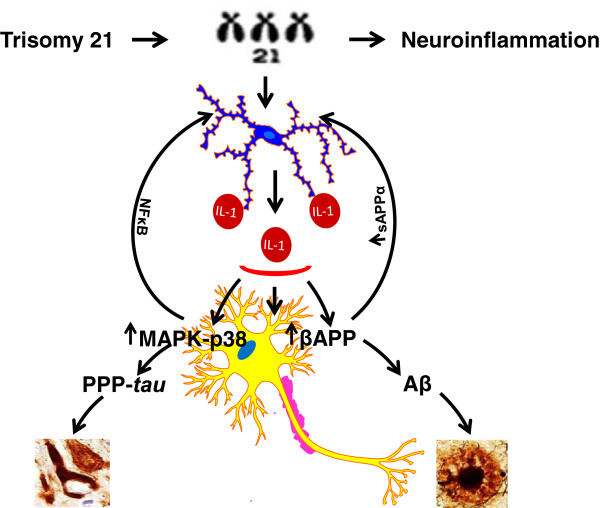
Down syndrome (DS) is the result of triplication of chromosome 21 (trisomy 21) and is the prevailing cause of mental retardation. In addition to the mental deficiencies and physical anomalies noted at birth, triplication of chromosome 21 gene products results in the neuropathological and cognitive changes of Alzheimer's disease (AD). Mapping of the gene that encodes the precursor protein (APP) of the β-amyloid (Aβ) present in the Aβ plaques in both AD and DS to chromosome 21 was strong evidence that this chromosome 21 gene product was a principal neuropathogenic culprit in AD as well as DS. The discovery of neuroinflammatory changes, including dramatic proliferation of activated glia overexpressing a chromosome 2 gene product--the pluripotent immune cytokine interleukin-1 (IL-1)--and a chromosome 21 gene product--S100B--in the brains of fetuses, neonates, and children with DS opened the possibility that early events in Alzheimer pathogenesis were driven by cytokines. The specific chromosome 21 gene products and the complexity of the mechanisms they engender that give rise to the neuroinflammatory responses noted in fetal development of the DS brain and their potential as accelerators of Alzheimer neuropathogenesis in DS are topics of this review, particularly as they relate to development and propagation of neuroinflammation, the consequences of which are recognized clinically and neuropathologically as Alzheimer's disease.
唐氏综合征(DS)是 21 号染色体三体(trisomy 21)的结果,是智力障碍的主要原因。除了出生时注意到的精神缺陷和身体异常外,21 号染色体基因产物的三倍体导致了阿尔茨海默病(AD)的神经病理学和认知变化。编码β-淀粉样蛋白(Aβ)前体蛋白(APP)的基因定位于 21 号染色体,这强烈表明该 21 号染色体基因产物是 AD 以及 DS 中主要的神经致病性罪魁祸首。神经炎症变化的发现,包括在唐氏综合征胎儿、新生儿和儿童的大脑中过度表达一种 2 号染色体基因产物——多能免疫细胞因子白细胞介素-1(IL-1)——和一种 21 号染色体基因产物 S100B 的激活神经胶质细胞的显著增殖,使人们有可能认为阿尔茨海默病发病机制中的早期事件是由细胞因子驱动的。本综述讨论了特定的 21 号染色体基因产物以及它们引发的神经炎症反应的复杂性,这些反应在唐氏综合征大脑的胎儿发育中被注意到,它们可能是唐氏综合征中阿尔茨海默病神经发病机制的加速因素,特别是与神经炎症的发展和传播有关,其后果在临床上和神经病理学上被认为是阿尔茨海默病。