• 文献检索
  • 文档翻译
  • 深度研究
  • 学术资讯
  • Suppr Zotero 插件Zotero 插件
  • 邀请有礼
  • 套餐&价格
  • 历史记录
应用&插件
Suppr Zotero 插件Zotero 插件浏览器插件Mac 客户端Windows 客户端微信小程序
定价
高级版会员购买积分包购买API积分包
服务
文献检索文档翻译深度研究API 文档MCP 服务
关于我们
关于 Suppr公司介绍联系我们用户协议隐私条款
关注我们

Suppr 超能文献

核心技术专利:CN118964589B侵权必究
粤ICP备2023148730 号-1Suppr @ 2026

文献检索

告别复杂PubMed语法,用中文像聊天一样搜索,搜遍4000万医学文献。AI智能推荐,让科研检索更轻松。

立即免费搜索

文件翻译

保留排版,准确专业,支持PDF/Word/PPT等文件格式,支持 12+语言互译。

免费翻译文档

深度研究

AI帮你快速写综述,25分钟生成高质量综述,智能提取关键信息,辅助科研写作。

立即免费体验

加速度计检测日常活动的最佳位置。

Optimal placement of accelerometers for the detection of everyday activities.

机构信息

School of Computing and Mathematics, University of Ulster, Jordanstown, Co. Antrim, Northern Ireland BT37 0QB, UK.

出版信息

Sensors (Basel). 2013 Jul 17;13(7):9183-200. doi: 10.3390/s130709183.

DOI:10.3390/s130709183
PMID:23867744
原文链接:https://pmc.ncbi.nlm.nih.gov/articles/PMC3758644/
Abstract

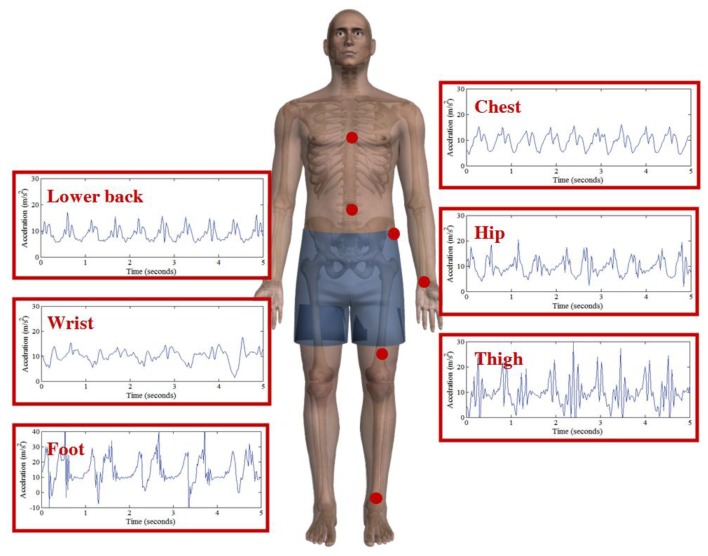
This article describes an investigation to determine the optimal placement of accelerometers for the purpose of detecting a range of everyday activities. The paper investigates the effect of combining data from accelerometers placed at various bodily locations on the accuracy of activity detection. Eight healthy males participated within the study. Data were collected from six wireless tri-axial accelerometers placed at the chest, wrist, lower back, hip, thigh and foot. Activities included walking, running on a motorized treadmill, sitting, lying, standing and walking up and down stairs. The Support Vector Machine provided the most accurate detection of activities of all the machine learning algorithms investigated. Although data from all locations provided similar levels of accuracy, the hip was the best single location to record data for activity detection using a Support Vector Machine, providing small but significantly better accuracy than the other investigated locations. Increasing the number of sensing locations from one to two or more statistically increased the accuracy of classification. There was no significant difference in accuracy when using two or more sensors. It was noted, however, that the difference in activity detection using single or multiple accelerometers may be more pronounced when trying to detect finer grain activities. Future work shall therefore investigate the effects of accelerometer placement on a larger range of these activities.

摘要

本文旨在探讨如何确定加速度计的最佳位置,以实现对各种日常活动的检测。本研究调查了将放置在不同身体部位的加速度计数据进行组合对活动检测准确性的影响。八位健康男性参与了本研究。数据由六个无线三轴加速度计采集,这些加速度计分别放置在胸部、手腕、下背部、臀部、大腿和脚部。所进行的活动包括行走、在电动跑步机上跑步、坐、躺、站立和上下楼梯。在所有研究的机器学习算法中,支持向量机提供了最准确的活动检测。尽管所有位置的数据提供了相似的准确性水平,但臀部是使用支持向量机进行活动检测的最佳单个位置,其准确性比其他研究位置略高。使用一个以上的传感器可显著提高分类的准确性。使用两个或更多传感器时,准确性没有显著差异。然而,应当注意,在尝试检测更精细的活动时,使用单个或多个加速度计进行活动检测的差异可能更为明显。因此,未来的工作将进一步研究加速度计位置对更广泛的这些活动的影响。
https://cdn.ncbi.nlm.nih.gov/pmc/blobs/a581/3758644/8ec2277829b3/sensors-13-09183f3.jpg
https://cdn.ncbi.nlm.nih.gov/pmc/blobs/a581/3758644/5d4911d0cb0d/sensors-13-09183f1.jpg
https://cdn.ncbi.nlm.nih.gov/pmc/blobs/a581/3758644/6216986f9f03/sensors-13-09183f2.jpg
https://cdn.ncbi.nlm.nih.gov/pmc/blobs/a581/3758644/8ec2277829b3/sensors-13-09183f3.jpg
https://cdn.ncbi.nlm.nih.gov/pmc/blobs/a581/3758644/5d4911d0cb0d/sensors-13-09183f1.jpg
https://cdn.ncbi.nlm.nih.gov/pmc/blobs/a581/3758644/6216986f9f03/sensors-13-09183f2.jpg
https://cdn.ncbi.nlm.nih.gov/pmc/blobs/a581/3758644/8ec2277829b3/sensors-13-09183f3.jpg

相似文献

1
Optimal placement of accelerometers for the detection of everyday activities.加速度计检测日常活动的最佳位置。
Sensors (Basel). 2013 Jul 17;13(7):9183-200. doi: 10.3390/s130709183.
2
Estimating energy expenditure using body-worn accelerometers: a comparison of methods, sensors number and positioning.使用穿戴式加速度计估算能量消耗:方法、传感器数量和位置的比较
IEEE J Biomed Health Inform. 2015 Jan;19(1):219-26. doi: 10.1109/JBHI.2014.2313039. Epub 2014 Mar 20.
3
Detection of physical activity types using triaxial accelerometers.使用三轴加速度计检测身体活动类型。
J Phys Act Health. 2014 Jan;11(1):76-84. doi: 10.1123/jpah.2011-0347. Epub 2012 Dec 17.
4
A universal, accurate intensity-based classification of different physical activities using raw data of accelerometer.使用加速度计原始数据对不同身体活动进行通用、准确的基于强度的分类。
Clin Physiol Funct Imaging. 2015 Jan;35(1):64-70. doi: 10.1111/cpf.12127. Epub 2014 Jan 7.
5
Single-accelerometer-based daily physical activity classification.基于单加速度计的日常身体活动分类。
Annu Int Conf IEEE Eng Med Biol Soc. 2009;2009:6107-10. doi: 10.1109/IEMBS.2009.5334925.
6
Posture and movement classification: the comparison of tri-axial accelerometer numbers and anatomical placement.姿势与运动分类:三轴加速度计数量及解剖学放置的比较
J Biomech Eng. 2014 May;136(5):051003. doi: 10.1115/1.4026230.
7
The use of accelerometers and gyroscopes to estimate hip and knee angles on gait analysis.在步态分析中使用加速度计和陀螺仪来估计髋关节和膝关节角度。
Sensors (Basel). 2014 May 13;14(5):8430-46. doi: 10.3390/s140508430.
8
Predicting human movement with multiple accelerometers using movelets.使用移动子(movelets)通过多个加速度计预测人体运动。
Med Sci Sports Exerc. 2014 Sep;46(9):1859-66. doi: 10.1249/MSS.0000000000000285.
9
Estimating intensity of physical activity: a comparison of wearable accelerometer and gyro sensors and 3 sensor locations.估算身体活动强度:可穿戴式加速度计与陀螺仪传感器及三个传感器位置的比较
Annu Int Conf IEEE Eng Med Biol Soc. 2007;2007:1511-4. doi: 10.1109/IEMBS.2007.4352588.
10
Genetic algorithm-based classifiers fusion for multisensor activity recognition of elderly people.基于遗传算法的分类器融合用于老年人多传感器活动识别
IEEE J Biomed Health Inform. 2015 Jan;19(1):282-9. doi: 10.1109/JBHI.2014.2313473. Epub 2014 Apr 21.

引用本文的文献

1
Effects of biobanding on training loads and technical performance of young football players.生物绷带对年轻足球运动员训练负荷和技术表现的影响。
PLoS One. 2025 Feb 13;20(2):e0317432. doi: 10.1371/journal.pone.0317432. eCollection 2025.
2
The Impacts of Engagement in Men's Sheds on Incidental Physical Activity and Wellbeing Outcomes.参与男性活动中心对偶然身体活动和幸福感结果的影响。
Health Promot J Austr. 2025 Jan;36(1):e958. doi: 10.1002/hpja.958.
3
Accelerometer-based heart rate adjustment for ambulatory stress research.基于加速度计的动态应激研究中的心率调整

本文引用的文献

1
Comparison of median frequency between traditional and functional sensor placements during activity monitoring.活动监测期间传统传感器放置位置与功能传感器放置位置的中位数频率比较。
Measurement (Lond). 2013 Aug;46(7):2193-2200. doi: 10.1016/j.measurement.2013.03.004.
2
Sensor positioning for activity recognition using wearable accelerometers.使用可穿戴加速度计进行活动识别的传感器定位。
IEEE Trans Biomed Circuits Syst. 2011 Aug;5(4):320-9. doi: 10.1109/TBCAS.2011.2160540.
3
Best practices for using physical activity monitors in population-based research.
Psychophysiology. 2025 Jan;62(1):e14721. doi: 10.1111/psyp.14721. Epub 2024 Nov 19.
4
Frequency of physical activity during leisure time and variables related to pain and pain medication use in Spanish adults: A cross-sectional study.闲暇时间体力活动频率与西班牙成年人疼痛及疼痛药物使用相关变量的横断面研究。
PLoS One. 2024 Nov 13;19(11):e0310685. doi: 10.1371/journal.pone.0310685. eCollection 2024.
5
Classifying physical activity levels using Mean Amplitude Deviation in adults using a chest worn accelerometer: validation of the Vivalink ECG Patch.使用胸部佩戴式加速度计通过平均幅度偏差对成年人的身体活动水平进行分类:Vivalink心电图贴片的验证
BMC Sports Sci Med Rehabil. 2024 Oct 10;16(1):212. doi: 10.1186/s13102-024-00991-6.
6
Measuring gait parameters from a single chest-worn accelerometer in healthy individuals: a validation study.在健康个体中,从单个佩戴于胸部的加速度计测量步态参数:一项验证研究。
Sci Rep. 2024 Jun 17;14(1):13897. doi: 10.1038/s41598-024-62330-6.
7
Development and validation of a smartwatch algorithm for differentiating physical activity intensity in health monitoring.用于健康监测中区分身体活动强度的智能手表算法的开发与验证。
Sci Rep. 2024 Apr 25;14(1):9530. doi: 10.1038/s41598-024-59602-6.
8
Comparison of Step-Based Metrics Under Laboratory and Free-Living Conditions in Femoroacetabular Impingement Syndrome.股骨髋臼撞击综合征患者在实验室及自由生活条件下基于步幅的指标比较
J Athl Train. 2024 Oct 1;59(10):1004-1011. doi: 10.4085/1062-6050-0322.23.
9
Systematic design of health monitoring systems centered on older adults and ADLs.以老年人和日常生活活动为中心的健康监测系统的系统设计。
BMC Med Inform Decis Mak. 2024 Feb 13;23(Suppl 3):300. doi: 10.1186/s12911-024-02432-3.
10
Bi-directional associations of core affect and physical activity in adults with higher body weight: An ecological momentary assessment study.双向关联核心情绪和身体活动在体重较高的成年人:一项生态瞬间评估研究。
J Health Psychol. 2024 Sep;29(10):1115-1128. doi: 10.1177/13591053241228202. Epub 2024 Jan 29.
基于人群的研究中使用身体活动监测器的最佳实践。
Med Sci Sports Exerc. 2012 Jan;44(1 Suppl 1):S68-76. doi: 10.1249/MSS.0b013e3182399e5b.
4
Detection of type, duration, and intensity of physical activity using an accelerometer.使用加速度计检测身体活动的类型、持续时间和强度。
Med Sci Sports Exerc. 2009 Sep;41(9):1770-7. doi: 10.1249/MSS.0b013e3181a24536.
5
Improving assessment of daily energy expenditure by identifying types of physical activity with a single accelerometer.通过单一加速度计识别身体活动类型来改进日常能量消耗评估。
J Appl Physiol (1985). 2009 Sep;107(3):655-61. doi: 10.1152/japplphysiol.00150.2009. Epub 2009 Jun 25.
6
Activity identification using body-mounted sensors--a review of classification techniques.使用身体佩戴式传感器进行活动识别——分类技术综述
Physiol Meas. 2009 Apr;30(4):R1-33. doi: 10.1088/0967-3334/30/4/R01. Epub 2009 Apr 2.
7
A comparison of feature extraction methods for the classification of dynamic activities from accelerometer data.基于加速度计数据的动态活动分类中特征提取方法的比较
IEEE Trans Biomed Eng. 2009 Mar;56(3):871-9. doi: 10.1109/TBME.2008.2006190. Epub 2008 Oct 31.
8
Ambulatory monitoring of human posture and walking speed using wearable accelerometer sensors.使用可穿戴加速度计传感器对人体姿势和步行速度进行动态监测。
Annu Int Conf IEEE Eng Med Biol Soc. 2008;2008:5184-7. doi: 10.1109/IEMBS.2008.4650382.
9
Implementation of a real-time human movement classifier using a triaxial accelerometer for ambulatory monitoring.使用三轴加速度计进行动态监测的实时人体运动分类器的实现。
IEEE Trans Inf Technol Biomed. 2006 Jan;10(1):156-67. doi: 10.1109/titb.2005.856864.
10
Activity classification using realistic data from wearable sensors.使用可穿戴传感器的实际数据进行活动分类。
IEEE Trans Inf Technol Biomed. 2006 Jan;10(1):119-28. doi: 10.1109/titb.2005.856863.