Department of Genetics, University of Córdoba/Maimónides Institute for Research in Biomedicine of Córdoba (IMIBIC)/Reina Sofía University Hospital, 14071 Córdoba, Spain.
Nucleic Acids Res. 2013 Oct;41(18):8654-64. doi: 10.1093/nar/gkt625. Epub 2013 Jul 18.
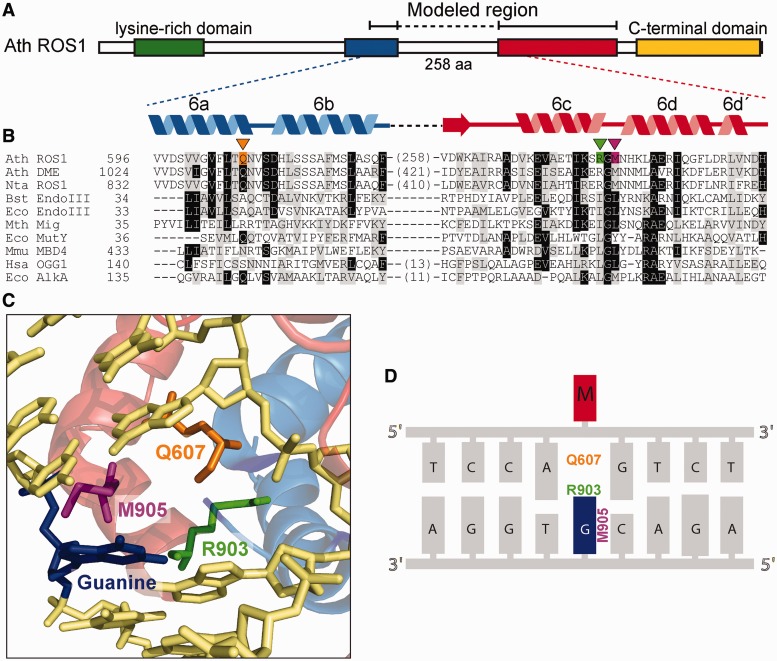
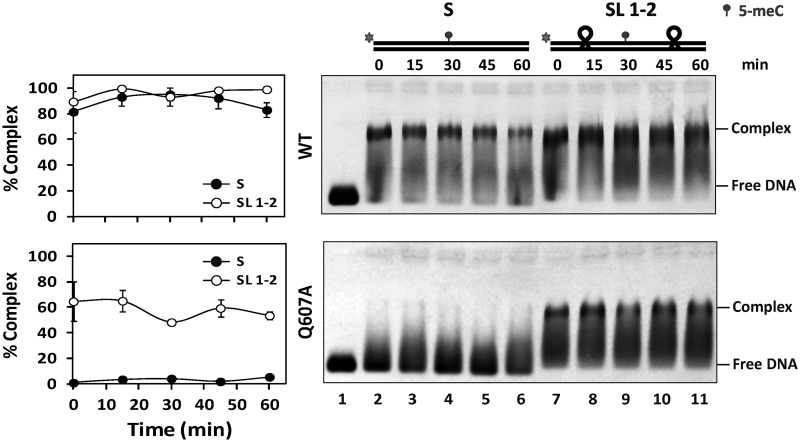
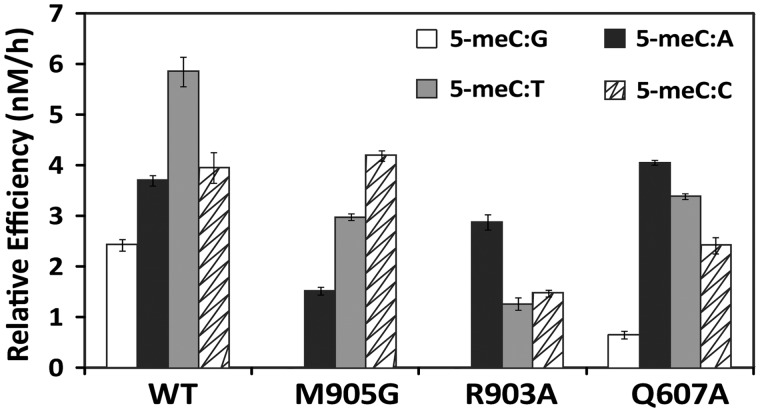
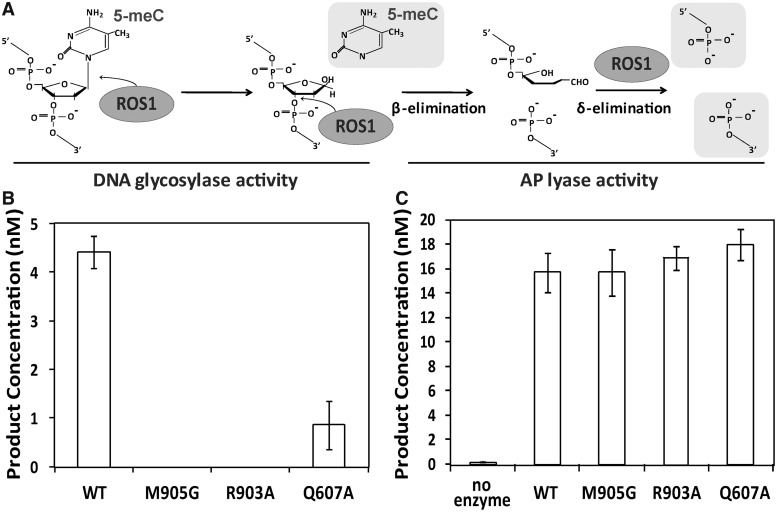
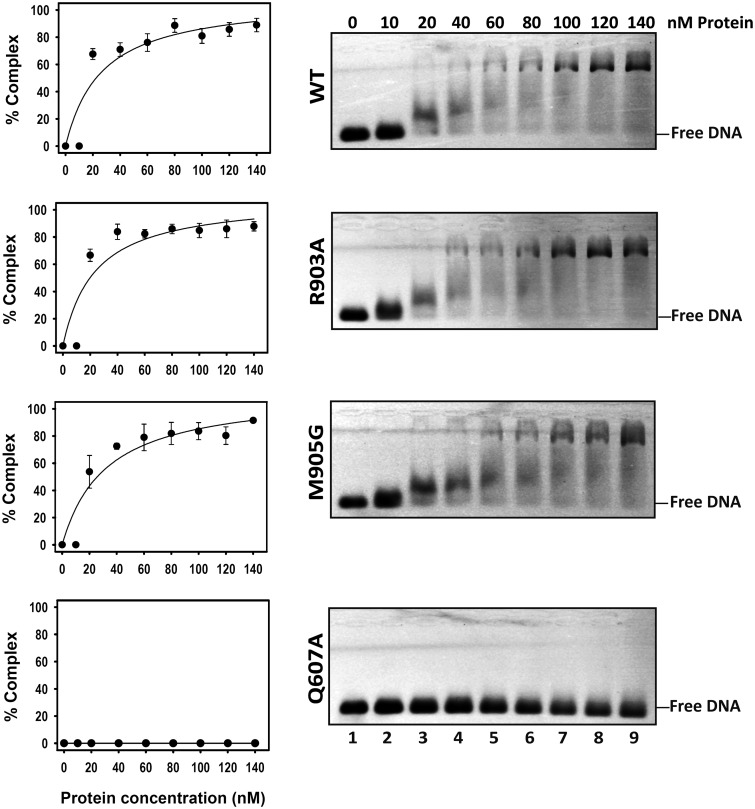
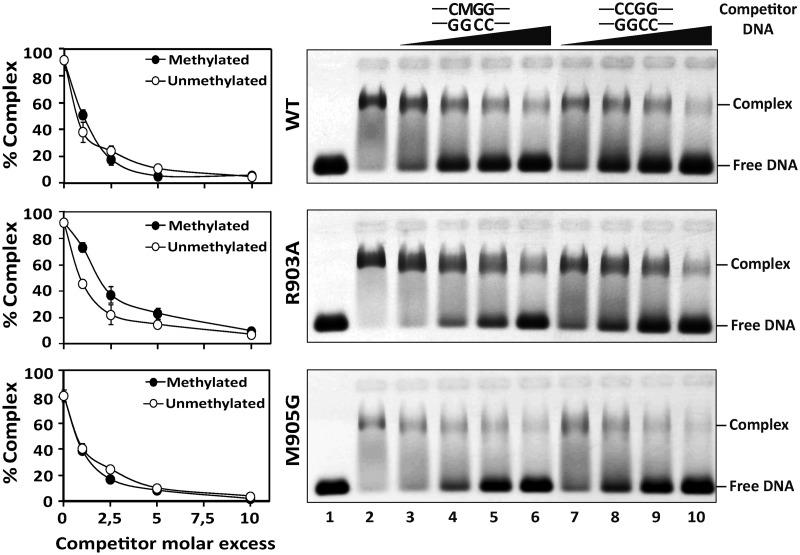
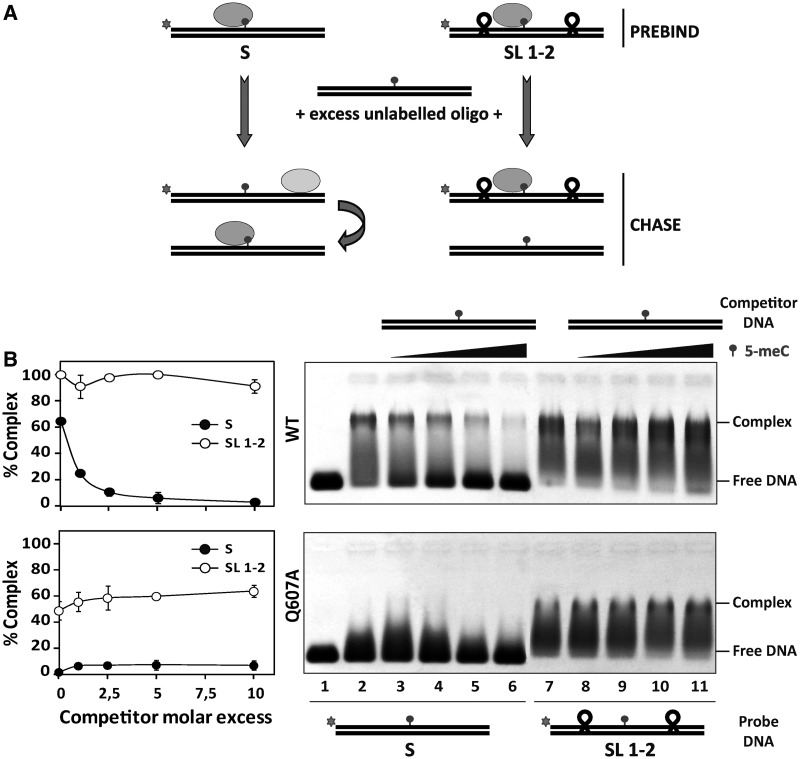
Active DNA demethylation is crucial for epigenetic control, but the underlying enzymatic mechanisms are incompletely understood. REPRESSOR OF SILENCING 1 (ROS1) is a 5-methylcytosine (5-meC) DNA glycosylase/lyase that initiates DNA demethylation in plants through a base excision repair process. The enzyme binds DNA nonspecifically and slides along the substrate in search of 5-meC. In this work, we have used homology modelling and biochemical analysis to gain insight into the mechanism of target location and recognition by ROS1. We have found that three putative helix-intercalating residues (Q607, R903 and M905) are required for processing of 5-meC:G pairs, but dispensable for excision of mismatched 5-meC. Mutant proteins Q607A, R903A and M905G retain the capacity to process an abasic site opposite G, thus suggesting that all three residues play a critical role in early steps of the base extrusion process and likely contribute to destabilization of 5-meC:G pairs. While R903 and M905 are not essential for DNA binding, mutation of Q607 abrogates stable binding to both methylated and nonmethylated DNA. However, the mutant protein Q607A can form stable complexes with DNA substrates containing blocked ends, which suggests that Q607 intercalates into the helix and inhibits sliding. Altogether, our results suggest that ROS1 uses three predicted helix-invading residues to actively interrogate DNA in search for 5-meC.
活性 DNA 去甲基化对于表观遗传控制至关重要,但相关的酶促机制尚未完全阐明。沉默抑制因子 1(ROS1)是一种 5-甲基胞嘧啶(5-meC)DNA 糖苷酶/裂合酶,它通过碱基切除修复过程在植物中启动 DNA 去甲基化。该酶非特异性地结合 DNA,并在底物上滑动以寻找 5-meC。在这项工作中,我们使用同源建模和生化分析深入了解了 ROS1 靶标定位和识别的机制。我们发现三个假定的螺旋插入残基(Q607、R903 和 M905)对于 5-meC:G 对的处理是必需的,但对于错配的 5-meC 的切除是可有可无的。突变蛋白 Q607A、R903A 和 M905G 保留了处理 G 对面碱基缺失的能力,这表明所有三个残基在碱基外排过程的早期步骤中发挥关键作用,并可能有助于 5-meC:G 对的不稳定。虽然 R903 和 M905 对于 DNA 结合不是必需的,但 Q607 的突变会使蛋白质完全丧失与甲基化和非甲基化 DNA 的稳定结合能力。然而,突变蛋白 Q607A 可以与含有封闭末端的 DNA 底物形成稳定的复合物,这表明 Q607 插入螺旋并抑制滑动。总之,我们的结果表明,ROS1 使用三个预测的螺旋入侵残基主动探测 DNA 以寻找 5-meC。