Cantonal Institute of Pathology, Ticino Cancer Registry, Locarno, Switzerland.
BMJ Open. 2013 Jul 17;3(7). doi: 10.1136/bmjopen-2013-002818. Print 2013.
Assessing the quality of cancer care (QoCC) has become increasingly important to providers, regulators and purchasers of care worldwide. The aim of this study was to develop evidence-based quality indicators (QIs) for colorectal cancer (CRC) to be applied in a population-based setting.
A comprehensive evidence-based literature search was performed to identify the initial list of QIs, which were then selected and developed using a two-step-modified Delphi process involving two multidisciplinary expert panels with expertise in CRC care, quality of care and epidemiology.
The QIs of the clinical cancer care (QC3) population-based project, which involves all the public and private hospitals and clinics present on the territory of Canton Ticino (South Switzerland).
Ticino Cancer Registry, The Colorectal Cancer Working Group (CRC-WG) and the external academic Advisory Board (AB).
Set of QIs which encompass the whole diagnostic-treatment process of CRC.
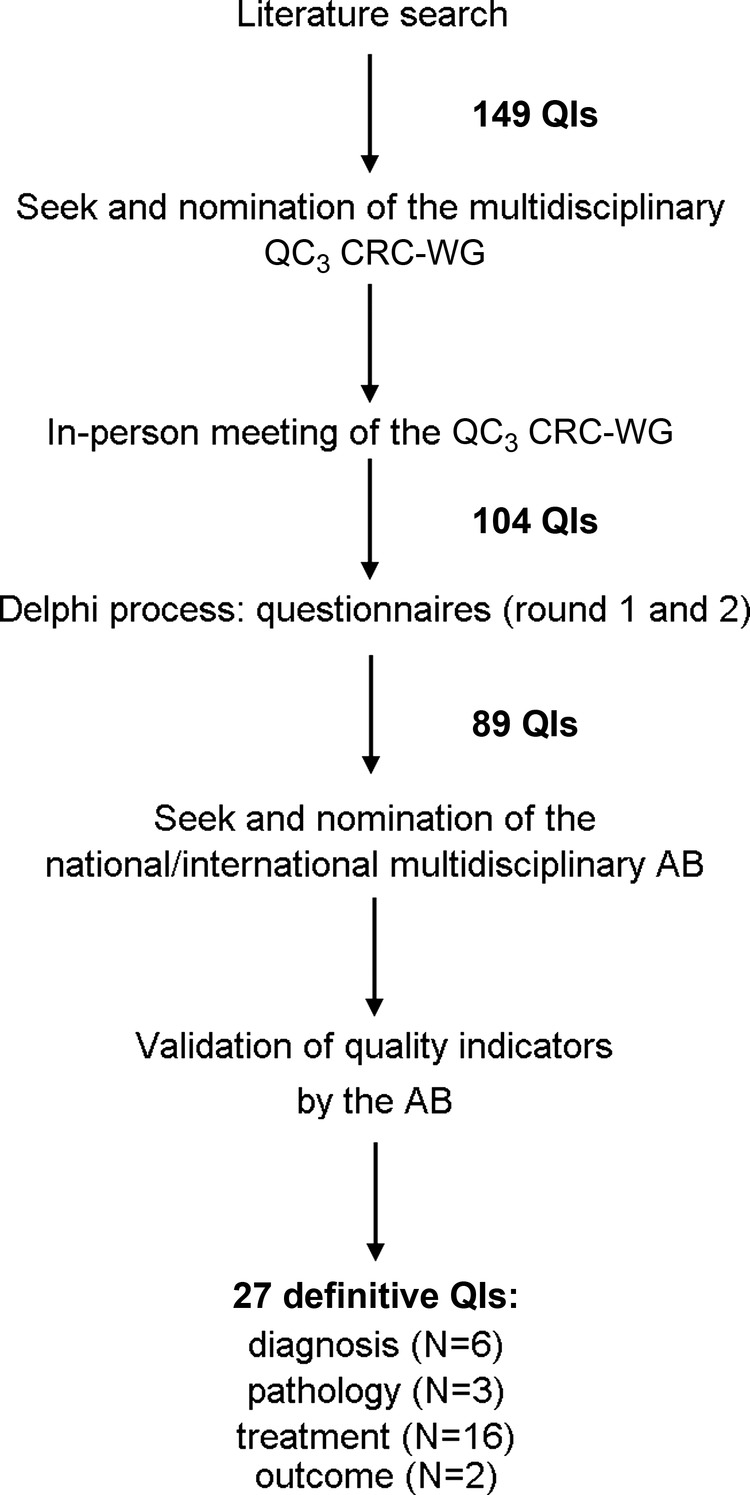
Of the 149 QIs that emerged from 181 sources of literature, 104 were selected during the in-person meeting of CRC-WG. During the Delphi process, CRC-WG shortened the list to 89 QI. AB finally validated 27 QIs according to the phase of care: diagnosis (N=6), pathology (N=3), treatment (N=16) and outcome (N=2).
Using the validated Delphi methodology, including a literature review of the evidence and integration of expert opinions from local clinicians and international experts, we were able to develop a list of QIs to assess QoCC for CRC. This will hopefully guarantee feasibility of data retrieval, as well as acceptance and translation of QIs into the daily clinical practice to improve QoCC. Moreover, evidence-based selected QIs allow one to assess immediate changes and improvements in the diagnostic-therapeutic process that could be translated into a short-term benefit for patients with a possible gain both in overall and disease-free survival.
评估癌症治疗质量(QoCC)对于全球范围内的医疗服务提供者、监管者和购买者来说变得越来越重要。本研究的目的是为结直肠癌(CRC)制定基于证据的质量指标(QIs),以便在基于人群的环境中应用。
进行了全面的基于证据的文献检索,以确定初始 QI 清单,然后使用两步修正 Delphi 过程选择和开发这些 QI,该过程涉及两个具有 CRC 护理、护理质量和流行病学专业知识的多学科专家小组。
临床癌症护理(QC3)基于人群项目的 QIs,涉及提契诺州(瑞士南部)的所有公立和私立医院和诊所。
提契诺癌症登记处、结直肠癌工作组(CRC-WG)和外部学术咨询委员会(AB)。
一套涵盖 CRC 整个诊断-治疗过程的 QIs。
从 181 个文献来源中出现了 149 个 QI,CRC-WG 在现场会议中选择了 104 个。在 Delphi 过程中,CRC-WG 将清单缩短至 89 个 QI。AB 根据护理阶段最终验证了 27 个 QI:诊断(N=6)、病理学(N=3)、治疗(N=16)和结果(N=2)。
使用经过验证的 Delphi 方法,包括对证据的文献综述以及整合当地临床医生和国际专家的专家意见,我们能够开发出一套用于评估 CRC 患者 QoCC 的 QI 清单。这有望确保数据检索的可行性,以及 QI 在日常临床实践中的接受和转化,以提高 QoCC。此外,基于证据选择的 QI 可以评估诊断-治疗过程中的即时变化和改进,这可能转化为患者的短期获益,从而有可能在总体和无病生存率方面获得收益。