INSERM U 972, IFR 93, Bicêtre Hospital, and Paul Brousse Hospital, Villejuif F-94807, France.
BMC Biol. 2013 Jul 19;11:86. doi: 10.1186/1741-7007-11-86.
Human pluripotent stem cells (hPSCs) hold great promise for applications in regenerative medicine. However, the safety of cell therapy using differentiated hPSC derivatives must be improved through methods that will permit the transplantation of homogenous populations of a specific cell type. To date, purification of progenitors and mature cells generated from either embryonic or induced pluripotent stem cells remains challenging with use of conventional methods.
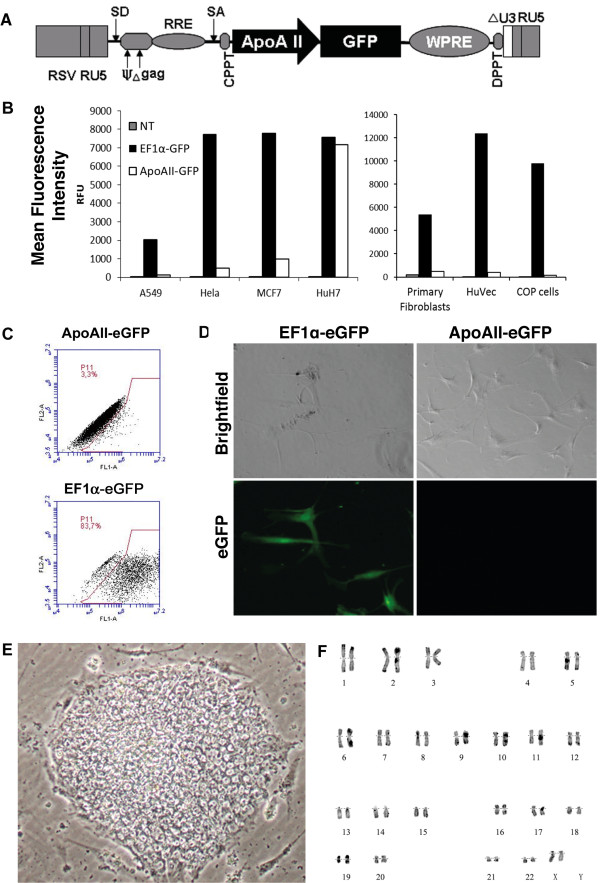
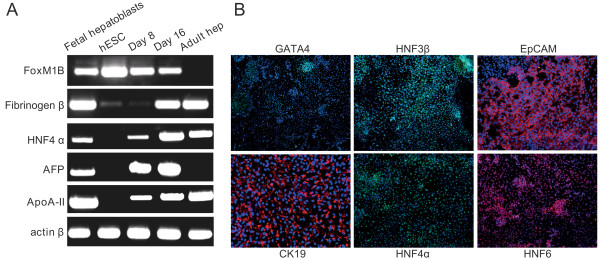
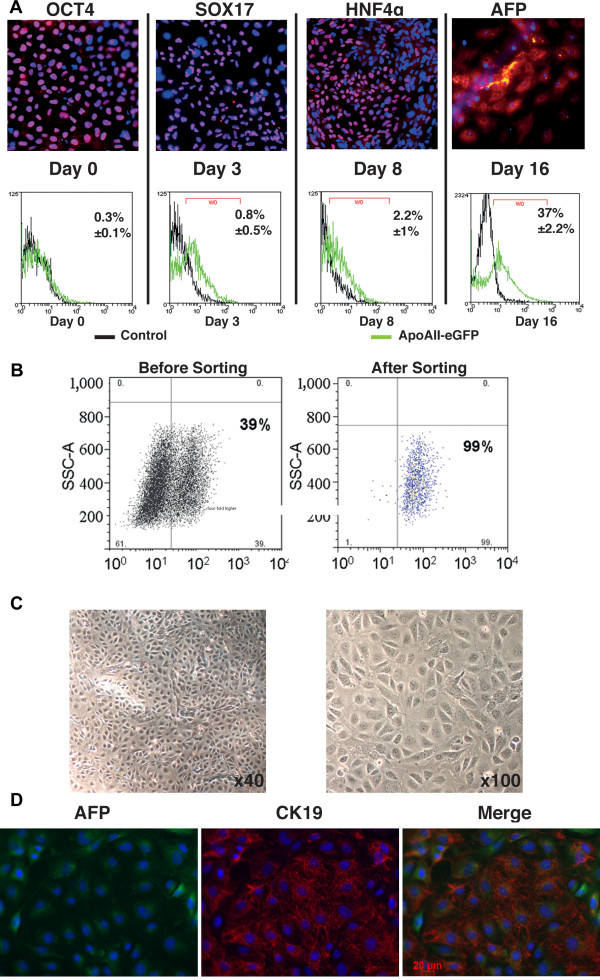
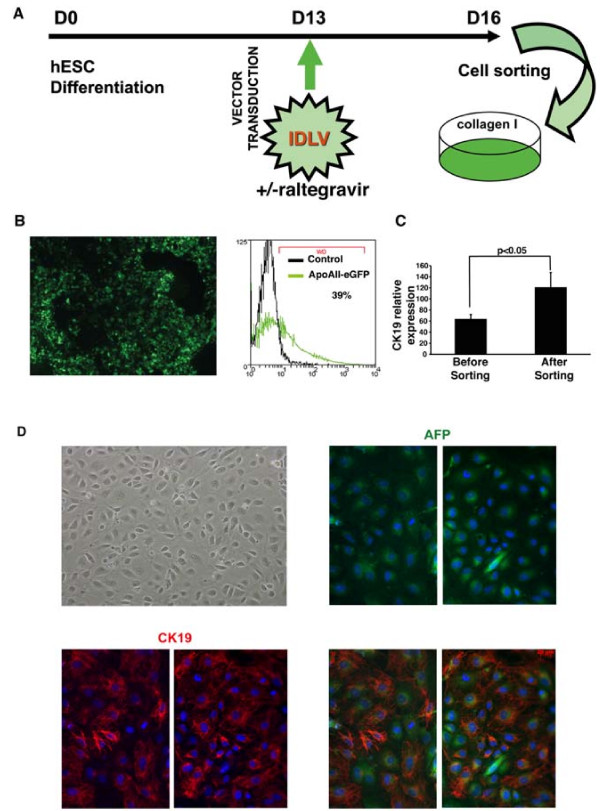
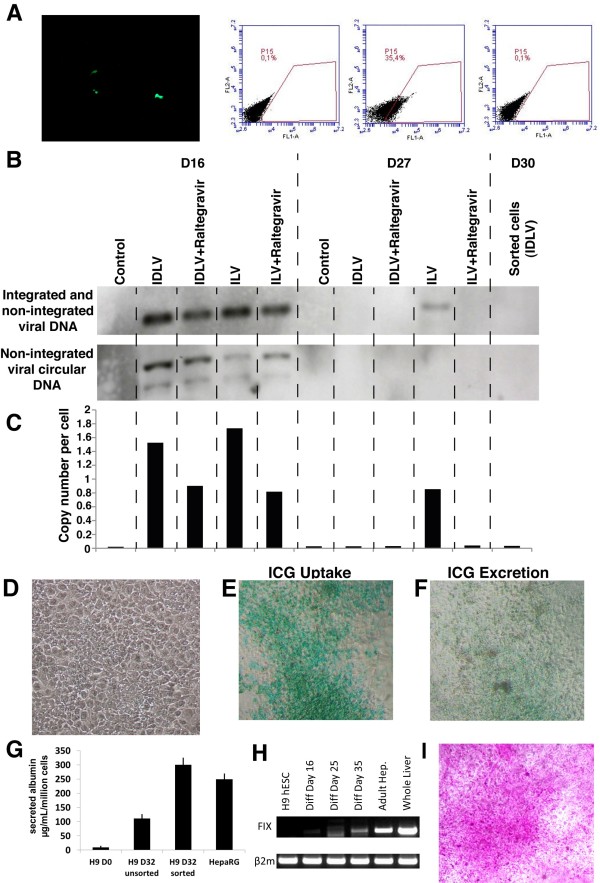
We used lentivectors encoding green fluorescent protein (GFP) driven by the liver-specific apoliprotein A-II (APOA-II) promoter to purify human hepatic progenitors. We evaluated both integrating and integration-defective lentivectors in combination with an HIV integrase inhibitor. A human embryonic stem cell line was differentiated into hepatic progenitors using a chemically defined protocol. Subsequently, cells were transduced and sorted at day 16 of differentiation to obtain a cell population enriched in hepatic progenitor cells. After sorting, more than 99% of these APOA-II-GFP-positive cells expressed hepatoblast markers such as α-fetoprotein and cytokeratin 19. When further cultured for 16 days, these cells underwent differentiation into more mature cells and exhibited hepatocyte properties such as albumin secretion. Moreover, they were devoid of vector DNA integration.
We have developed an effective strategy to purify human hepatic cells from cultures of differentiating hPSCs, producing a novel tool that could be used not only for cell therapy but also for in vitro applications such as drug screening. The present strategy should also be suitable for the purification of a broad range of cell types derived from either pluripotent or adult stem cells.
人类多能干细胞(hPSCs)在再生医学应用中具有巨大的应用前景。然而,通过允许同种异质性细胞类型移植的方法,必须提高使用分化 hPSC 衍生物的细胞治疗的安全性。迄今为止,使用传统方法,仍然难以对胚胎或诱导多能干细胞产生的祖细胞和成熟细胞进行纯化。
我们使用编码绿色荧光蛋白(GFP)的慢病毒载体,该载体由肝脏特异性载脂蛋白 A-II(APOA-II)启动子驱动,以纯化人类肝祖细胞。我们评估了整合和非整合缺陷型慢病毒载体与 HIV 整合酶抑制剂的联合使用。使用化学定义的方案将人胚胎干细胞系分化为肝祖细胞。随后,在分化的第 16 天对细胞进行转导和分选,以获得富含肝祖细胞的细胞群体。分选后,这些 APOA-II-GFP 阳性细胞中超过 99%表达肝母细胞标志物,如甲胎蛋白和角蛋白 19。当进一步培养 16 天时,这些细胞分化为更成熟的细胞,并表现出肝细胞特性,如白蛋白分泌。此外,它们没有载体 DNA 整合。
我们已经开发出一种从分化的 hPSC 培养物中纯化人肝细胞的有效策略,产生了一种新的工具,不仅可用于细胞治疗,还可用于药物筛选等体外应用。本策略也应适用于从多能或成体干细胞衍生的广泛细胞类型的纯化。