Department of Physiology and Pennsylvania Muscle Institute, Perelman School of Medicine, University of Pennsylvania, Philadelphia, Pennsylvania, United States of America.
PLoS Biol. 2013 Jul;11(7):e1001611. doi: 10.1371/journal.pbio.1001611. Epub 2013 Jul 16.
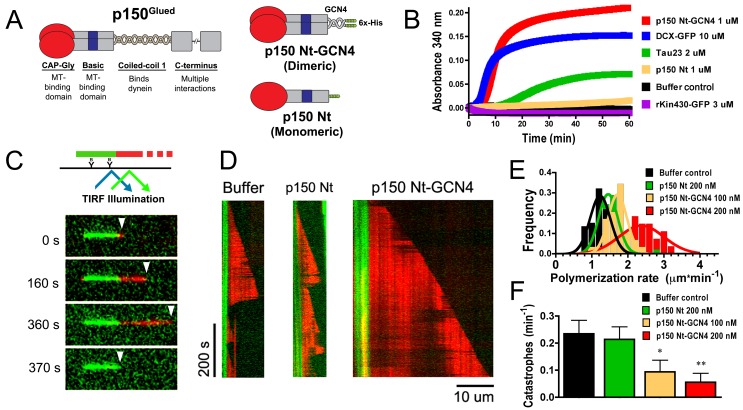
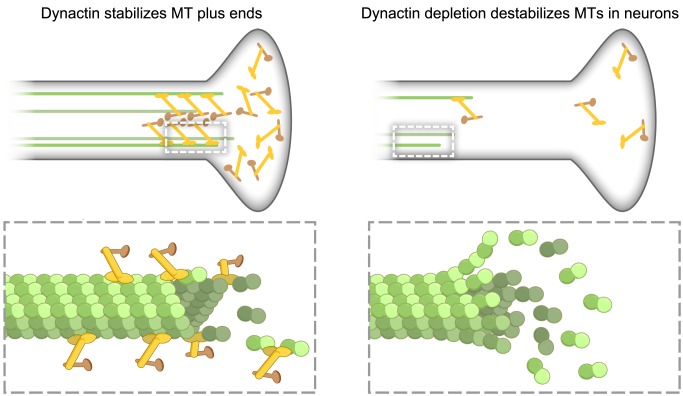
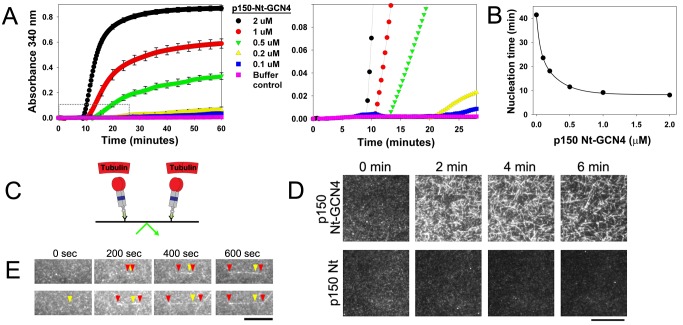
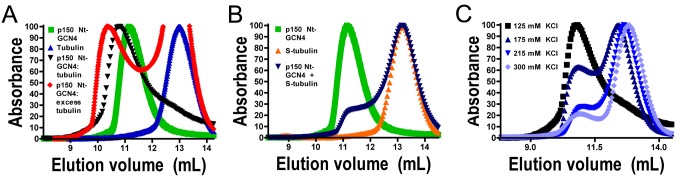
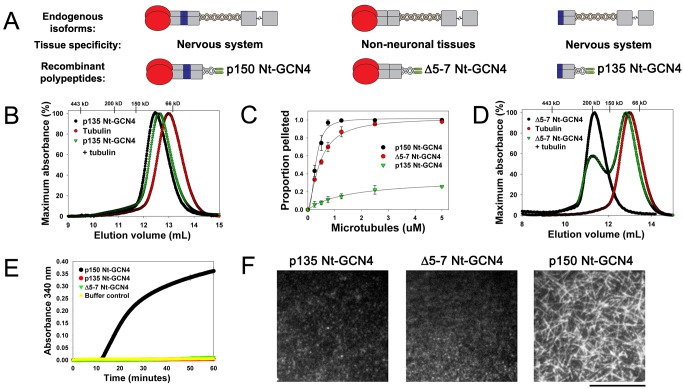
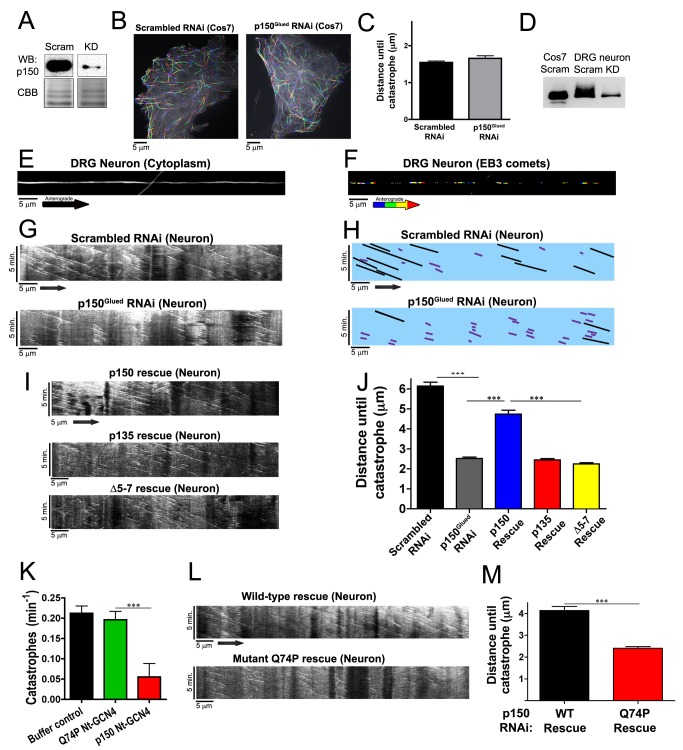
Regulation of microtubule dynamics in neurons is critical, as defects in the microtubule-based transport of axonal organelles lead to neurodegenerative disease. The microtubule motor cytoplasmic dynein and its partner complex dynactin drive retrograde transport from the distal axon. We have recently shown that the p150(Glued) subunit of dynactin promotes the initiation of dynein-driven cargo motility from the microtubule plus-end. Because plus end-localized microtubule-associated proteins like p150(Glued) may also modulate the dynamics of microtubules, we hypothesized that p150(Glued) might promote cargo initiation by stabilizing the microtubule track. Here, we demonstrate in vitro using assembly assays and TIRF microscopy, and in primary neurons using live-cell imaging, that p150(Glued) is a potent anti-catastrophe factor for microtubules. p150(Glued) alters microtubule dynamics by binding both to microtubules and to tubulin dimers; both the N-terminal CAP-Gly and basic domains of p150(Glued) are required in tandem for this activity. p150(Glued) is alternatively spliced in vivo, with the full-length isoform including these two domains expressed primarily in neurons. Accordingly, we find that RNAi of p150(Glued) in nonpolarized cells does not alter microtubule dynamics, while depletion of p150(Glued) in neurons leads to a dramatic increase in microtubule catastrophe. Strikingly, a mutation in p150(Glued) causal for the lethal neurodegenerative disorder Perry syndrome abrogates this anti-catastrophe activity. Thus, we find that dynactin has multiple functions in neurons, both activating dynein-mediated retrograde axonal transport and enhancing microtubule stability through a novel anti-catastrophe mechanism regulated by tissue-specific isoform expression; disruption of either or both of these functions may contribute to neurodegenerative disease.
神经元中微管动力学的调节至关重要,因为轴突细胞器的基于微管的运输缺陷会导致神经退行性疾病。微管马达细胞质动力蛋白及其伴侣复合物 dynactin 驱动从远端轴突的逆行运输。我们最近表明,dynactin 的 p150(Glued)亚基促进了动力蛋白驱动货物从微管正端开始运动。由于像 p150(Glued)这样定位于微管正端的微管相关蛋白也可能调节微管的动力学,我们假设 p150(Glued)可能通过稳定微管轨道来促进货物的起始。在这里,我们使用组装测定和 TIRF 显微镜在体外证明,并且在原代神经元中使用活细胞成像证明,p150(Glued)是微管的有效抗解聚因子。p150(Glued)通过与微管和微管二聚体结合来改变微管动力学;p150(Glued)的 N 端 CAP-Gly 和碱性结构域都需要串联才能发挥此活性。p150(Glued)在体内发生可变剪接,全长异构体主要在神经元中表达,包括这两个结构域。因此,我们发现非极化细胞中 p150(Glued)的 RNAi 不会改变微管动力学,而神经元中 p150(Glued)的耗竭会导致微管解聚的急剧增加。引人注目的是,导致致命神经退行性疾病 Perry 综合征的 p150(Glued)突变会破坏这种抗解聚活性。因此,我们发现 dynactin 在神经元中具有多种功能,既能激活动力蛋白介导的逆行轴突运输,又能通过组织特异性异构体表达调节的新的抗解聚机制增强微管稳定性;这两种功能的任何一种或两种的破坏都可能导致神经退行性疾病。