Aston Brain Centre, School of Life and Health Sciences, Aston University Birmingham, UK ; Sobell Department of Motor Neuroscience and Movement Disorders, UCL Institute of Neurology London, UK.
Front Hum Neurosci. 2013 Jul 15;7:362. doi: 10.3389/fnhum.2013.00362. eCollection 2013.
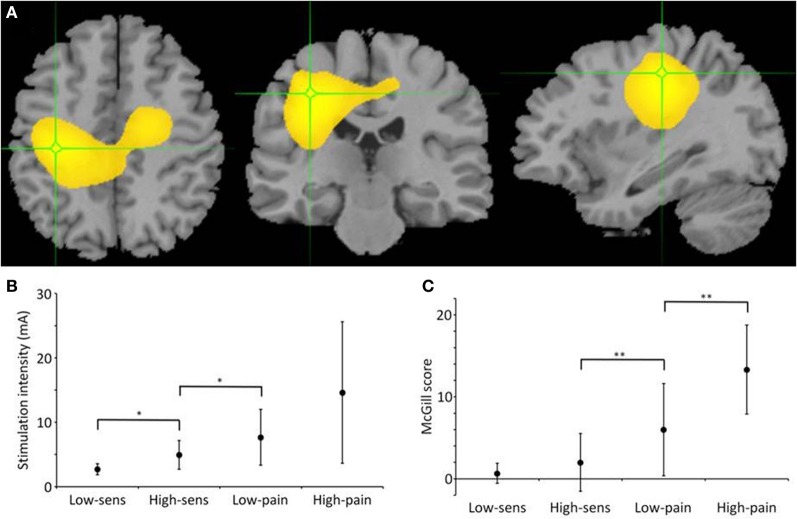
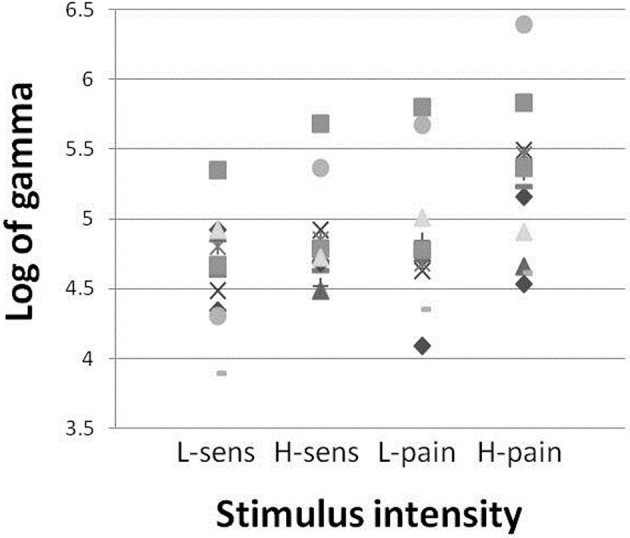
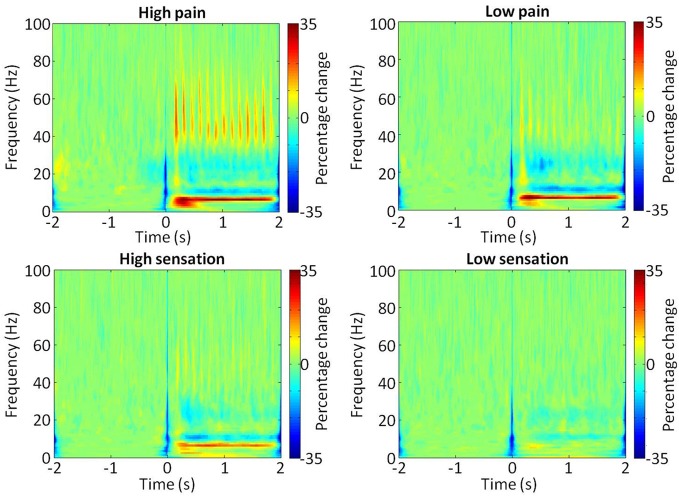
Gamma oscillations have previously been linked to pain perception and it has been hypothesized that they may have a potential role in encoding pain intensity. Stimulus response experiments have reported an increase in activity in the primary somatosensory cortex (SI) with increasing stimulus intensity, but the specific role of oscillatory dynamics in this change in activation remains unclear. In this study, Magnetoencephalography (MEG) was used to investigate the changes in cortical oscillations during four different intensities of a train of electrical stimuli to the right index finger, ranging from low sensation to strong pain. In those participants showing changes in evoked oscillatory gamma in SI during stimulation, the strength of the gamma power was found to increase with increasing stimulus intensity at both pain and sub-pain thresholds. These results suggest that evoked gamma oscillations in SI are not specific to pain but may have a role in encoding somatosensory stimulus intensity.
伽马振荡先前与疼痛感知有关,有人假设它们可能在编码疼痛强度方面具有潜在作用。刺激反应实验报告称,随着刺激强度的增加,初级体感皮层(SI)的活动增加,但在这种激活变化中,振荡动力学的具体作用尚不清楚。在这项研究中,使用脑磁图(MEG)来研究在右手食指的电刺激序列的四个不同强度下,皮层振荡的变化,从低感觉到强痛。在那些在刺激过程中显示出 SI 中诱发性γ振荡变化的参与者中,发现γ功率的强度随着疼痛和亚痛阈值下刺激强度的增加而增加。这些结果表明,SI 中的诱发性γ振荡并不是特异性疼痛的,但可能在编码体感刺激强度方面具有作用。