Ecological Services, U.S. Fish & Wildlife Service, Arlington, Virginia, United States of America.
PLoS One. 2013 Jul 10;8(7):e67867. doi: 10.1371/journal.pone.0067867. Print 2013.
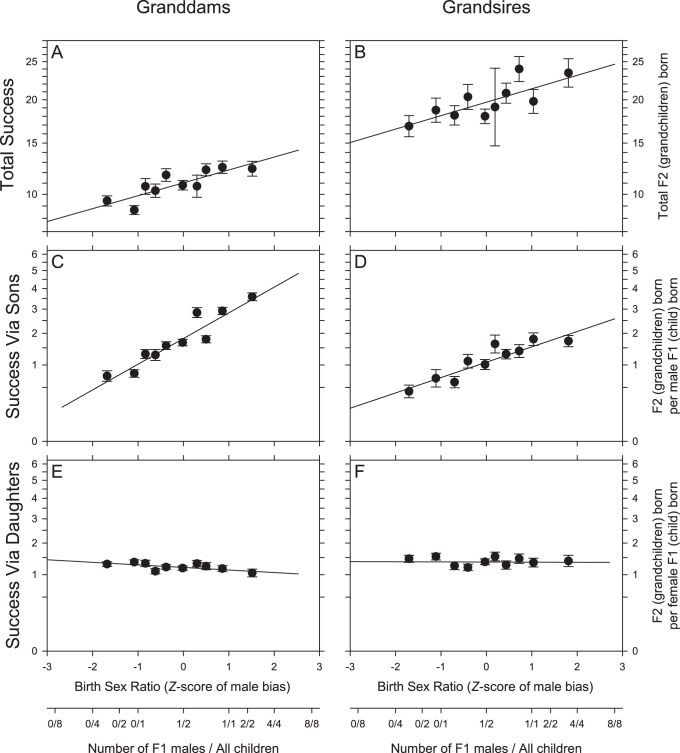
Population dynamics predicts that on average parents should invest equally in male and female offspring; similarly, the physiology of mammalian sex determination is supposedly stochastic, producing equal numbers of sons and daughters. However, a high quality parent can maximize fitness by biasing their birth sex ratio (SR) to the sex with the greatest potential to disproportionately outperform peers. All SR manipulation theories share a fundamental prediction: grandparents who bias birth SR should produce more grandoffspring via the favored sex. The celebrated examples of biased birth SRs in nature consistent with SR manipulation theories provide compelling circumstantial evidence. However, this prediction has never been directly tested in mammals, primarily because the complete three-generation pedigrees needed to test whether individual favored offspring produce more grandoffspring for the biasing grandparent are essentially impossible to obtain in nature. Three-generation pedigrees were constructed using 90 years of captive breeding records from 198 mammalian species. Male and female grandparents consistently biased their birth SR toward the sex that maximized second-generation success. The most strongly male-biased granddams and grandsires produced respectively 29% and 25% more grandoffspring than non-skewing conspecifics. The sons of the most male-biasing granddams were 2.7 times as fecund as those of granddams with a 50∶50 bias (similar results are seen in grandsires). Daughters of the strongest female-biasing granddams were 1.2 times as fecund as those of non-biasing females (this effect is not seen in grandsires). To our knowledge, these results are the first formal test of the hypothesis that birth SR manipulation is adaptive in mammals in terms of grandchildren produced, showing that SR manipulation can explain biased birth SR in general across mammalian species. These findings also have practical implications: parental control of birth SR has the potential to accelerate genetic loss and risk of extinction within captive populations of endangered species.
种群动态预测,父母平均应平等地投资于雄性和雌性后代;同样,哺乳动物性别决定的生理学据称是随机的,产生的雄性和雌性后代数量相等。然而,高质量的父母可以通过偏向他们的出生性别比例(SR)来最大化适应度,使性别偏向具有最大潜力的后代。所有的 SR 操纵理论都有一个基本的预测:偏向出生 SR 的祖父母应该通过受青睐的性别产生更多的孙辈。自然界中具有偏向性出生 SR 的著名例子与 SR 操纵理论一致,提供了令人信服的间接证据。然而,这一预测从未在哺乳动物中得到直接检验,主要是因为在自然界中,获得完全的三代系谱来检验偏向性的个体是否会为偏向性的祖父母产生更多的孙辈,这几乎是不可能的。三代系谱是使用 198 种哺乳动物 90 年的圈养繁殖记录构建的。雄性和雌性的祖父母一直偏向于使第二代表现最佳的性别出生。最强烈的男性偏向祖母和祖父分别比非偏向的同物种产生 29%和 25%更多的孙辈。最偏向男性的祖母的孙子比具有 50∶50 偏向的祖母的孙子多 2.7 倍(在祖父中也有类似的结果)。最强女性偏向祖母的孙女比非偏向女性的孙女多 1.2 倍(在祖父中则没有这种情况)。据我们所知,这些结果是首次正式检验了出生性别比操纵在产生孙辈方面是适应性的假设,表明出生性别比操纵可以解释哺乳动物中普遍存在的偏向性出生性别比。这些发现还具有实际意义:父母控制出生性别比有可能加速濒危物种圈养种群中的遗传损失和灭绝风险。