Institute of Infection, Immunity & Inflammation, College of Medical, Veterinary & Life Sciences, University of Glasgow, Glasgow, United Kingdom.
Antimicrob Agents Chemother. 2013 Oct;57(10):4882-93. doi: 10.1128/AAC.00508-13. Epub 2013 Jul 22.
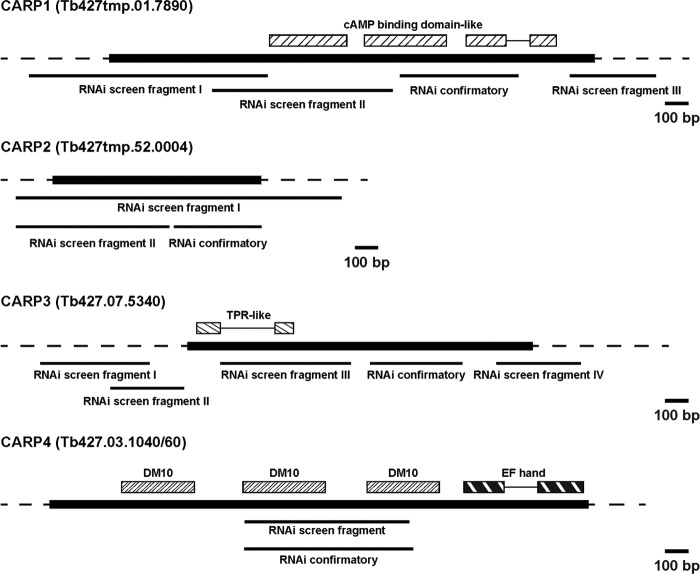
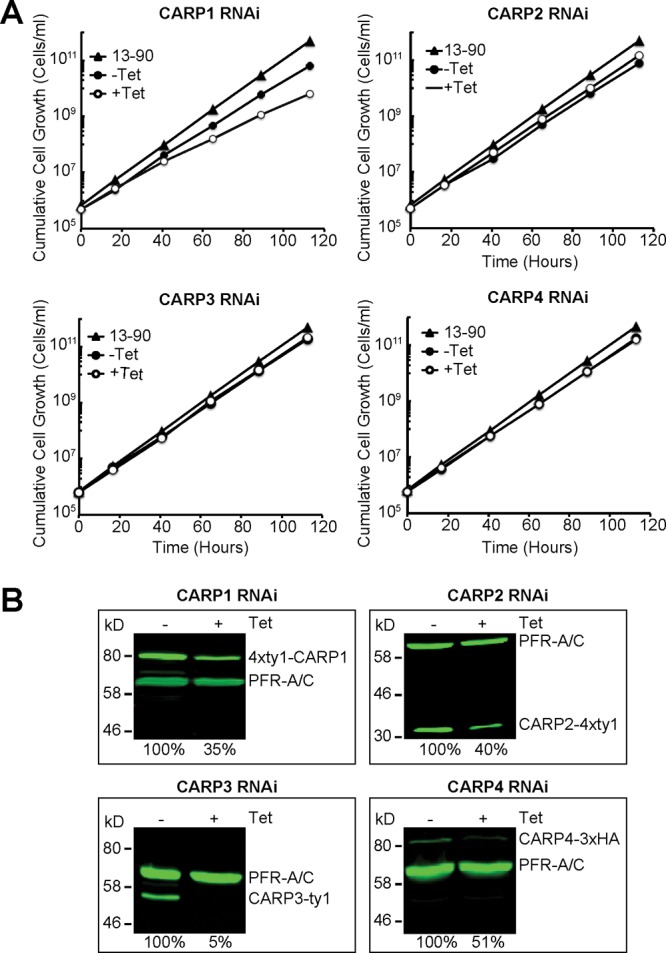
One of the most promising new targets for trypanocidal drugs to emerge in recent years is the cyclic AMP (cAMP) phosphodiesterase (PDE) activity encoded by TbrPDEB1 and TbrPDEB2. These genes were genetically confirmed as essential, and a high-affinity inhibitor, CpdA, displays potent antitrypanosomal activity. To identify effectors of the elevated cAMP levels resulting from CpdA action and, consequently, potential sites for adaptations giving resistance to PDE inhibitors, resistance to the drug was induced. Selection of mutagenized trypanosomes resulted in resistance to CpdA as well as cross-resistance to membrane-permeable cAMP analogues but not to currently used trypanocidal drugs. Resistance was not due to changes in cAMP levels or in PDEB genes. A second approach, a genome-wide RNA interference (RNAi) library screen, returned four genes giving resistance to CpdA upon knockdown. Validation by independent RNAi strategies confirmed resistance to CpdA and suggested a role for the identified cAMP Response Proteins (CARPs) in cAMP action. CARP1 is unique to kinetoplastid parasites and has predicted cyclic nucleotide binding-like domains, and RNAi repression resulted in >100-fold resistance. CARP2 and CARP4 are hypothetical conserved proteins associated with the eukaryotic flagellar proteome or with flagellar function, with an orthologue of CARP4 implicated in human disease. CARP3 is a hypothetical protein, unique to Trypanosoma. CARP1 to CARP4 likely represent components of a novel cAMP signaling pathway in the parasite. As cAMP metabolism is validated as a drug target in Trypanosoma brucei, cAMP effectors highly divergent from the mammalian host, such as CARP1, lend themselves to further pharmacological development.
近年来,最有前途的新型抗锥虫药物靶标之一是由 TbrPDEB1 和 TbrPDEB2 编码的环 AMP(cAMP)磷酸二酯酶(PDE)活性。这些基因已通过遗传确认是必需的,并且高亲和力抑制剂 CpdA 显示出强大的抗锥虫活性。为了鉴定 CpdA 作用导致的 cAMP 水平升高的效应物,并且因此鉴定出对 PDE 抑制剂产生抗性的潜在适应位点,诱导了对该药物的抗性。诱变的锥虫的选择导致对 CpdA 的抗性以及对膜通透 cAMP 类似物的交叉抗性,但对目前使用的杀锥虫药物没有抗性。抗性不是由于 cAMP 水平或 PDEB 基因的变化引起的。第二种方法是全基因组 RNA 干扰(RNAi)文库筛选,该方法在敲低时返回了四个赋予 CpdA 抗性的基因。通过独立的 RNAi 策略进行验证,确认了对 CpdA 的抗性,并表明鉴定出的 cAMP 反应蛋白(CARPs)在 cAMP 作用中起作用。CARP1 是动基体原生动物所独有的,具有预测的环核苷酸结合样结构域,并且 RNAi 抑制导致 >100 倍的抗性。CARP2 和 CARP4 是与真核鞭毛蛋白组或鞭毛功能相关的假定保守蛋白,CARP4 的同源物与人类疾病有关。CARP3 是一种假定的蛋白质,仅存在于锥虫中。CARP1 到 CARP4 可能代表寄生虫中新的 cAMP 信号通路的组成部分。由于 cAMP 代谢已被验证为布氏锥虫的药物靶标,因此与哺乳动物宿主高度不同的 cAMP 效应物,如 CARP1,适合进一步的药理学开发。