Parikh Devangi A, Kolli Sagar N, Karnik Hemangi S, Lele Smita S, Tendolkar Bharati A
Department of Anesthesia, Lokmanya Tilak Municipal Medical College and Lokmanya Tilak Municipal General Hospital, Sion, Mumbai, India.
J Anaesthesiol Clin Pharmacol. 2013 Apr;29(2):173-8. doi: 10.4103/0970-9185.111671.
Analgesia and sedation are usually required for the comfort of the patient and surgeon during tympanoplasty surgery done under local anesthesia. In this study, satisfaction scores and effectiveness of sedation and analgesia with dexmedetomidine were compared with a combination of midazolam-fentanyl.
Ninety patients undergoing tympanoplasty under local anesthesia randomly received either IV dexmedetomidine 1 μg kg(-1) over 10 min followed by 0.2 μg kg(-1)h(-1) infusion (Group D) or IV midazolam 0.06 mg kg(-1) plus IV fentanyl 1 μg kg(-1) over 10 min (Group MF) followed by normal saline infusion at 0.2 ml kg(-1)h(-1). Sedation was titrated to Ramsay sedation score (RSS) of three. Vital parameters, rescue analgesics (fentanyl 1 μg kg(-1)) and sedatives (midazolam 0.01 mg kg(-1)), patient and surgeon satisfaction scores were recorded.
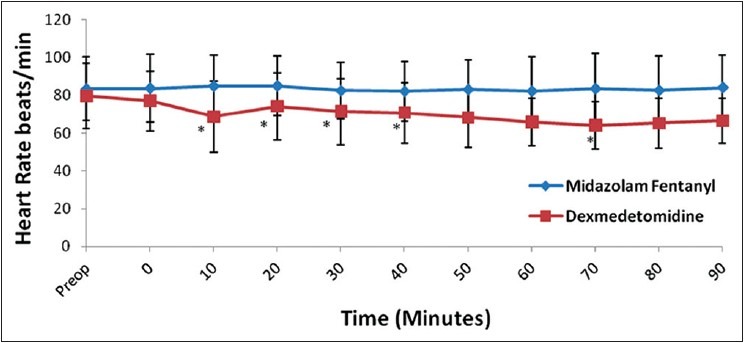
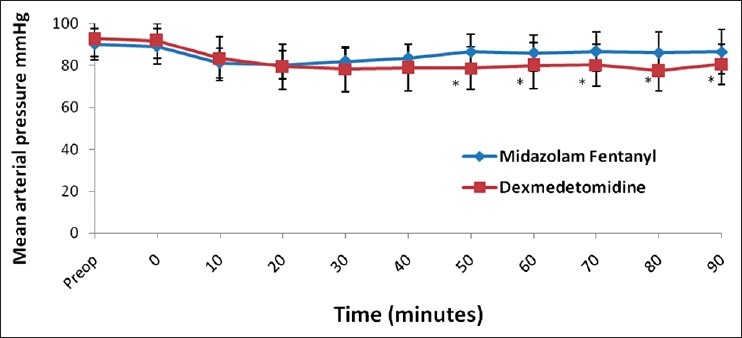
Patient and surgeon satisfaction score was better in Group D than Group MF (median interquartile range (IQR) 9 (8-10) vs. 8 (6.5-9.5) and 9 (8.5-9.5) vs. 8 (6.75-9.25), P = 0.0001 for both). Intraoperative heart rate and mean arterial pressure in Group D were lower than the baseline values and the corresponding values in Group MF (P < 0.05). Percentage of patients requiring rescue fentanyl was higher in Group MF than Group D (40% vs. 11.1%, P = 0.01). One patient in Group D while four in Group MF (8.8%) required rescue sedation with midazolam (P > 0.17). Seven patients in Group D had dry mouth vs. none in Group MF (P = 0.006). One patient in Group D had bradycardia with hypotension which was effectively treated.
Dexmedetomidine is comparable to midazolam-fentanyl for sedation and analgesia in tympanoplasty with better surgeon and patient satisfaction. Hemodynamics need to be closely monitored.
在局部麻醉下进行鼓室成形术时,通常需要进行镇痛和镇静以确保患者和外科医生的舒适度。在本研究中,比较了右美托咪定与咪达唑仑 - 芬太尼联合使用时的镇静和镇痛满意度评分及效果。
90例在局部麻醉下接受鼓室成形术的患者被随机分为两组,一组在10分钟内静脉注射右美托咪定1μg/kg,随后以0.2μg/(kg·h)的速度输注(D组);另一组在10分钟内静脉注射咪达唑仑0.06mg/kg加静脉注射芬太尼1μg/kg(MF组),随后以0.2ml/(kg·h)的速度输注生理盐水。将镇静程度调整至Ramsay镇静评分(RSS)为3分。记录生命体征参数、急救镇痛药(芬太尼1μg/kg)和镇静药(咪达唑仑0.01mg/kg)的使用情况、患者和外科医生的满意度评分。
D组患者和外科医生的满意度评分高于MF组(中位数四分位间距(IQR)分别为9(8 - 10)对8(6.5 - 9.5)和9(8.5 - 9.5)对8(6.75 - 9.25),两组P值均为0.0001)。D组术中心率和平均动脉压低于基线值及MF组相应值(P < 0.05)。MF组需要急救芬太尼的患者百分比高于D组(40%对11.1%,P = 0.01)。D组有1例患者而MF组有4例患者(8.8%)需要用咪达唑仑进行急救镇静(P > 0.17)。D组有7例患者出现口干,而MF组无(P = 0.006)。D组有1例患者出现心动过缓伴低血压,经有效治疗。
在鼓室成形术中,右美托咪定在镇静和镇痛方面与咪达唑仑 - 芬太尼相当,外科医生和患者满意度更高。需要密切监测血流动力学。