Centre for Physical Activity Studies, Institute for Health and Social Science Research, Central Queensland University, Queensland, Australia,
J Cancer Surviv. 2013 Dec;7(4):570-81. doi: 10.1007/s11764-013-0296-4. Epub 2013 Jul 26.
Health outcome trials have provided strong evidence that participating in regular physical activity can improve the quality of life and health of post-treatment breast cancer survivors. Focus is now needed on how to promote changes in physical activity behaviour among this group.
This systematic review examines the efficacy of behavioural interventions for promoting physical activity among post-treatment breast cancer survivors.
Behavioural intervention studies published up until July 2012 were identified through a systematic search of two databases: MEDLINE and CINAHL, and by searching reference lists of relevant publications and scanning citation libraries of project staff.
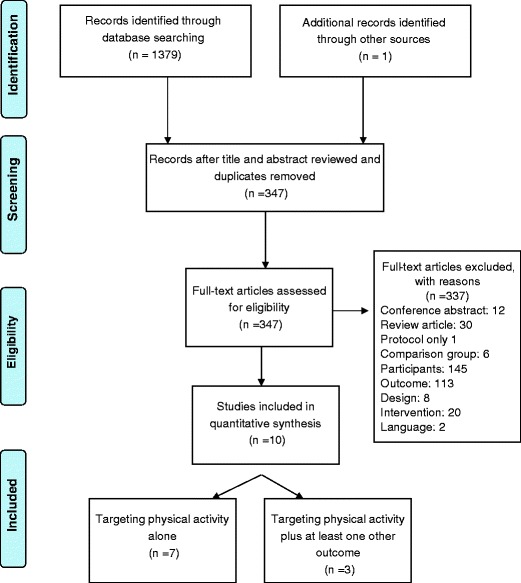
Eight out of the ten identified studies reported positive intervention effects on aerobic physical activity behaviour, ranging from during the intervention period to 6 months post-intervention. Only two studies reported intervention effect sizes. The identification of factors related to efficacy was not possible because of the limited number and heterogeneity of studies included, as well as the lack of effect sizes reported. Nonetheless, an examination of the eight studies that did yield significant intervention effects suggests that 12-week interventions employing behaviour change techniques (e.g., self-monitoring and goal setting) derived from a variety of theories and delivered in a variety of settings (i.e., one-on-one, group or home) can be effective at changing the aerobic physical activity behaviour of breast cancer survivors in the mid- to long terms.
Behavioural interventions do hold promise for effectively changing physical activity behaviour among breast cancer survivors. However, future research is needed to address the lack of studies exploring long-term intervention effects, mediators of intervention effects and interventions promoting resistance-training activity, and to address issues impacting on validity, such as the limited use of objective physical activity measures and the use of convenience samples.
Identifying effective ways of assisting breast cancer survivors to adopt and maintain physical activity is important for enhancing the well-being and health outcomes of this group.
健康结果试验提供了有力的证据,表明定期参加体育活动可以提高治疗后乳腺癌幸存者的生活质量和健康水平。现在需要关注的是如何促进这一群体的身体活动行为的改变。
本系统评价研究了促进治疗后乳腺癌幸存者进行身体活动的行为干预的效果。
通过对两个数据库(MEDLINE 和 CINAHL)进行系统搜索,以及对相关出版物的参考文献列表进行搜索和项目工作人员的引文库进行扫描,确定了截至 2012 年 7 月发表的行为干预研究。
10 项研究中有 8 项报告了对有氧运动行为的积极干预效果,从干预期间到干预后 6 个月不等。只有两项研究报告了干预效果大小。由于纳入研究的数量有限且存在异质性,以及报告的效果大小有限,因此无法确定与疗效相关的因素。尽管如此,对确实产生显著干预效果的 8 项研究进行检查表明,采用来自各种理论并在各种环境下(即一对一、小组或家庭)实施的行为改变技术(例如自我监测和目标设定)的 12 周干预措施,可以在中长期内有效地改变乳腺癌幸存者的有氧运动行为。
行为干预确实有希望有效地改变乳腺癌幸存者的身体活动行为。然而,需要进一步的研究来解决缺乏探索长期干预效果、干预效果的中介因素以及促进阻力训练活动的干预措施的问题,并解决影响有效性的问题,例如有限使用客观的身体活动测量和使用方便的样本。
确定有效帮助乳腺癌幸存者养成并保持身体活动的方法对于增强这一群体的幸福感和健康结果非常重要。