Grigoryan Larissa, Pavlik Valory N, Hyman David J
Department of Family and Community Medicine, Baylor College of Medicine, Houston, TX, USA.
Department of Family and Community Medicine, Baylor College of Medicine, Houston, TX, USA.
J Am Soc Hypertens. 2013 Nov-Dec;7(6):471-6. doi: 10.1016/j.jash.2013.06.004. Epub 2013 Jul 23.
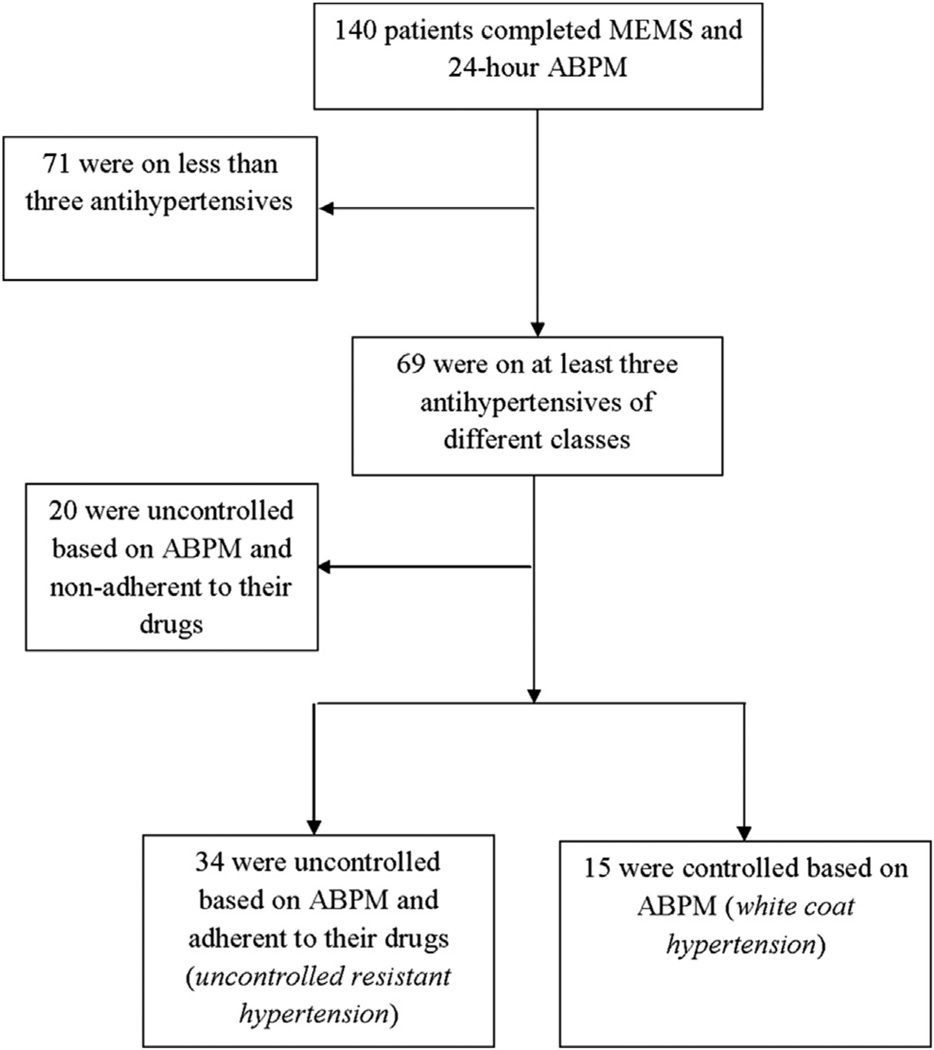
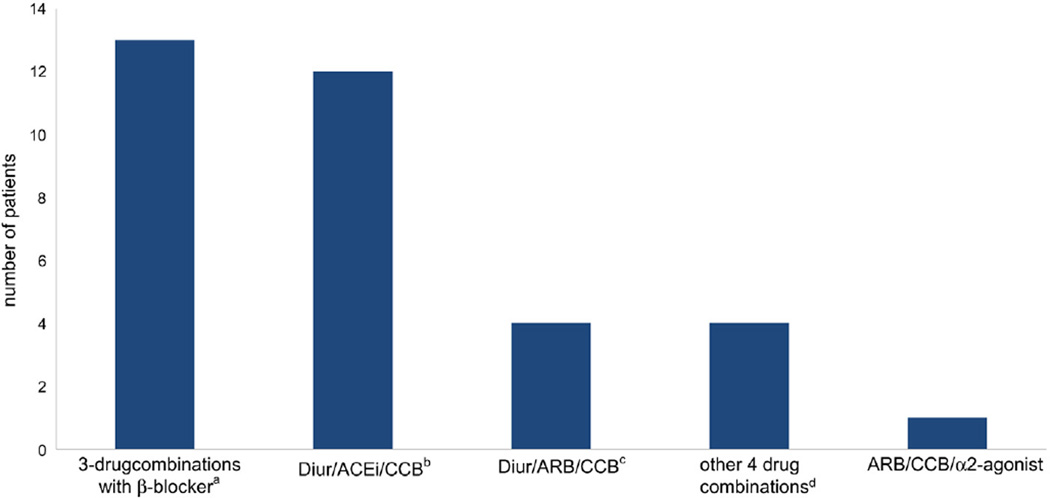
Most studies on the prevalence and determinants of resistant hypertension (RH) do not account for white coat hypertension, medication non-adherence, or use of suboptimal treatment dosages. We studied the characteristics, drug combinations, and dosages of patients on at least three antihypertensives of different classes who had uncontrolled blood pressure on 24-hour ambulatory blood pressure monitoring and high medication adherence measured by electronic monitoring. The data were collected as part of the baseline measures of a hypertension control trial. Of 140 monitored primary care patients, all with uncontrolled office blood pressure, 69 (49%) were on at least three antihypertensives of different classes. Of these 69, 15 (22%) were controlled on ambulatory blood pressure monitoring, 20 (29%) were uncontrolled and non-adherent, leaving only 34 (49%) adherent to their medications and having uncontrolled ambulatory hypertension (uncontrolled RH). Thirty-one (91%) of the 34 uncontrolled RH patients were prescribed a diuretic, of which 24 were on hydrochlorothiazide 25 mg. Less than half of the patients on angiotensin-converting enzyme inhibitor, angiotensin receptor blocker, or calcium channel blocker were prescribed maximal doses of these agents. Half of the RH can be attributed to white coat effect and poor medication adherence, and all of the remaining patients were on apparently suboptimal drug combinations and/or dosages. Primary care physicians need to be educated regarding the optimal treatment of RH.
大多数关于难治性高血压(RH)患病率及决定因素的研究未考虑白大衣高血压、药物治疗依从性差或使用的治疗剂量未达最佳情况。我们研究了在24小时动态血压监测中血压未得到控制且通过电子监测显示药物治疗依从性高的、使用至少三种不同类别降压药的患者的特征、药物组合及剂量。这些数据是作为一项高血压控制试验的基线测量的一部分收集的。在140名接受监测的初级保健患者中,所有患者的诊室血压均未得到控制,其中69名(49%)患者使用了至少三种不同类别的降压药。在这69名患者中,15名(22%)在动态血压监测中血压得到控制,20名(29%)血压未得到控制且存在药物治疗不依从情况,仅剩下34名(49%)患者坚持用药但动态血压仍未得到控制(难治性RH)。34名难治性RH患者中有31名(91%)被处方了利尿剂,其中24名使用的是25毫克氢氯噻嗪。使用血管紧张素转换酶抑制剂、血管紧张素受体阻滞剂或钙通道阻滞剂的患者中,不到一半的患者被处方了这些药物的最大剂量。一半的难治性高血压可归因于白大衣效应和药物治疗依从性差,其余所有患者使用的药物组合和/或剂量显然未达最佳。需要对初级保健医生进行有关难治性高血压最佳治疗方法的培训。