The National Research Centre for the Working Environment, Copenhagen, Denmark.
PLoS One. 2013 Jul 24;8(7):e69020. doi: 10.1371/journal.pone.0069020. Print 2013.
Particulate air pollution is associated with cardiovascular disease. Acute phase response is causally linked to cardiovascular disease. Here, we propose that particle-induced pulmonary acute phase response provides an underlying mechanism for particle-induced cardiovascular risk.
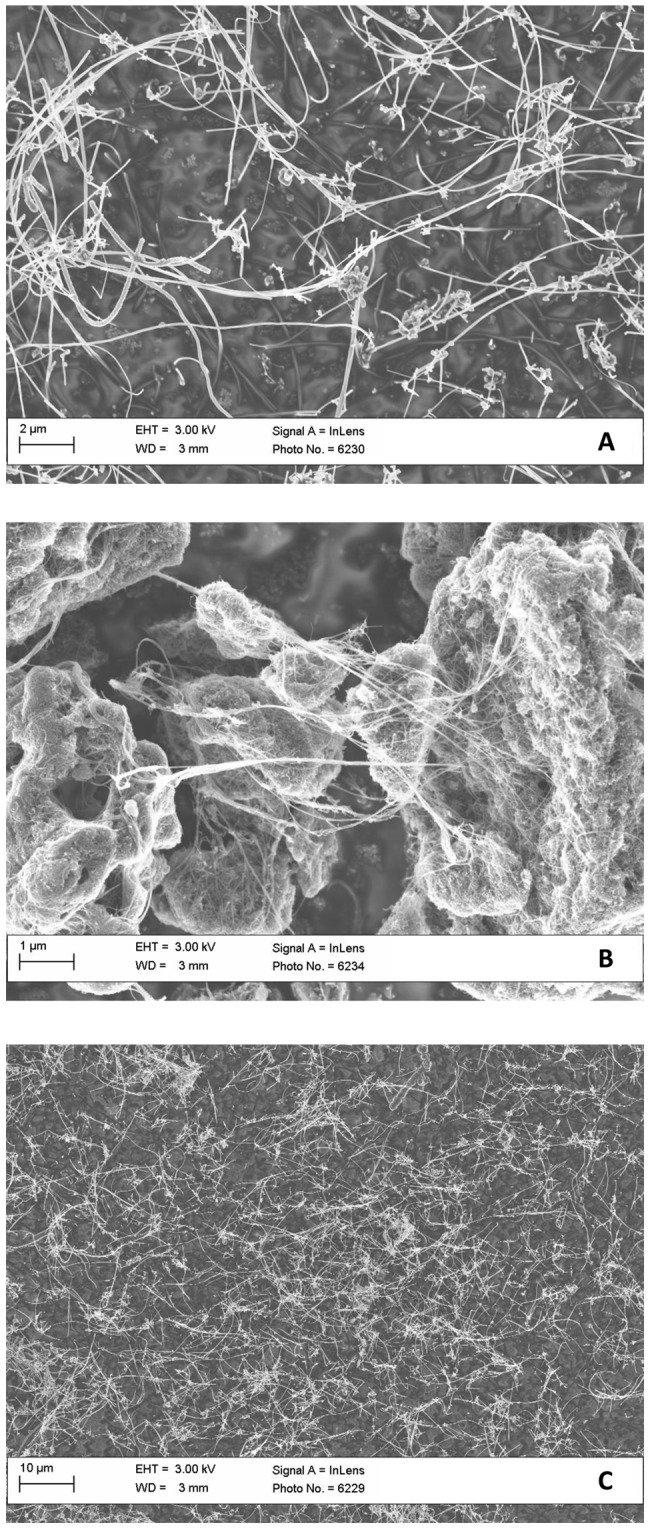
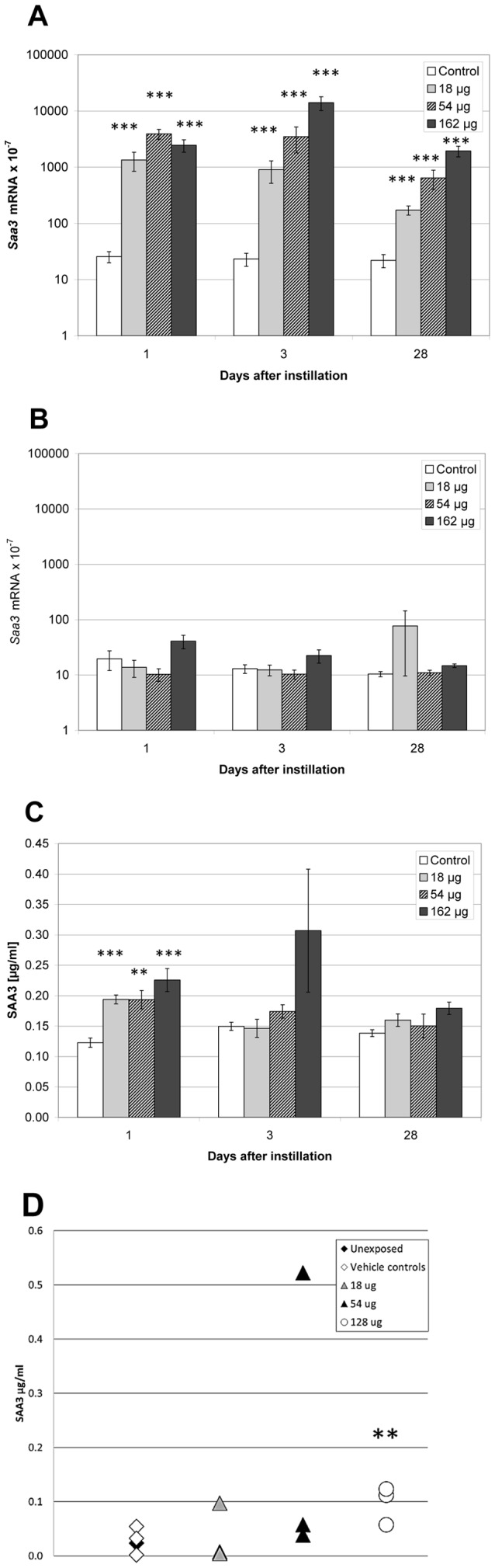
We analysed the mRNA expression of Serum Amyloid A (Saa3) in lung tissue from female C57BL/6J mice exposed to different particles including nanomaterials (carbon black and titanium dioxide nanoparticles, multi- and single walled carbon nanotubes), diesel exhaust particles and airborne dust collected at a biofuel plant. Mice were exposed to single or multiple doses of particles by inhalation or intratracheal instillation and pulmonary mRNA expression of Saa3 was determined at different time points of up to 4 weeks after exposure. Also hepatic mRNA expression of Saa3, SAA3 protein levels in broncheoalveolar lavage fluid and in plasma and high density lipoprotein levels in plasma were determined in mice exposed to multiwalled carbon nanotubes.
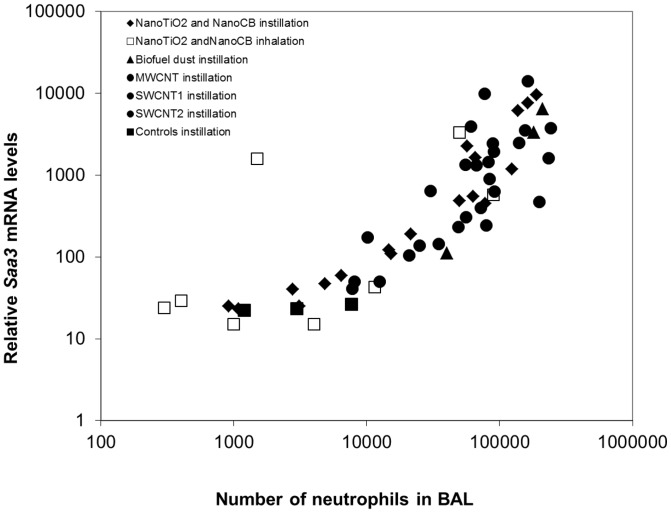
Pulmonary exposure to particles strongly increased Saa3 mRNA levels in lung tissue and elevated SAA3 protein levels in broncheoalveolar lavage fluid and plasma, whereas hepatic Saa3 levels were much less affected. Pulmonary Saa3 expression correlated with the number of neutrophils in BAL across different dosing regimens, doses and time points.
Pulmonary acute phase response may constitute a direct link between particle inhalation and risk of cardiovascular disease. We propose that the particle-induced pulmonary acute phase response may predict risk for cardiovascular disease.
颗粒物空气污染与心血管疾病有关。急性期反应与心血管疾病有因果关系。在这里,我们提出,颗粒引起的肺部急性期反应为颗粒引起的心血管风险提供了潜在机制。
我们分析了暴露于不同颗粒(包括纳米材料(炭黑和二氧化钛纳米颗粒、多壁和单壁碳纳米管)、柴油废气颗粒和生物燃料厂空气中采集的粉尘)的雌性 C57BL/6J 小鼠肺组织中血清淀粉样蛋白 A(Saa3)的 mRNA 表达。通过吸入或气管内滴注将颗粒单次或多次暴露于小鼠,在暴露后长达 4 周的不同时间点测定 Saa3 的肺 mRNA 表达。还测定了暴露于多壁碳纳米管的小鼠的肝 Saa3 mRNA 表达、支气管肺泡灌洗液和血浆中的 SAA3 蛋白水平以及血浆中的高密度脂蛋白水平。
肺部暴露于颗粒强烈增加了肺组织中的 Saa3 mRNA 水平,并升高了支气管肺泡灌洗液和血浆中的 SAA3 蛋白水平,而肝 Saa3 水平的影响则要小得多。肺 Saa3 表达与不同给药方案、剂量和时间点的 BAL 中性粒细胞数量相关。
肺部急性期反应可能构成颗粒吸入与心血管疾病风险之间的直接联系。我们提出,颗粒引起的肺部急性期反应可能预示着心血管疾病的风险。