Graduate School of Frontier Biosciences, Osaka University, Suita, Osaka, Japan.
PLoS One. 2013 Jul 23;8(7):e70091. doi: 10.1371/journal.pone.0070091. Print 2013.
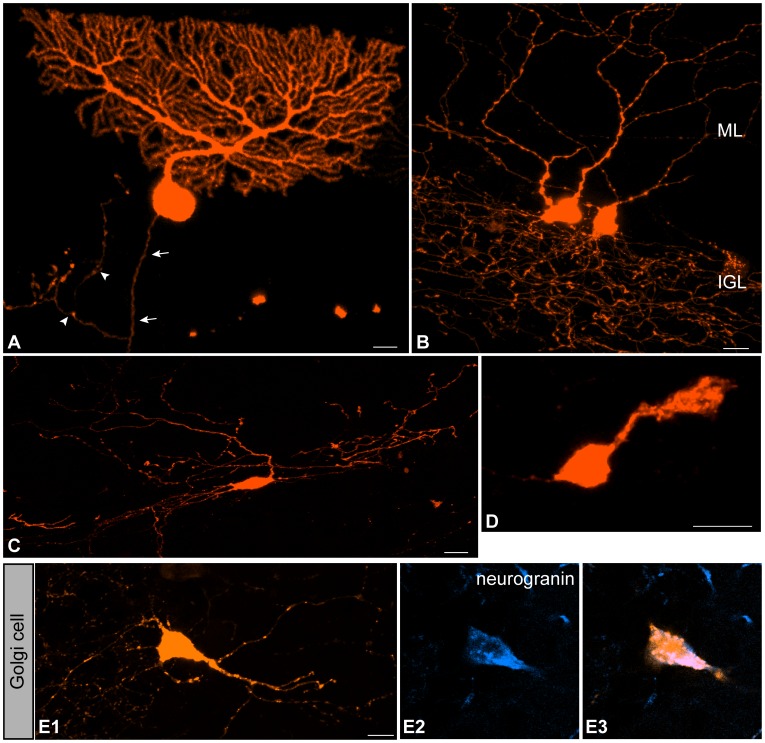
Cerebellar cortical functions rely on precisely arranged cytoarchitectures composed of several distinct types of neurons and glias. Studies have indicated that cerebellar excitatory and inhibitory neurons have distinct spatial origins, the upper rhombic lip (uRL) and ventricular zone (VZ), respectively, and that different types of neurons have different birthdates. However, the spatiotemporal relationship between uRL/VZ progenitors and their final phenotype remains poorly understood due to technical limitations. To address this issue, we performed in utero electroporation (IUE) of fluorescent protein plasmids using mouse embryos to label uRL/VZ progenitors at specific developmental stages, and observed labeled cells at maturity. To overcome any potential dilution of the plasmids caused by progenitor division, we also utilized constructs that enable permanent labeling of cells. Cerebellar neurons and glias were labeled in a Golgi-like manner enabling ready identification of labeled cells. Five types of cerebellar neurons, namely Purkinje, Golgi, Lugaro and unipolar brush cells, large-diameter deep nuclei (DN) neurons, and DN astrocytes were labeled by conventional plasmids, whereas plasmids that enable permanent labeling additionally labeled stellate, basket, and granule cells as well as three types of glias. IUE allows us to label uRL/VZ progenitors at different developmental stages. We found that the five types of neurons and DN astrocytes were labeled in an IUE stage-dependent manner, while stellate, basket, granule cells and three types of glias were labeled regardless of the IUE stage. Thus, the results indicate the IUE is an efficient method to track the development of cerebellar cells from uRL/VZ progenitors facing the ventricular lumen. They also indicate that while the generation of the five types of neurons by uRL/VZ progenitors is regulated in a time-dependent manner, the progenitor pool retains multipotency throughout embryonic development.
小脑皮质功能依赖于精确排列的细胞结构,这些结构由几种不同类型的神经元和神经胶质组成。研究表明,小脑兴奋性和抑制性神经元具有不同的空间起源,分别为上菱形唇(uRL)和脑室区(VZ),并且不同类型的神经元具有不同的出生日期。然而,由于技术限制,uRL/VZ 祖细胞及其最终表型之间的时空关系仍不清楚。为了解决这个问题,我们使用小鼠胚胎进行了荧光蛋白质粒的子宫内电穿孔(IUE),以在特定的发育阶段标记 uRL/VZ 祖细胞,并在成熟时观察标记的细胞。为了克服祖细胞分裂引起的质粒潜在稀释问题,我们还利用了能够永久标记细胞的构建体。小脑神经元和神经胶质以类似于高尔基的方式标记,使标记细胞易于识别。五种类型的小脑神经元,即浦肯野、高尔基、Lugaro 和单极刷状细胞、大直径深部核(DN)神经元和 DN 星形胶质细胞被常规质粒标记,而能够永久标记的质粒还标记了星状、篮状和颗粒细胞以及三种类型的神经胶质。IUE 使我们能够在不同的发育阶段标记 uRL/VZ 祖细胞。我们发现,五种类型的神经元和 DN 星形胶质细胞的标记与 IUE 阶段有关,而星状、篮状、颗粒细胞和三种类型的神经胶质的标记与 IUE 阶段无关。因此,结果表明 IUE 是一种从面向脑室腔的 uRL/VZ 祖细胞追踪小脑细胞发育的有效方法。它们还表明,尽管 uRL/VZ 祖细胞产生的五种类型的神经元是时间依赖性的,但祖细胞池在整个胚胎发育过程中保持多能性。