Department of Urology, Kyoto University Graduate School of Medicine, Sakyo-ku, Kyoto, Japan.
Int J Mol Sci. 2013 Jul 26;14(8):15615-35. doi: 10.3390/ijms140815615.
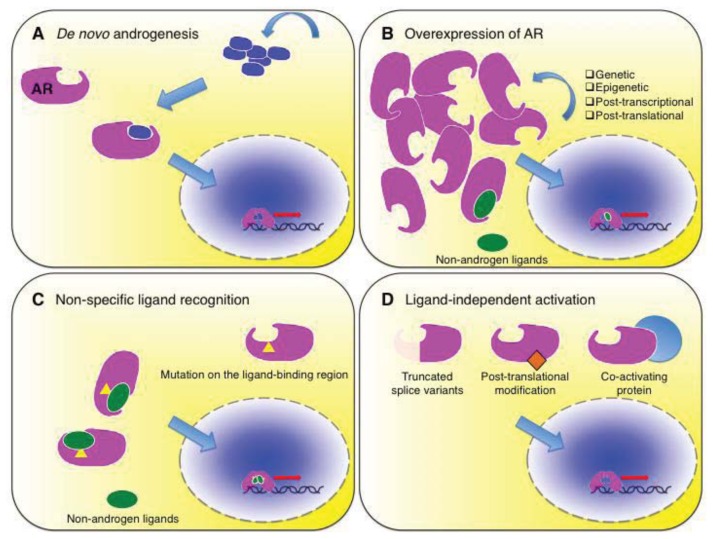
In the majority of castration-resistant prostate cancer (CRPC), prostate-specific antigen (PSA), product of a gene that is almost exclusively regulated by the androgen receptor (AR), still acts as a serum marker reflecting disease burden, indicating that AR signaling is activated even under castrate level of serum androgen. Accumulated evidence shows that transcriptional ability of AR is activated both in ligand-dependent and -independent manners in CRPC cells. Some androgen-independent sublines derived from originally androgen-dependent LNCaP prostate cancer cells overexpress the AR and PSA, for which silencing the AR gene suppresses cellular proliferation. The overexpression of the AR confers androgen-independent growth ability on androgen-dependent prostate cancer cells. Some patient-derived prostate cancer xenograft lines also acquire castration-resistant growth ability secreting PSA. More recent publications have shown that the AR activated in CRPC cells regulates distinct gene sets from that in androgen-dependent status. This concept provides very important insights in the development of novel anti-prostate cancer drugs such as new generation anti-androgens and CYP17 inhibitors.
在大多数去势抵抗性前列腺癌 (CRPC) 中,前列腺特异性抗原 (PSA) 是一种几乎仅受雄激素受体 (AR) 调控的基因产物,仍然作为反映疾病负担的血清标志物,表明 AR 信号即使在去势水平的血清雄激素下也被激活。大量证据表明,AR 的转录能力在 CRPC 细胞中以配体依赖和非依赖的方式被激活。一些源自最初依赖雄激素的 LNCaP 前列腺癌细胞的雄激素非依赖性亚系过度表达 AR 和 PSA,其中沉默 AR 基因可抑制细胞增殖。AR 的过度表达赋予雄激素依赖性前列腺癌细胞雄激素非依赖性生长能力。一些患者衍生的前列腺癌异种移植系也获得了分泌 PSA 的去势抵抗性生长能力。最近的出版物表明,在 CRPC 细胞中激活的 AR 调节与雄激素依赖性状态不同的基因集。这一概念为开发新型抗前列腺癌药物(如新一代抗雄激素和 CYP17 抑制剂)提供了非常重要的见解。