Wang Tian, Pelletier Matthew H, Bertollo Nicky, Crosky Alan, Walsh William R
Surgical and Orthopaedic Research Laboratories, University of New South Wales, Prince of Wales Clinical School, Sydney, NSW 2031, Australia ; School of Materials Science & Engineering, University of New South Wales, Sydney, NSW 2052, Australia.
Open Orthop J. 2013 Jun 28;7:250-7. doi: 10.2174/1874325001307010250. Print 2013.
Shape-closed cemented implants rely on a stronger bond and have displayed inferior clinical outcomes when compared to force-closed designs. Implant contamination such as saline, bone marrow and blood prior to cement application has the potential to affect the cement-implant bond. The consequences of implant contamination were investigated in this study.
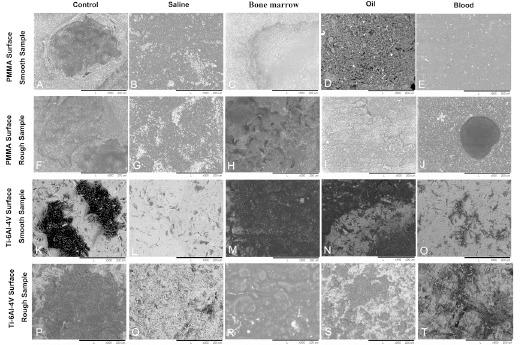
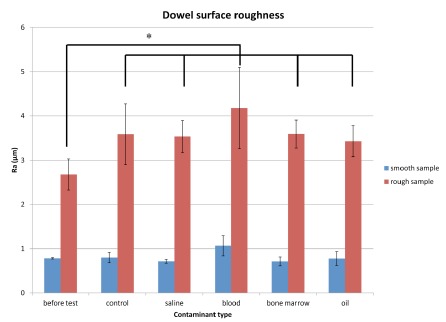
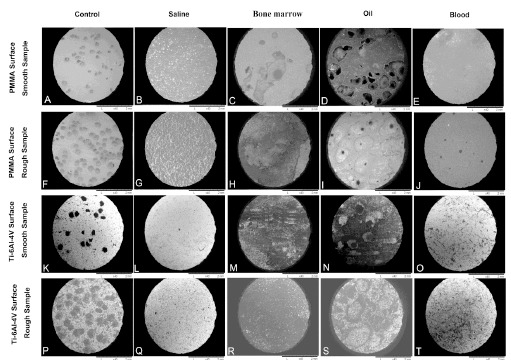
Fifty Titanium alloy (Ti-6Al-4V) dowels were separated into ten groups based on surface roughness and contaminant, and then cemented in polyvinyl chloride tubes. Push-out testing was performed at 1mm per minute. The roughness of the dowel surface was measured before and after the testing. The dowel surface and cement mantel were analyzed using a Scanning Electron Microscopy (SEM) to determine the distribution and characteristics of any debris and contaminants on the surface.
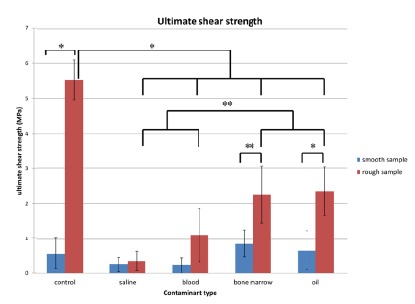
Contaminants largely decreased stem-cement interfacial shear strength, especially for rough surfaces. Saline produced the greatest decrease, followed by blood. The effect of bone marrow was less pronounced and similar to that of oil. Increasing surface roughness increased the interfacial bonding strength, even with contaminants. There was a non-significant increase in mean bonding strength for smooth surfaces with bone marrow and oil contamination. SEM showed that contaminants influence the interfacial bond by different mechanisms. More debris was found on rough samples following testing.
The results of this study underscore the importance of keeping an implant free from contamination, and suggest if contamination does occur, a saline rinse may further decrease the stability of an implant. The deleterious effects of contamination on rough surface cement bonding were considerable, and indicate that contamination at the time of surgery may, in part, contribute to inferior clinical outcomes for rough surfaced cemented stems.
形状封闭的骨水泥植入物依赖更强的粘结力,但与压力封闭设计相比,其临床效果较差。在应用骨水泥之前,植入物受到盐水、骨髓和血液等污染有可能影响骨水泥与植入物之间的粘结。本研究对植入物污染的后果进行了调查。
将50根钛合金(Ti-6Al-4V)销钉根据表面粗糙度和污染物分为10组,然后粘结在聚氯乙烯管中。以每分钟1毫米的速度进行推出试验。在试验前后测量销钉表面的粗糙度。使用扫描电子显微镜(SEM)分析销钉表面和骨水泥壳,以确定表面上任何碎片和污染物的分布及特征。
污染物大大降低了柄-骨水泥界面剪切强度,尤其是对于粗糙表面。盐水造成的降低最大,其次是血液。骨髓的影响不太明显且与油的影响相似。增加表面粗糙度会提高界面粘结强度,即使存在污染物也是如此。对于受骨髓和油污染的光滑表面,平均粘结强度有不显著的增加。扫描电子显微镜显示,污染物通过不同机制影响界面粘结。试验后在粗糙样品上发现了更多碎片。
本研究结果强调了使植入物免受污染的重要性,并表明如果确实发生污染,盐水冲洗可能会进一步降低植入物的稳定性。污染对粗糙表面骨水泥粘结的有害影响相当大,表明手术时的污染可能在一定程度上导致粗糙表面骨水泥柄的临床效果较差。